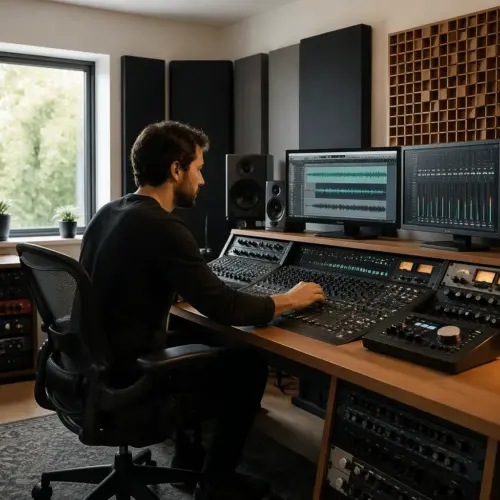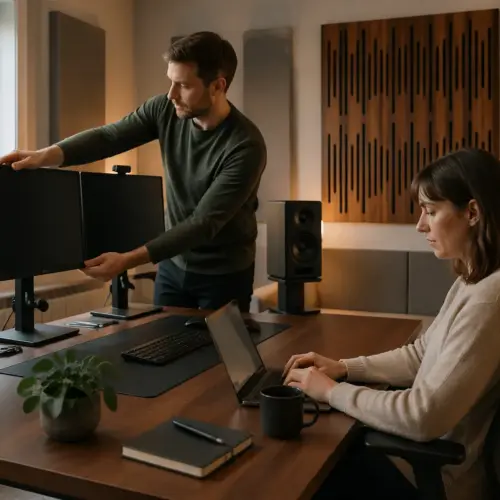


If your desk faces into the room and a closet sits right behind you, you already know the sound is weird in a way you cannot quite describe. This is one of those home office layouts that looks normal on a floor plan but behaves like a tiny acoustics experiment.
The main issue with room geometry with closet behind desk is that the “rear wall” is not a simple wall anymore. It is a mix of thin panels, air gaps, and a cavity that can either help you or mess with you depending on how you treat it.
Some people get lucky and the closet acts like a crude absorber, especially if it is full of clothing. Others get a sharp slap back to the ears from closet doors, plus lumpy bass that changes every time the doors are open or closed.
This article focuses on practical geometry moves you can make without rebuilding the room. The goal is to reduce rear wall reflections, avoid extra comb filtering at the listening position, and add bass absorption where it counts.
It also assumes you want a setup that stays usable as a normal room, not a studio that takes over your life. You can get most of the benefit with a few consistent choices and a couple of high-impact treatment spots.
When people talk about “bad rooms,” they usually mean rooms that change their tone depending on where you sit. A closet behind the desk exaggerates that effect because you are sitting right on top of a complicated boundary.
How a closet changes the rear wall behavior
A normal rear wall is a predictable reflector, so you can plan around it with absorption or diffusion. A closet behind your desk is unpredictable because the boundary is partly rigid and partly flexible, and the cavity behind the doors stores energy.
Closet doors often act like big, light diaphragms that flex and re-radiate low mids back into the room. That re-radiation arrives late enough to smear speech intelligibility and early enough to blur imaging when you are mixing.
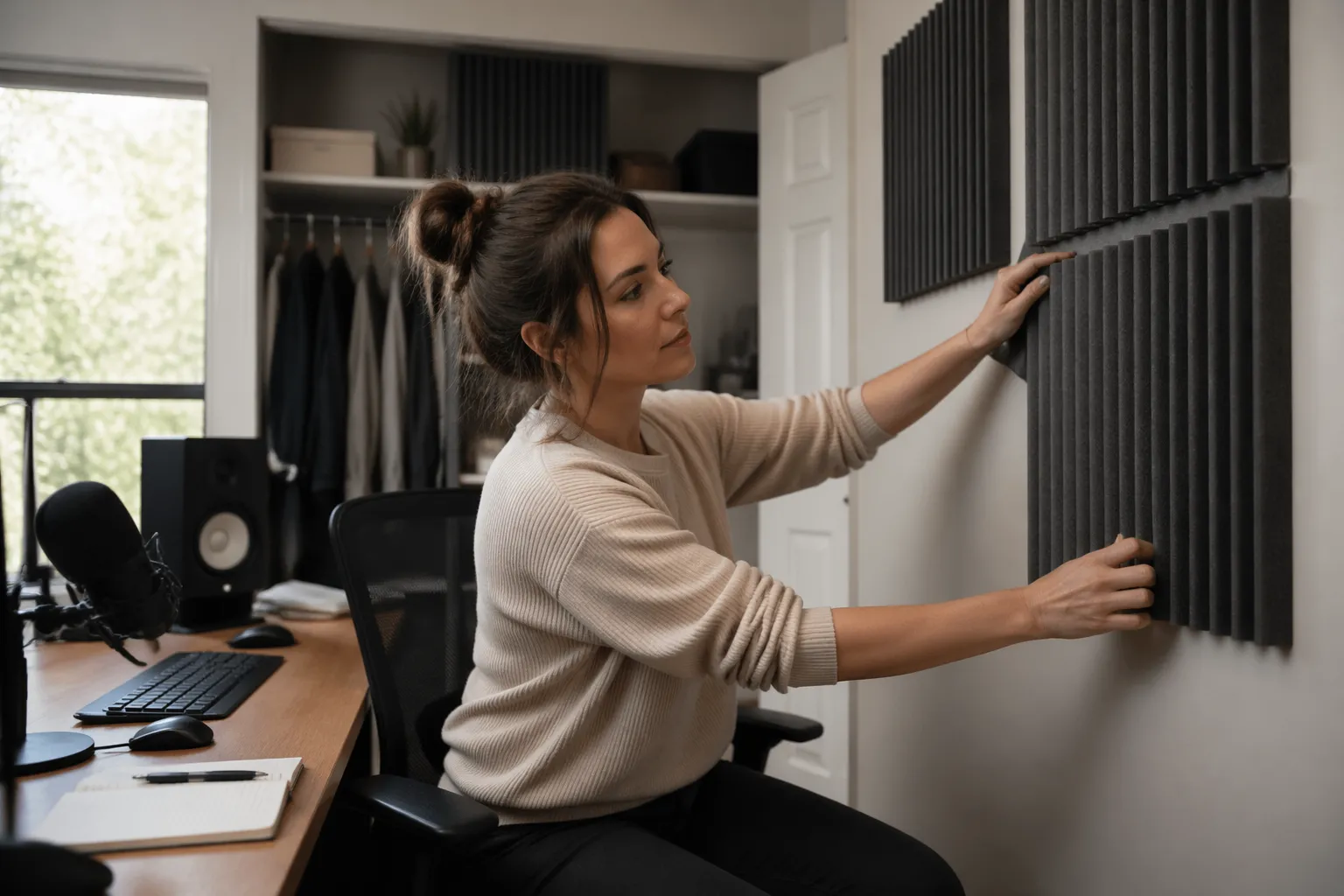
If the closet is packed with hanging clothes, the cavity can behave like a rough broadband absorber above the low bass region. If it is mostly empty, it acts more like a resonant box that rings at a few notes and ignores everything else.
The geometry matters because your head is close to that boundary, sometimes 12 to 30 inches away in a typical home office. That short distance makes rear wall reflections strong, and it makes small changes, like door position, audible fast.
Another detail is that closets are rarely built like the rest of the wall, so the materials change abruptly. Drywall, door skins, mirrors, and hollow cavities all have different reflection and absorption behavior, so the “rear wall” is basically a patchwork.
If your closet has mirrored doors, the high frequency return is usually brighter and more focused, which makes the reflection feel sharper. If the doors are thin hollow-core panels, the return can be duller but still annoying because it is delayed and uneven.
The closet opening also behaves like a pressure release in some bands and a pressure trap in others, depending on how it is stuffed. That is why the same room can measure “fine” at one frequency and then fall apart at the next.
Even the top shelf matters because it creates a shallow cavity above the hanging clothes that can act like a little drum. If you hear a honky, nasal quality in the low mids, that shelf cavity is sometimes part of the story.
People often assume the closet is either “open” or “closed,” but acoustically it is more like a variable filter. The door gap, the track, and the amount of exposed fabric all change what comes back to your ears.
Because the closet is behind you, the reflection is not just a tone problem but also a localization problem. Your brain uses early reflections to judge space, and a strong rear reflection can make the room feel smaller and more fatiguing than it really is.
Deciding if the desk should stay there or move
Before you buy panels, decide if the desk location is even worth saving, because the best acoustic treatment cannot fix a bad starting point. With room geometry with closet behind desk, the decision usually comes down to symmetry and distance to boundaries.
If your speakers fire down the long dimension of the room and the side walls are roughly equal left and right, keeping the desk can make sense. If one side wall is a hallway opening and the other is a solid wall, you will fight balance problems all day.
Try a quick test: move the chair forward so your ears are at least 36 inches from the closet doors, then listen to speech and pink noise at a moderate level. If clarity improves and the center image stops wobbling, the rear boundary is a big part of the problem.
If you cannot pull forward without blocking the room, consider rotating the desk 90 degrees so the closet becomes a side boundary instead of the rear boundary. That swap often reduces the direct slap to the ears, even if it creates new side reflection work.
Also look at what is in front of you, because the front wall and desk surface are part of the same system. A great rear wall solution will not feel great if the front wall is glass or if the desk is a giant reflective slab.
If you are using nearfield monitors, you can sometimes “outrun” the room a bit by moving closer to the speakers and lowering the listening level. That does not remove the closet reflection, but it reduces how much it dominates what you hear.
Pay attention to how your chair position affects bass, not just clarity. If moving forward makes the low end suddenly tighten up, you were probably sitting in a null created by the closet boundary.
Do a simple clap test while sitting at the desk and then while standing a few feet forward. If the flutter or slap changes dramatically, the rear boundary is contributing more than you think.
Sometimes the “move the desk” option is not about sound at all but about workflow, because you will never keep a setup consistent if it makes the room annoying to live in. The best acoustic plan is the one you will actually maintain for months.
If you do move the desk, try to keep the speakers away from exact midpoints of the room dimensions. Closets can already create strong modal quirks, and sitting at a perfect midpoint can stack the problems on top of each other.
If you cannot move the desk, treat it like a fixed constraint and optimize everything around it. That mindset helps because you stop chasing the fantasy of a perfect room and start building a reliable one.
Sliding doors vs hinged doors: what to expect acoustically
Door style changes what you hear because it changes stiffness, gaps, and how much of the closet opening is exposed at any moment. Sliding closet doors tend to rattle and leak more, while hinged doors tend to seal better but reflect more like a single flat panel.
For rear wall reflections, the worst case is often two large, flat, hard panels sitting a foot behind your head. The best case is a partially open closet with soft contents exposed, but you have to keep it consistent or your mix position changes day to day.
Sliding doors also create a weird “half boundary” situation because one panel overlaps the other, which changes thickness and stiffness across the surface. That can make one part of the door reflect like a hard wall while another part behaves more like a membrane.
If your sliding doors are in a metal track, the track itself can buzz and add a faint metallic ring that you only notice after you fix the obvious problems. That kind of noise is subtle, but it can make you think your tweeters are harsh.
Hinged doors tend to have a clear “on/off” behavior, where closed is reflective and open is more absorptive if clothes are exposed. The downside is that open hinged doors can create angled reflectors that bounce sound toward the side walls and ceiling.
If the doors have louvers or decorative grooves, you might get a little bit of scattering, but do not count on it as real diffusion. Most of the time those features are too shallow to matter below the top octave.
A curtain is often the most forgiving “door” because it reduces specular reflections without needing perfect alignment. The tradeoff is that a thin curtain does not do much in the low mids, so you still need thickness somewhere else.
If you switch between open and closed doors during the day, you are basically changing the rear wall treatment every time. That is fine for casual listening, but it is a recipe for second-guessing when you are doing critical work.
If you want a consistent sound, pick one door position that works and make it your default. Consistency beats theoretical perfection when the room is doing something complicated behind your head.
| Door type and setup | What you tend to hear | Low-effort mitigation |
|---|---|---|
| Sliding doors fully closed | Strong high frequency slap, possible rattles | Add felt bumpers, seal loose tracks, place absorption behind chair |
| Sliding doors partially open | Asymmetry, image pulls toward the open side | Open both sides equally, hang a thick blanket inside |
| Hinged doors fully closed | Cleaner reflection, less rattle, more comb filtering | Mount thin absorber on doors, keep chair distance consistent |
| Hinged doors open | Less slap, more room tone from cavity | Open both doors, face clothes toward room, add a rug in closet |
| No doors, curtain instead | Less specular reflection, more broadband damping | Use a heavy theater curtain with deep pleats |
Managing reflections coming back to your ears
The reflection that bothers you most is usually the one that leaves the speakers, hits the closet doors, and returns to your ears within a few milliseconds. That path creates comb filtering that makes vocals sound phasey and makes you over-EQ the presence range.
Start by controlling the area directly behind your head, because proximity makes it high leverage. A 4 inch thick mineral wool panel with a 2 inch air gap on a stand behind the chair can beat a fancy diffuser in this particular layout.
If the chair has to stay close to the doors, treat the doors themselves to reduce specular energy. You can use 1 to 2 inch rigid fiberglass panels with fabric wrap, mounted with removable strips so you can still access the closet without drilling everywhere.
Do not ignore the ceiling and side first reflection points just because the closet is the obvious thing in the room. When rear wall reflections drop, the side and ceiling paths become more noticeable, and your brain will start blaming the speakers instead.
It helps to think in terms of time, not just “loud reflections.” A reflection that arrives very quickly can be more damaging than a slightly louder one that arrives later, because it interferes more directly with the direct sound.
When the closet is close, the rear reflection can arrive almost like a second copy of the speaker, which is why the sound feels like it is coming from everywhere. That is also why small head movements can make the tone shift, especially in the upper mids.
A thick panel behind the chair works well because it sits right in the return path, and it does not care what the closet doors are doing. If you can only afford one serious piece of treatment, that is often the one in this layout.
If you mount absorption on the doors, make sure it is secure enough that it does not buzz or flap. A flapping fabric edge can create its own noise and distract you more than the reflection you were trying to fix.
Try to reduce big, flat, parallel surfaces around the listening position, because they create repeated bounces that build a “zingy” tail. Closets often add one more parallel plane right where you do not want it.
Diffusion behind the head usually needs distance to work, and closet-back setups rarely have that distance. If you want a sense of spaciousness, you are usually better off with absorption behind you and gentle diffusion farther away in the room.
Also check what is on the desk, because screens and hard desk surfaces reflect upward and back toward you. A small change like lowering the monitor height or adding a desk mat can reduce a reflection that stacks with the closet return.
How to think about bass when the rear boundary is a closet
Closets tempt people into treating only the highs, then they wonder why the low end still lies to them. Bass absorption is harder here because the closet cavity can behave like a pressure zone, and light doors barely slow down the lowest modes.
If the closet spans most of the wall, the rear boundary is effectively a big, leaky membrane that shifts with door position. That can move nulls around 60 to 120 Hz, which is exactly where kick and bass decisions go wrong in a home office.
Corner traps still matter, even when the rear wall is not a normal wall. Put thick traps in the vertical corners where the closet wall meets the side walls, because those corners still collect modal pressure and they do not care what the doors are doing.
If you can spare the depth, a deep absorber behind the chair is the most direct way to reduce low mid buildup from the closet area. Think 6 inches or more of fluffy insulation in a simple frame, because thin panels do not touch the problem band.
One reason closets confuse bass is that the cavity can act like a giant, poorly tuned bass trap that only works on a narrow range. If that narrow range happens to line up with a room mode, you get a misleading “tight” note and a messy note right next to it.
Door flex can also create a kind of one-note resonance, especially with hollow sliding panels. When you hear a specific bass note bloom and then hang around, that is often the door acting like a drum head.
Try not to judge bass with the closet doors in a random position, because you will chase your tail with EQ. Pick a door position, stabilize the setup, and then make bass decisions from that stable baseline.
Speaker placement matters more than people want to admit, because moving the speakers a few inches changes boundary interaction. With a closet behind you, you are already dealing with a weird rear boundary, so give yourself every advantage up front.
If you are using a subwoofer, the closet can make integration feel impossible if the sub is exciting the same rear-wall-related null at the listening position. Sometimes moving the sub a foot left or right is more effective than changing crossover settings all day.
Do not assume the closet itself is your bass trap just because it is a cavity. A closet full of clothes can help in the upper bass and low mids, but the true low bass usually needs thickness in corners and along big boundaries.
If you have a top shelf, placing a folded duvet or thick blanket up there can reduce some of the low-mid “hollow” quality. It is not magic, but it is a cheap way to add irregular, lossy mass in a spot that likes to ring.
When you evaluate bass, use a few reference tracks that you know are balanced, and keep the listening level steady. Bass perception changes with volume, and closet-back rooms already exaggerate that effect.
Using the closet space without turning it into a project
You can get real acoustic benefit from the closet without building a custom helmholtz contraption or tearing out doors. The trick is to use the closet as a soft, irregular volume, then keep it consistent so your reference does not drift.
Clothes are decent mid and high frequency absorption, but only if they hang with some depth and spacing. A packed, compressed closet absorbs less than you think, so leave a little air between garments and avoid hard plastic storage bins near ear height.
Think of the closet like a big, messy absorber that works best when it is messy in the right way. A mix of fabrics, different lengths, and uneven surfaces tends to damp reflections better than a perfectly flat row of identical coats.
If you store boxes, try to keep them low and to the sides rather than stacked flat across the back wall. A flat stack of boxes is basically a reflector, and it undoes the benefit of having soft material in there.
A moving blanket is one of the easiest upgrades because it is thick, cheap, and forgiving. If you hang it with deep folds instead of pulling it tight, it behaves more like a real absorber and less like a thin sheet.
If you use the closet daily, make the acoustic setup easy to reset in ten seconds. The best “treatment” is the one that does not get abandoned because it is annoying to live with.
Try to avoid hard, reflective items right at head height, because that is where the most damaging reflections tend to return. Even a glossy suitcase can create a little hot spot that makes the rear wall feel brighter than it needs to be.
Closet floors are often bare wood or thin carpet over a hard base, and that surface can reflect into the cavity and back out. A small rug inside the closet is a low-effort way to add damping where the air is moving.
If you have a closet light with a buzzing fixture, fix it, because noise floors matter more in small rooms than people expect. A quiet room makes it easier to hear what the reflections are actually doing.
- Open both doors the same amount
- Hang a thick moving blanket on a rod
- Keep shoes and boxes off the back wall
- Add a small rug on the closet floor
- Place a pillow or folded duvet on the top shelf
- Use felt pads to stop door rattles
If you want to go one step further, add a freestanding absorber that lives just inside the closet opening. That way you get absorption without permanently modifying the doors or the room.
Keep a mental note of what “normal” looks like inside the closet, because acoustic consistency is visual consistency. If the closet turns into a random storage pit, the sound will follow it.
If you share the space with someone else, agree on a default door position and a default “do not move this” blanket or curtain. That one agreement can save you hours of chasing a sound that changed because someone grabbed a jacket.
A practical layout checklist for closet-back setups
A checklist sounds boring, but it stops you from chasing your tail with random panel placement. Room geometry with closet behind desk rewards simple, repeatable decisions more than it rewards exotic gear.
Start with symmetry, because an uneven left and right environment makes every reflection fix less effective. Measure from each speaker to the nearest side wall, then match toe-in and distance so the stereo image has a fair shot.
Set your listening position so your ears are not pressed into the rear boundary, even if you have to shorten the desk depth. If you cannot get 36 inches, aim for 24 inches and plan on heavier absorption behind you.
Decide on a door position and stick to it during work sessions, because moving doors changes the reflection pattern. If you need closet access often, treat the doors so closed and open positions sound closer to each other.
Check speaker height and make sure the tweeters are aimed at ear level, because a vertical mismatch can make reflections feel worse than they are. When the direct sound is weak, the room sound takes over, and the closet is part of that room sound.
Make sure the desk is not pushing the speakers too close together, because narrow spacing forces you to listen louder to get a stable center image. Louder playback excites the closet boundary more and makes the rear reflection harder to ignore.
Confirm that your chair position is centered between the speakers, not just centered on the desk. In small rooms, a couple of inches off center can make one side reflection line up perfectly while the other side does not.
Once you pick a chair distance from the closet, mark it in a subtle way so it stays consistent. A tiny piece of tape under the desk or a mark on a rug can save you from accidental drift.
Do the first reflection points on the side walls and ceiling after you handle the rear boundary, not before. If you treat the sides first, you might misread the room and end up under-treating the biggest offender behind you.
Make sure nothing in the closet is physically touching the doors if the doors are prone to rattling. A hanger tapping a door can sound like distortion, and it will drive you nuts during bass-heavy playback.
Finally, decide what “good enough” means for your work, because home offices have limits. The goal is translation and comfort, not a perfect graph.
Common mistakes I see in closet-behind-desk rooms
The most common mistake is putting foam on the closet doors and calling it done. Foam can take the edge off highs, but it does almost nothing for the low mids that make rear wall reflections sound boxy.
Another mistake is leaving one closet door open and one closed because it is convenient. That asymmetry pulls the phantom center, and you will start panning weirdly to compensate without realizing it.
People also forget that a closet door can buzz like a cheap snare drum when bass hits. If you hear a rattle on certain notes, fix the mechanical problem first with felt, bumpers, or track adjustment before you blame the speakers.
Finally, many home office setups ignore the chair itself, even though it sits in the reflection path. A high-back mesh chair can reflect a surprising amount of upper mid energy, so a simple throw over the back can change what you hear.
A related mistake is buying a diffuser for the rear wall because it looks “studio,” then placing it six inches behind the head. Diffusers need space to work, and in this layout they often just turn a strong reflection into a slightly different strong reflection.
Another common trap is treating only what you can see and ignoring what you can measure, like the ceiling reflection. Closet-back rooms are already reflection-heavy, so leaving the ceiling untreated can keep the sound edgy even after you fix the doors.
People also underestimate how much a computer monitor reflects, especially if it is large and glossy. That reflection combines with the closet return and makes the upper mids feel like they are shifting as you move your head.
Some setups use tiny desktop speaker stands that wobble, which adds mechanical vibration into the desk and into the room. If the desk is vibrating, the closet doors can sympathetically vibrate too, and the whole system gets harder to diagnose.
Another mistake is changing three things at once, like moving the desk, adding panels, and changing door position in the same afternoon. If you do that, you will not know what helped, so you cannot repeat the result later.
Lastly, people sometimes chase a “dead” sound behind the head and end up over-absorbing the highs while leaving the low mids untouched. That creates a room that feels dull but still has muddy bass, which is the worst of both worlds.
Quick measurement moves that confirm what is happening
You do not need a lab, but you do need a reality check, because ears adapt fast. A cheap USB measurement mic and free software like REW can show whether the closet is causing a deep notch at the listening position.
Run a sweep with the closet doors closed, then run the same sweep with them open the exact same amount on both sides. If the response changes a lot above 200 Hz, you are seeing rear wall reflections, and if it changes below 150 Hz, you are seeing boundary and cavity effects.
Use the impulse response view to spot a strong early reflection from behind you. If you see a spike a few milliseconds after the direct sound, that is your target, and you can often reduce it with a single thick panel behind the chair.
After each change, re-measure and listen to one or two tracks you know too well, like a podcast voice and a simple bass-heavy song. The point is not perfection, it is getting the room to stop changing its story every time you shift in your seat.
If you want a fast sanity check without learning every REW feature, look at the frequency response smoothing and compare before and after. You are not hunting for a ruler-flat line, you are hunting for fewer dramatic swings caused by the rear boundary.
Measure left and right speakers separately, because closet asymmetry and door overlap can affect one side more than the other. If one speaker has a deeper notch or a stronger reflection spike, the closet setup is probably not symmetrical.
Try a measurement with a pillow or thick blanket temporarily taped to the closet doors, just as a test. If the impulse reflection drops and the response smooths out, you have confirmed the rear boundary is the lever worth pulling.
Do not forget to measure with your normal chair in place, because the chair changes what reaches the mic at ear height. If you measure with an empty room and then work in a different configuration, you will be solving the wrong problem.
If you are working with a laptop mic or phone app, treat it as a rough indicator, not a final answer. Even rough tools can still show you that “doors open” and “doors closed” are two different acoustic rooms.
Once you find a setup that measures and sounds better, save the measurement files and take a quick photo of the door position and treatment placement. That documentation makes it easy to return to the baseline after life happens.
When you listen after changes, focus on stable center vocals and bass note evenness rather than “more treble” or “less treble.” Closet problems often show up as instability, not just a simple tonal tilt.
Conclusion
A closet behind your desk can be a nuisance, but it can also be a useful chunk of soft volume if you treat it with some discipline. Once you control rear wall reflections and keep the door position consistent, the room starts acting like a room again.
Prioritize geometry first, then use targeted absorption, especially behind your head and in the corners, where bass absorption pays off. If you do those basics, room geometry with closet behind desk stops being a constant compromise and becomes a workable home office setup.
The big win is not that the room becomes perfect, but that it becomes predictable. Predictable rooms let you work faster because you stop second-guessing every EQ move and every low-end decision.
If you only change one thing, make the rear boundary less reflective and less variable, because that is what makes this layout feel strange. After that, every other improvement you make will stack instead of fighting the closet.