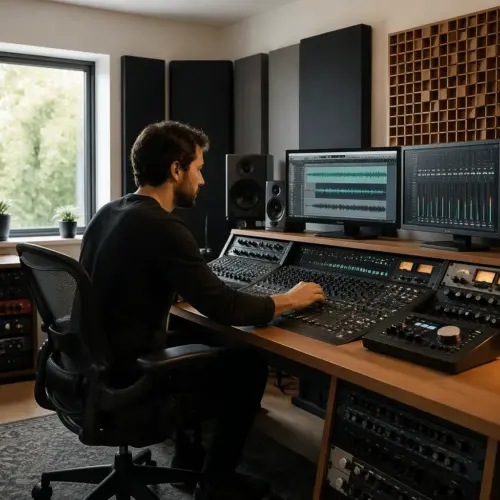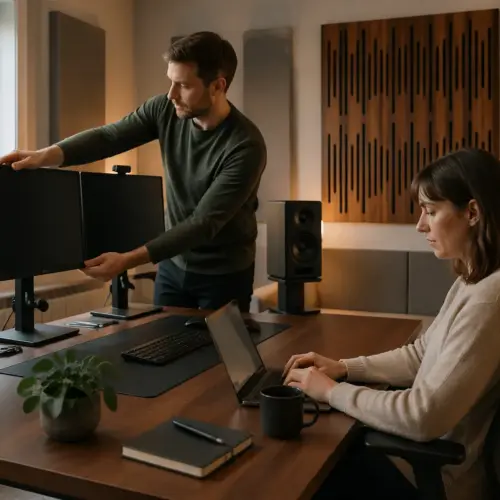

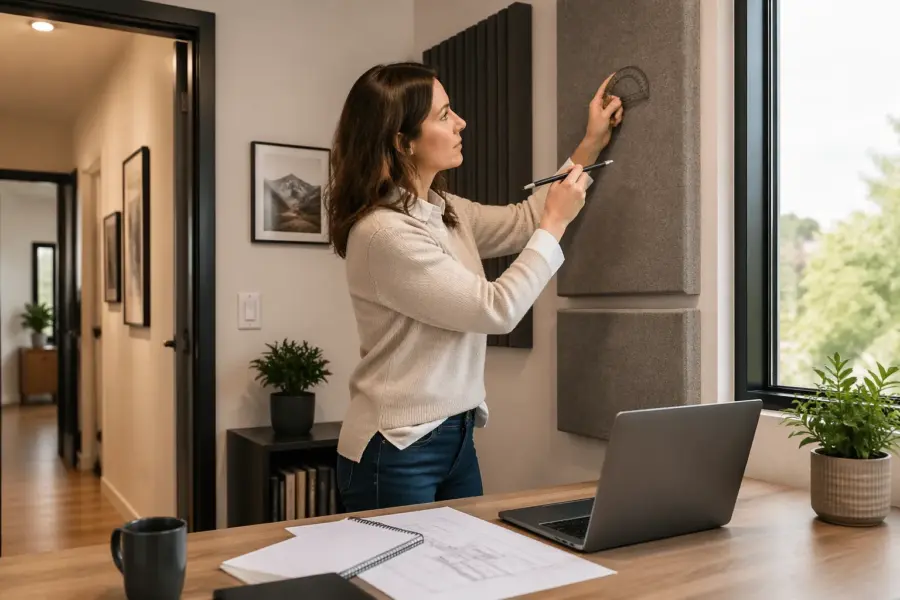
A home office studio that opens to a hallway can sound weird even when the speakers and desk are decent. The hallway acts like a missing wall, and it changes how low end builds up, where the stereo image sits, and how confident your mix decisions feel.
If you are chasing a reliable studio layout with hallway opening, you have to treat geometry as part of the acoustic plan, not as a furniture problem. You can make it work, but you need to choose where the opening sits relative to your speakers and your listening position.
The good news is that you do not need a perfect rectangle to get solid results. You do need a repeatable setup that keeps the open boundary from pulling your bass and balance to one side.
Most people notice the issue after they do a few mixes and realize the low end is inconsistent in the car or on headphones. The room is not lying to you on purpose, but the hallway is changing the rules compared to a closed box.
It also affects daily workflow in small ways, like how loud you feel comfortable monitoring and whether you trust what you hear at low volume. If the room feels unstable, you end up turning things up just to feel the bass, and that is not a great habit.
The goal here is not to “fix” the hallway like it is a defect, but to make your setup predictable. Predictability is what lets you work fast, because you stop second guessing every kick and bass move.
What an open hallway does to bass and balance
A hallway opening behaves like an acoustic leak at low frequencies, because bass wavelengths are long and do not respect doorways. Instead of pressurizing the room evenly, some energy escapes, and the room modes shift compared to the same room with a closed wall.
That escape is usually called bass leakage, and you can hear it as a thinner or less stable bottom end near the opening. The opposite can also happen, where the remaining corners load up and the bass gets lumpy and one note heavy.
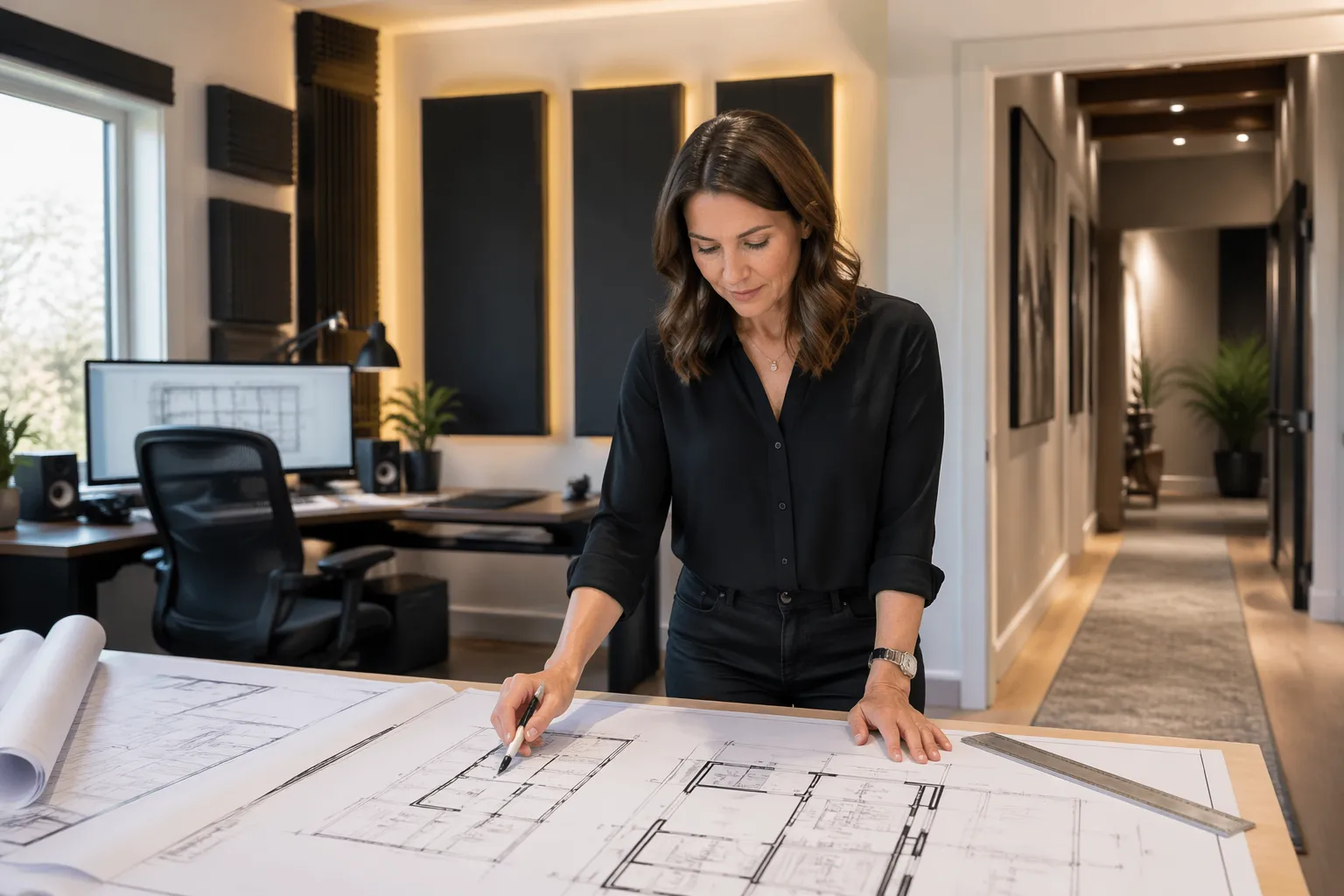
At mid and high frequencies the hallway is less of a leak and more of a reflection problem, depending on what is down the corridor. If the hallway has hard floors and bare walls, it can throw back a delayed slap that smears the center image.
The tricky part is that the opening changes the left right balance even if your desk is centered on the short wall. One side of the room has a boundary, and the other side has an open boundary, so early reflections and low frequency support do not match.
This mismatch often shows up as a phantom center that feels like it is leaning, even when your speaker levels match. You may find yourself panning slightly off center just to make vocals feel centered, which is a sign the room is steering you.
Another common symptom is that the bass sounds fine at the chair but changes a lot when you stand up or take one step sideways. That is normal in small rooms, but the hallway opening can exaggerate it by creating a stronger gradient across the room.
The hallway can also act like a resonant extension, especially if it is long and narrow. In some homes, certain notes seem to “take off” down the corridor and come back as a low mid bloom that makes mixes feel cloudy.
Even if you do not hear obvious echoes, the time smear from the hallway can still reduce clarity. A reflection that arrives late enough will not sound like an echo, but it can still blur transients and make the room feel less focused.
Doors and openings down the hall matter too, because they change what the hallway “loads” into. If a bedroom door is open at the end of the corridor, the effective acoustic volume can change, and your bass response can shift without you touching anything.
That is why hallway rooms can feel like they have good days and bad days. The room is responding to small changes in the house, and you need a setup that is robust enough to stay usable anyway.
Decide if the opening should be behind you, beside you, or in front of you
When you can choose, put the hallway opening behind your listening position more often than not. You keep the front wall and side wall geometry more symmetrical around the speakers, which usually matters more for imaging than what happens behind your chair.
An opening beside you is the hardest case because it creates a strong left right mismatch in both reflections and bass support. If your studio layout with hallway opening forces this, plan on heavier treatment on the open side and accept that perfection is unlikely.
An opening in front of you can work, but it tends to rob the front wall area of predictable boundary behavior. If your speakers fire toward the hallway, the low end can feel clean in one spot and disappear when you lean forward, which is a bad way to spend a workday.
There is also a practical angle that matters in a home office, which is noise travel. If the hallway leads to a living room, putting the opening behind you can reduce how much direct speaker output blasts down the corridor during calls or late sessions.
Behind you also tends to make the room feel more “closed” at the front, which helps your brain lock onto a stable image. You can still get reflections from behind, but those are usually easier to manage with absorption or diffusion than a missing side wall.
If the opening must be beside you, try to choose which side strategically. Many people prefer the opening on the rear half of the room rather than right next to the speakers, because it reduces how much the earliest reflections differ between left and right.
In front of you can be acceptable if you are very nearfield and the speakers are close, because the direct sound dominates. The risk is that you lose the predictable “push” from the front wall that often helps the low end feel anchored.
Think about where you will place bass trapping and reflection treatment before you commit to a layout. If the opening steals the only spot you could have put a big trap, you may be trading one problem for another.
Also consider how you enter and exit the room, because daily annoyance leads to compromised setups. A layout that sounds slightly worse but stays in place is often better than a theoretically perfect setup that you keep moving to get through the doorway.
If you share the space with other people, the opening location affects how “present” your work sounds to them. Sometimes the best compromise is to aim speakers away from the hallway even if it is not the absolute best acoustic choice, because it keeps the household happier.
Set your listening triangle to minimize pull toward the opening
Your listening triangle is the speakers and your head forming an equilateral or near equilateral shape, and it is the anchor for everything else. In a room with an open boundary, small shifts in listening position can change the bass more than you expect.
I prefer starting with the desk centered on the most solid wall, then moving the listening position forward and back to find a smoother low end before I touch EQ. If the hallway is on one side, resist the urge to sit closer to the closed wall, because that often makes the stereo pull worse.
Start with speaker height and make sure the tweeters are at ear level, because a hallway problem can trick you into blaming the top end. If your vertical alignment is off, you will chase imaging issues that are not actually caused by the opening.
Keep the distances from each speaker to your head as equal as you can, and measure it with a tape instead of eyeballing. In asymmetrical rooms, a one inch difference can feel like the room is “tilting” the mix.
Try to keep both speakers the same distance from the front wall, even if the side walls are not symmetrical. This reduces one major variable, so you can focus on the hallway effect without stacking problems.
If the opening is on the left, you may notice the left speaker feels lighter in the low mids, which can make you turn it up unintentionally. Instead of adjusting levels first, adjust placement and toe in so the phantom center stops drifting.
Nearfield monitoring is your friend here, because it increases the ratio of direct sound to room sound. Bringing the speakers a little closer and keeping the triangle tight can make the hallway feel less influential.
Do not ignore the desk itself, because a wide desk can create strong early reflections that interact with the hallway asymmetry. If one side of the desk is closer to an opening, that reflection pattern can become uneven and pull the image.
A small change in speaker distance from the front wall can also change how the bass couples to the room. If you are stuck with the hallway beside you, moving both speakers forward or back together can sometimes reduce the sense that one side is missing.
When you test changes, do them in small increments and listen for repeatable improvements. The hallway can make the room feel chaotic, so your process needs to be calm and methodical.
| Setup choice | What to measure or listen for | Adjustment to try first |
|---|---|---|
| Triangle too wide | Center image drifts toward hallway side | Bring speakers closer together by 1 to 2 inches |
| Listening position too close to front wall | Upper bass gets boomy, kick sounds slow | Move chair back 4 to 8 inches |
| Listening position too close to hallway opening | Low end thins out on hallway side | Shift desk away from opening by 2 to 6 inches |
| Toe in too aggressive | High end feels bright, image narrows | Reduce toe in a few degrees |
| Toe in too relaxed | Phantom center gets fuzzy | Increase toe in until tweeters aim near ears |
Once you get a decent triangle, mark speaker and chair positions with tape so you can return to them. A hallway setup can drift over time as you clean, roll the chair, or move the desk for a meeting.
It also helps to pick a consistent monitoring level, because the room response changes with loudness perception. If you keep changing volume to “find the bass,” you will never learn what the room is really doing.
Manage asymmetry without overcorrecting
When one side opens to a hallway, the room is asymmetrical, and you should treat it like asymmetry instead of pretending it is a normal rectangle. The goal is not identical measurements left and right, it is a stable image and predictable translation.
Start by controlling first reflections at the side walls, because that is where the hallway side often loses support. If the hallway side has no wall near the speaker, use a movable panel or a thick absorber on a stand placed where the wall would have been.
Do not stack treatment on the open side until the room sounds dead on that side and live on the other. Overcorrecting can make the stereo feel pinned to the treated side, and it can make reverbs seem lopsided when you pan.
Use measurement tools, but trust your ears on the last mile, because hallway reflections can be inconsistent depending on doors and furniture down the hall. A simple test is pink noise in mono, because the image should sit in the center without wandering when you move your head slightly.
Think in terms of matching the early reflection energy rather than matching the exact wall construction. If one side is open, your job is to prevent the other side from dominating the first 20 milliseconds of what you hear.
Ceiling reflections can be a hidden part of the asymmetry problem, because the hallway side often has a different ceiling line or nearby light fixtures. A ceiling cloud over the listening position can reduce variables and make the room feel more even.
If you are using absorption panels, keep them similar in thickness and placement on left and right where possible. Even if the hallway side uses a stand, try to match the surface area and distance from the speaker to keep the timing similar.
Diffusion can help behind you if the opening is behind you, but it is not a magic fix for a missing side wall. In small rooms, diffusion often behaves like mild scattering, so treat it as a flavor tool rather than the foundation.
Be careful with aggressive EQ correction, because it can compensate for one seat position and make everything else worse. If the hallway causes a deep null, EQ will not fill it in, and you will just stress your monitors and your ears.
It is normal for the open side to measure slightly different in the low end, and that is not automatically a failure. What matters is whether you can make decisions that translate, not whether the graphs look pretty.
When you add treatment, change one thing at a time and keep notes, because asymmetrical rooms can produce confusing results. If you change three variables at once, you will not know which one helped or hurt.
Use furniture and placement to “define” the room boundary
You cannot build a wall in most home offices, but you can fake a boundary with mass and depth. A tall bookcase, a wardrobe, or even a filled storage unit near the hallway side can add some low frequency resistance and reduce the sense of a missing wall.
Place that large furniture so it breaks the direct line from the speakers to the hallway, but do not block the corridor completely if it becomes annoying to live with. If you can keep a clear path while adding a partial barrier, you usually reduce bass leakage without creating a new reflection nightmare.
Soft furniture matters too, but it works higher than most people expect, so do not assume a couch fixes the low end. A thick rug with pad can tame floor bounce, and that can make the listening position feel less sharp and fatiguing during long edits.
If you use a rolling chair mat, choose one with some grip and thickness, because thin plastic sheets can add a bright slap that makes the hallway problem worse. I have heard rooms improve just by swapping a hard mat for a rug and moving the chair a few inches.
A bookcase works best when it is not empty, because uneven spines and objects create a mix of absorption and scattering. If it is full of identical boxes, it becomes more like a flat reflective surface, which may not be what you want near the opening.
A tall, heavy curtain can also count as “furniture” if it is thick and hangs with deep folds. It will not stop sub bass, but it can reduce the hallway’s ability to throw midrange back into the room.
Plants can help a little in the upper mids if they are large and leafy, but do not treat them like acoustic panels. They are better as small polish tools that also make the space feel like a place you want to work.
Try not to place a large reflective cabinet only on the closed side, because that can worsen the left right imbalance. If you need storage, consider balancing the visual and acoustic mass so one side is not doing all the reflecting.
Even a simple room divider can help if it is thick and positioned well. The key is to put it where it changes the first reflection path, not just where it looks good on a video call.
Desk placement matters too, because a desk shoved into a corner can make the room feel tighter and more uneven. If you can float the desk a little and keep the speaker area symmetrical, the hallway becomes easier to manage.
Do not underestimate how much a filled closet or a heavy door near the hallway can change the sound. If you can keep nearby doors consistently open or consistently closed, you reduce day to day variation.
Layout examples for wide vs narrow hallway openings
A narrow hallway opening, like a standard door width, acts like a leak but still leaves you with a mostly intact side wall. In that case, you can often get away with treating the door area with a thick curtain when you work and leaving it open the rest of the day.
A wide opening, like a big cased arch or a missing wall section, behaves more like the room is attached to another volume. Your studio layout with hallway opening becomes a two space system, and the bass can shift depending on where the hallway turns and what is at the far end.
For narrow openings beside the desk, try keeping the speakers on stands slightly forward of the desk edge so the first reflection points stay predictable. For wide openings beside the desk, I would rather rotate the entire setup so the opening ends up behind the listening position if the room allows it.
If the opening is in front of the desk and it is wide, pull the speakers closer to you and reduce the listening distance, because nearfield monitoring helps. You trade some room sound for direct sound, which is a fair deal in a home office where geometry is not negotiable.
With a narrow opening, you can sometimes treat it like a door that is always open, and that makes planning easier. You can place absorption on the wall area around the door and treat the door itself with a removable panel if needed.
If the narrow opening is behind you, consider adding absorption on the back wall to prevent energy from bouncing out and then returning late. This can make the room feel tighter without needing to touch the hallway at all.
With a wide opening, think about what the hallway connects to, because that connected space becomes part of your low end behavior. A hallway that opens into a larger living area can swallow bass differently than one that ends at a closed door.
A wide opening beside you may require a more “set piece” approach, like a freestanding absorber that lives there permanently. It is not glamorous, but it can turn a frustrating room into a workable one.
If you cannot rotate the setup, you can still improve things by moving the desk so the opening is closer to the rear half of your body rather than next to the speakers. That one change can reduce how much the opening affects the earliest reflections.
In very small rooms, even a narrow opening can dominate if it is close to the speaker. In that case, treat the area like a missing corner and plan your bass trapping as if the corner is virtual.
In larger rooms, a wide opening can be less scary because the listening position is farther from the boundary. Distance buys you time, and time buys you clarity, so do not assume a wide opening is always worse.
Treat the opening like a tunable acoustic element
A hallway opening is not automatically bad, because it can reduce the worst pressure buildup in small rooms. Some rooms with heavy low end can sound tighter when the open boundary lets the lowest mode breathe.
The problem is consistency, because a door that is sometimes open and sometimes closed changes your bass every time. If you can, commit to one state during work hours, and build your listening position and treatment plan around that state.
A heavy curtain on a ceiling track can act like a switchable boundary, and it is a renter friendly move. When you close it, you reduce the hallway reflections, and when you open it, you get airflow and access without moving gear.
If you want something sturdier, a freestanding gobos style absorber placed at the mouth of the hallway is hard to beat. It will not stop bass leakage completely, but it can calm the upper bass and lower mids where voices and guitars get muddy.
Think of the opening like a variable port on a speaker cabinet, because it changes how the room “breathes.” Closing it down a bit can raise the sense of low end weight, while opening it can reduce boom but also reduce punch.
If you use a curtain, make it wider than the opening so it can bunch up with deep folds. A flat curtain is mostly decoration, but deep folds create more effective absorption and reduce flutter.
You can also experiment with a partially closed door if the hallway has a door, because small angles change reflections. A door cracked open can create a strong specular reflection, so it is often better fully open or fully closed than halfway.
Another tunable option is a movable bookshelf or storage unit on sliders that can shift a few inches. That lets you “dial in” how much boundary you want without turning the room into a construction project.
If the hallway has a hard floor, adding a runner rug can reduce the slap that returns to the room. This is especially helpful if you clap and hear a bright zing coming back from the corridor.
Do not forget lighting and HVAC noise, because an open hallway can bring in more background sound. A quieter room lets you monitor at lower levels, which makes the acoustic problems less stressful.
Once you find a configuration that works, try to keep it stable for a few weeks. Your ears adapt to a room, and constant changes make it harder to learn what “normal” sounds like in your space.
Bass strategy when one side leaks
People hear bass leakage and immediately buy a subwoofer, which is often the wrong reflex. If the room already loses low end into the hallway, adding more low end can make you chase your tail with EQ and level.
Start with corner traps in the corners you actually have, because those corners still store energy even if one side opens up. Thick broadband traps, like 6 inch mineral wool panels with an air gap, usually beat thin foam by a mile in this situation.
If one front corner is missing because it opens to the hallway, put a trap on a stand at that corner location, and leave a little space behind it. That creates some boundary behavior where your ear expects it, and it often helps the kick drum stop leaning to one side.
When you set the listening position, avoid sitting at the exact center of the room length, because that is where nulls love to live. A common starting point is about 38 percent of the room length from the front wall, then you adjust by ear and measurement for your actual geometry.
In hallway rooms, I also like to check bass consistency across a small left right movement at the chair. If the bass changes drastically when you move 6 inches, you may need to adjust placement before you add more trapping.
Do not ignore speaker boundary interference, because the distance to the front wall can create a dip in the upper bass. If you combine that dip with a hallway leak, you can end up with a bass response that looks fine on average but feels weak on real music.
If you do use a subwoofer, treat it like a placement tool, not a volume tool. A sub placed well can fill a null at the listening position, but a sub placed poorly will just excite the hallway and make the room harder to read.
Consider multiple smaller traps rather than one huge one if the hallway steals your best corner. Spreading absorption across available corners and wall-ceiling junctions can create a more even decay time.
Pay attention to decay, not just frequency response, because a hallway can create weird ringing in the low mids. A room that measures flat but rings for too long will still make you under-mix bass and over-mix low mids.
Sometimes the best bass move is to reduce how much low end you monitor while you work and rely on references. If you keep your monitoring honest and consistent, you can make good decisions even if the room is not perfect.
Headphones can be a useful cross-check, but do not let them replace fixing the room basics. The point is to make the speakers trustworthy enough that you are not mixing blind on one of your main tools.
Quick checks that tell you if the hallway is winning
You can waste days moving panels if you do not have a couple of quick reality checks. The first is a mono vocal track, because if the vocal image slides toward the opening, your reflection balance is off.
The second check is a sine sweep or stepped tones around 40 to 200 Hz, because that range shows the open boundary problem fast. If one or two notes disappear when you lean toward the hallway side, you need to move the listening position or change the triangle before you buy more gear.
A third check is to play a familiar reference track and listen at a low volume, because low volume reveals balance issues. If the bass vanishes at low volume but feels huge when you turn up, the room is probably exaggerating certain notes.
Another fast test is to flip left and right speakers in your interface or monitor controller if you can. If the problem follows the speaker, it is a speaker or placement issue, and if it stays in the same direction, it is the room and hallway geometry.
Clap tests are crude, but they can reveal a hallway slap you did not realize was there. If you hear a bright return that seems to come from the corridor, you should treat the hallway surfaces or the opening edge.
Try walking down the hallway while music plays and notice where the bass gets louder. Those hot spots can hint at which frequencies are escaping and returning, and that can guide where you place a curtain or gobo.
When you measure in REW, measure left and right speakers separately and compare decay times as well as frequency response. A hallway side that decays faster in some bands can make that side feel thinner even if the average SPL is similar.
Do not forget to check with the door in its normal working position, because measurements with a door open and mixing with it closed is a recipe for confusion. Consistency is the whole game in a hallway room.
- Mono pink noise at moderate level
- Sine sweep 40 to 200 Hz
- Hand clap test for hallway slap
- Speaker polarity check with a mono kick
- Reference track with steady bass line
- Measure left and right separately in REW
If you only do one thing, do the mono pink noise test and move your head a few inches side to side. A stable center is a strong sign your early reflection balance is under control.
If you only do two things, add the stepped tone test and write down the worst notes. Those notes are your map, and they will tell you whether placement changes are helping or just moving the problem around.
Conclusion
A hallway opening changes the room, but it does not ruin it, as long as you plan around the open boundary instead of ignoring it. The best studio layout with hallway opening keeps the speaker area as symmetrical as possible and puts the listening position where bass and imaging stay steady.
Pick the opening location relative to you, set the listening triangle carefully, and treat asymmetry with restraint so you do not create a new problem. When you control bass leakage and keep the listening position from drifting toward the opening, your mixes translate and your workday gets calmer.
Once you have a stable baseline, stop tweaking and spend time learning the room with reference tracks you know well. A hallway room can be a perfectly usable studio if you treat it like a system and keep it consistent.
The payoff is not just better bass, but faster decisions and less fatigue. When the room stops fighting you, you can focus on the music instead of the geometry.