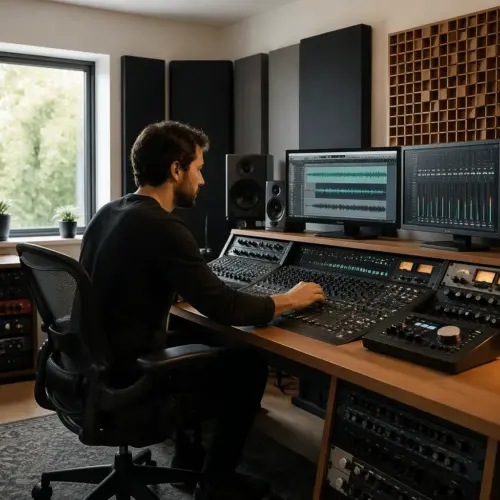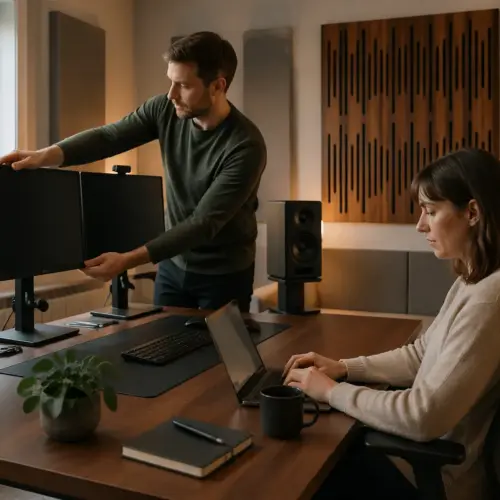

A home office studio with low knee wall can sound weirdly lopsided even when the room looks tidy. That half wall changes what your speakers hit first, and your ears notice fast.
People treat knee walls like harmless dividers, but acoustically they behave like a hard boundary with a missing top half. The result is a mix of side wall behavior and open plan behavior that is hard to predict by eyeballing.
If you want mixes that translate, you need to manage partial wall reflections, keep speaker line of sight consistent, and lock down a repeatable listening position. The good news is that most fixes are about placement and a few targeted panels, not rebuilding the room.
How a knee wall changes reflections and perceived symmetry
A knee wall breaks the usual assumption that left and right boundaries match, even when the room is technically rectangular. One speaker may see a solid surface at ear height while the other sees open air above the wall, and that difference shifts imaging.
The first problem is timing, because the wall side creates an early reflection that arrives close to the direct sound. The open side often has a later, weaker reflection path, so the stereo picture pulls toward the more reflective side.
The second problem is spectrum, because a half wall tends to reflect mids and highs well but does less for low frequencies. That makes the reflective side sound brighter and more “present,” which can trick you into under mixing treble.
Perceived symmetry matters more than visual symmetry, and a knee wall breaks it in a sneaky way. If you sit centered in the room but one side boundary is missing above 36 to 48 inches, your brain still uses that early reflection as a location cue.
In a normal room, you can often get away with being a little off center because the reflections are at least similar on both sides. With a knee wall, a small offset can turn into a big imbalance because one side is already acting like a different room.
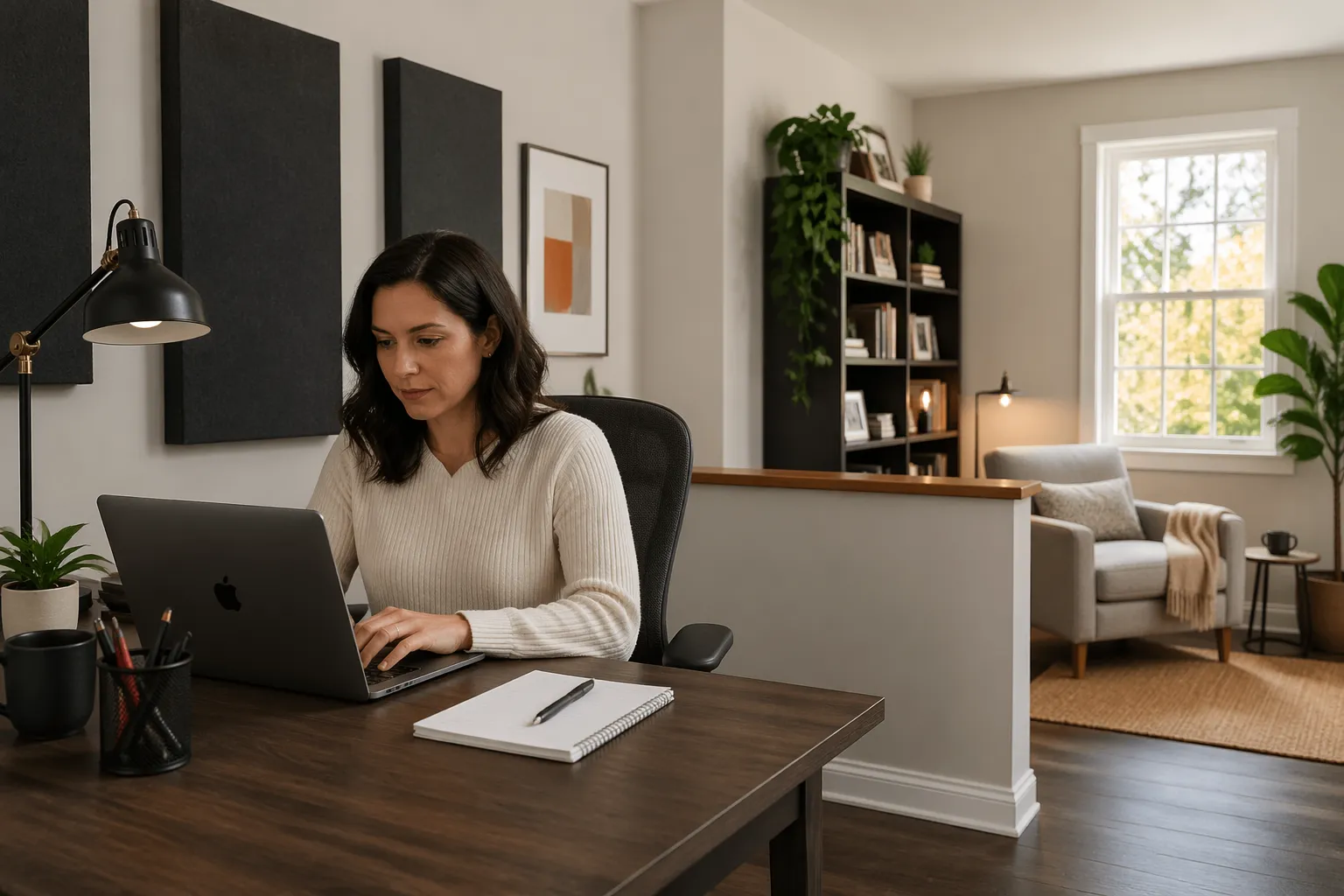
That imbalance shows up as a phantom center that does not feel nailed down, especially on dry vocals and snare. You may find yourself panning things to “fix” the room, which is a sign the room is driving the decision.
A knee wall also changes vertical reflections, because the top edge becomes a new “ceiling” for part of the room. If your ceiling is sloped, the knee wall can create a little pocket where reflections bunch up in a way that is hard to see.
Even when the knee wall is covered in paint that looks matte, acoustically it is still a hard surface at mid and high frequencies. The ear is very sensitive to those early midrange reflections, so the problem can feel bigger than the wall looks.
Another sneaky effect is that the open side often lets sound escape, so the decay time can differ left to right. That can make reverbs and room mics feel tilted, even when the direct sound seems mostly fine.
If you clap or snap in the room, you may hear a slightly different “zip” or flutter depending on which direction you face. That is the knee wall changing the reflection pattern, not your imagination.
When people say a room “sounds like it leans,” this is often what they mean. The knee wall side is giving you more early energy, and your brain interprets that as a shift in position.
The goal is not to eliminate every reflection, because that would make the room unpleasant and unnatural. The goal is to make the early reflections similar enough that your brain stops using them as a left-right map.
Determine if the knee wall is acting like a side wall or furniture
Before you buy panels, decide what the knee wall “is” to the speakers at your listening position. If the wall is close enough to the speaker and your ears that it creates a strong early bounce, treat it like a side wall.
If the wall is low, far, or heavily cluttered with books and soft stuff, it can behave more like furniture with scattered reflections. In that case you still manage it, but you do not need the same heavy treatment you would put on a real side wall.
A quick reality check is to sit at the desk and have someone slide a mirror along the knee wall top and face. If you can see a speaker’s tweeter in the mirror from your listening position, that surface is an early reflection point.
Also look at height, because the top edge can act like a reflector even when the face of the wall is below the tweeter. That “lip” reflection is a common source of partial wall reflections that smear the center image.
Distance matters more than most people think, because reflections get dramatically stronger as surfaces get closer. A knee wall that is two feet from a speaker is a different animal than one that is six feet away.
Material matters too, because drywall over studs reflects differently than a thick plaster wall or a wood cap. If the top is a hardwood ledge, it can be extra reflective in the upper mids where harshness lives.
Look at what is above the knee wall, because that space can act like an acoustic “leak” into another zone. If it opens into a stairwell or loft, you are dealing with a partial open boundary rather than a simple reflection surface.
If there is a railing, spindles, or decorative trim above the knee wall, you may get scattering instead of a clean reflection. Scattering is usually less damaging than a strong specular bounce, but it can still blur detail.
Try a simple listening test with a mono track and slow head turns. If the tonal balance changes quickly as you move a few inches, the knee wall is acting like a strong reflector rather than soft clutter.
Another quick test is to temporarily cover the top edge with a folded blanket and see if the center image stabilizes. If it does, you just proved the wall is an early reflection source worth treating properly.
Do not confuse “looks soft” with “is acoustically soft,” because thin fabrics barely affect mids and highs unless there is real thickness behind them. A decorative runner on the ledge may look cozy but do almost nothing above 1 kHz.
If the knee wall is acting like furniture, you can often improve things by rearranging what sits on it. If it is acting like a side wall, you should plan for absorption or redirection just like you would on drywall.
Place your desk so both speakers “see” similar boundaries
Desk placement is the highest leverage move in a home office studio with low knee wall, and it costs nothing. Your goal is simple, both speakers should have similar boundary conditions within the first few feet.
Start by choosing a wall to face that lets you keep left and right as similar as possible, even if that means the knee wall ends up behind you. I would rather work with a knee wall behind the chair than beside one speaker, because side asymmetry ruins imaging faster than rear asymmetry.
In practice, that often means resisting the urge to face the “prettiest” direction in the room. A view out a window is nice, but it is not worth a phantom center that drifts every time you move your head.
Try to keep the desk centered between the true side walls if the room has them, even if the knee wall is part of one side. Centering helps you start from a place where left and right distances can be matched.
If you cannot center the desk, you can still aim for symmetry by creating an artificial boundary on the open side. A freestanding absorber or a thick curtain can make the open side behave closer to the knee wall side.
Watch out for putting one speaker near a hard corner while the other is near open space, because that creates a bass imbalance that is hard to EQ away. You want both speakers to have similar corner proximity, even if neither is perfect.
Keep the speakers and listening position in an equilateral triangle as a baseline, then adjust from there. When the triangle is skewed, you end up chasing imaging problems that are not really about the knee wall at all.
Toe-in can help, but it is not a magic fix for asymmetry. If one speaker is firing across the knee wall edge and the other is firing into open air, toe-in will not make those reflections match.
Try small moves first, because moving the desk 3 to 6 inches can change which surfaces are in the early reflection window. It is common to find a “sweet strip” where the knee wall edge stops being the first thing your speaker hits.
Also consider desk depth, because a very deep desk pushes speakers closer to the knee wall or closer to the front wall depending on orientation. A shallower desk or speaker stands behind the desk can open up more placement options.
If you have to place the desk near the knee wall, try to keep the wall equally present on both sides. Two equal problems are easier to treat than one big problem on one side only.
Once you find a workable spot, mark it with tape on the floor so you can return to it after cleaning or rearranging. Repeatability is part of acoustics, because your ears learn the room you keep giving them.
| Desk and speaker situation | What the speakers “see” | Best first move |
|---|---|---|
| Knee wall on left side only | Left has near hard boundary, right is open above wall | Shift desk so both sides have similar distance to boundaries |
| Knee wall behind the chair | Both speakers see similar side walls, rear boundary is partial | Prioritize side reflection control, then rear absorption |
| Knee wall in front near one speaker | One speaker has a strong front-side bounce off the top edge | Raise speakers or move forward to clear the top edge line |
| Knee wall beside both speakers equally | Both speakers reflect off the same height boundary | Treat both top edges and keep toe-in symmetrical |
Use the table as a starting point, not a rulebook, because every knee wall is a different height and distance. The point is to identify what is asymmetric and remove that asymmetry first.
When you cannot remove the asymmetry, you can often reduce it by moving the speakers closer together. A narrower speaker spacing reduces the level of side reflections relative to the direct sound.
Be careful with pushing the desk too close to the front wall, because that can increase bass buildup and SBIR issues. You are balancing early reflection control with low frequency behavior, and the knee wall is just one piece of that puzzle.
If the room is small, you may get better results by placing the speakers on stands just behind the desk rather than on the desktop. That reduces desktop reflections and gives you more freedom to clear the knee wall edge.
Control early reflections created by the top edge of the wall
The top edge of a half wall is a reflection generator, because it is a flat, hard strip right at mid ear height in many rooms. You can get comb filtering from that edge even when the wall face is below the tweeter.
One fix is to raise the monitors so the tweeters sit clearly above the top edge line, which improves speaker line of sight to your ears. Another fix is to lower the monitors so the reflection path is longer and weaker, but that often fights ergonomic desk height.
If you can treat only one thing, treat the edge, because it is the closest reflective strip in the room. A 2 inch or 4 inch absorptive panel laid horizontally along the top, secured safely, can knock down the strongest partial wall reflections.
Do not ignore the desk itself, because the knee wall edge and the desktop can team up and create a bright “splash” into your ears. I like a small desk mat and slightly higher speaker stands, because that combo often cleans up the 1 kHz to 4 kHz range where harshness lives.
The reason the edge is so annoying is that it is a clean, specular reflector, so the reflection is coherent and strong. Coherent reflections are the ones that create obvious comb filtering and that “phasey” feeling in the upper mids.
If the top has a sharp corner, that corner can also diffract sound and create a secondary path. Diffraction is subtle, but it can make the imaging feel fuzzy even when the frequency response looks acceptable.
Sometimes the simplest fix is to change the angle of the speakers slightly so the strongest reflection does not aim at your ears. This is not a substitute for treatment, but it can reduce the severity while you experiment.
A thick absorber on the top edge works better than a thin foam strip, because you want real absorption down into the midrange. If you only tame the very top end, you can still get a hard midrange bounce that makes vocals feel forward.
If you cannot place an absorber on the edge, a dense, irregular arrangement can help by breaking up the reflection. A row of uneven books or a thick woven basket can scatter some energy, though it will not be as consistent as a panel.
Be mindful of safety and stability if you lay anything on the wall top, especially if the wall overlooks stairs. A panel that slides off is not worth the acoustic benefit, so secure it like you mean it.
It can also help to treat the face of the knee wall at the mirror point, not just the top. If the wall face is in the early reflection path, a vertical absorber there can reduce the reflection before it ever reaches the edge.
If you have a sloped ceiling, check whether the knee wall edge is creating a bounce up to the slope and back down to your ears. That two-step path can arrive early enough to matter and can be hard to guess without a mirror test.
After you treat the edge, listen again at low volume, because low volume makes reflection problems more obvious. When the edge is under control, the center image tends to stay stable even when you mix quietly.
Keep bass response consistent when one side is partially open
Low frequencies do not care that the wall is only half height, because bass wraps around and fills the volume. What changes is the room’s effective volume and how pressure builds, so one side can feel “lighter” in the low end.
If one side opens into a hallway or a loft area above the knee wall, you may lose some boundary gain and some modal buildup on that side. That can trick you into pushing bass too hard, then your mix booms in a normal closed room.
Start with speaker placement, because moving monitors a few inches changes bass more than most people expect. Keep both speakers the same distance from the front wall, and avoid placing one speaker close to a corner while the other is near open space.
Then use bass trapping where it still works, which is usually the real corners and the wall ceiling corners, not the open side above the knee wall. Thick corner traps, even DIY rockwool stacks, help reduce the “one note” bass that makes the room hard to trust.
SBIR is a big deal in small rooms, and a knee wall can make it uneven left to right. If one speaker has a nearby boundary and the other does not, the cancellation dips will not match, and your low end will feel different per side.
Try to keep the monitors the same distance from any nearby vertical surface, including the knee wall face if it is near one speaker. Matching distances does not eliminate SBIR, but it keeps it symmetrical so it is easier to learn.
Do not assume the open side means “less bass problems,” because the remaining boundaries can still create strong modes. Sometimes the open side just changes where the peaks and nulls land, which can make the listening position more sensitive.
If you have a subwoofer, integrate it carefully because the knee wall can make the best sub location non-intuitive. A sub that sounds great on the floor near the knee wall might be a mess at the desk because the boundary conditions are uneven.
Sub placement experiments are worth doing, because a sub moved one foot can change the response more than any plugin. If you have the patience, the “sub crawl” method can reveal positions that avoid the worst nulls.
When bass feels inconsistent, check your chair position too, because moving your head forward or backward changes what mode you are sitting in. A knee wall can shift those mode patterns so the usual “safe” spots are not safe anymore.
It also helps to keep the room reasonably sealed and consistent during mixing, meaning doors in the same position and curtains in the same position. A partially open boundary plus an open door can change the low end enough to mess with decisions.
If you can only add one bass treatment, go thick rather than wide. A couple of deep traps in the best corners usually beats a bunch of thin panels scattered around.
Once bass is more consistent, you will notice your kick and bass level decisions become boring, which is exactly what you want. A room that makes you constantly second guess the low end is a room that will slow you down.
Set a listening position that does not sit on the knee wall’s acoustic fault line
Your listening position should not sit right where the room changes from closed to open, because that boundary shift can create a weird midbass dip. If your ears are level with the top of the wall, you are often sitting in the worst spot for edge reflections too.
I like starting with the usual 38 percent rule from the front wall as a rough guess, then adjusting by measurement and by ear. In a home office studio with low knee wall, I will break that “rule” quickly if it puts my head too close to the divider edge.
Think of the knee wall as creating a transition zone, and avoid putting your head right in that transition. Even a move of 6 to 12 inches can take you out of a cancellation dip caused by the edge and the open volume above it.
Seat height matters too, because changing ear height changes the reflection geometry to the wall top. If you can raise or lower your chair a little, you may find a height where the edge reflection is less intense.
Try to keep the listening position stable day to day, because a knee wall room can be sensitive to small moves. If you roll your chair back to take a call and then roll forward to mix, you may be hearing a different low end.
In tight rooms, you may be tempted to sit very close to the speakers to reduce room influence, and that can help. Just make sure you are not so close that the left-right triangle collapses and the stereo field feels narrow.
Also watch the relationship between your head and the ceiling slope if you are in an attic-style space. The knee wall and the slope can create a reflection path that is strong at one ear and weaker at the other.
If your chair ends up near the knee wall, consider putting absorption behind you at head height, even if the wall is low. A rear absorber can reduce the sense of “slap” that makes the room feel small and nervous.
Try not to sit with your head exactly halfway between floor and ceiling if the ceiling is flat, because that can line you up with modal patterns. With a knee wall and a slope, the “halfway” point is not obvious, so you have to listen and measure.
When you find a listening position that feels stable, lock it in with physical cues like a rug edge, a desk position mark, or a chair mat. Consistency is part of what makes a room learnable.
- Keep tweeters at ear height
- Equal left and right speaker distance to the listening position
- Clear speaker line of sight over the knee wall edge
- Avoid sitting with ears exactly level with the wall top
- Start 30 to 45 inches from the front wall, then measure
- Use a rug if the floor is hard and reflective
The list looks basic, but it is the stuff that makes the advanced fixes actually work. If you skip the basics, you end up treating symptoms instead of the cause.
When the listening position is right, panning feels predictable and mono compatibility checks stop being stressful. You will also notice that EQ moves translate better to headphones and car speakers.
Treat the knee wall like a reflection zone, not a decoration shelf
A lot of people turn a half wall into a display ledge, then wonder why their mixes get brittle. Hard objects lined up along the edge create a picket fence of reflections that change with tiny head movements.
If you need storage there, choose soft and irregular items, like fabric bins or a row of books with uneven depths. Avoid glass frames, metal desk lamps, and flat monitor stands on the wall top, because they act like little mirrors for sound.
If the wall top must stay clear, you can still tame it with a removable absorber that sits like a runner. A simple wood frame filled with mineral wool and wrapped in breathable fabric can sit on the edge and come off when you want the room to look normal.
Do not chase perfection, because the goal is repeatability, not a lab. When partial wall reflections stop changing every time you shift in your chair, your decisions get faster and you second guess less.
Think of the knee wall zone as part of your early reflection plan, the same way you think about side walls and the ceiling cloud. If you ignore it, you are leaving a major reflective surface untreated right next to your mix position.
A clean-looking ledge is tempting, but a clean-sounding ledge is better. If you want it to look nice, build or buy an absorber with fabric that matches the room so it reads like intentional decor.
If you have to place gear on the knee wall, keep it low and non-reflective, and avoid flat screens angled at your ears. A glossy monitor or tablet on that ledge can create a sharp reflection that is worse than the bare wall.
Plants can be a mixed bag, because leaves scatter some highs but pots and soil surfaces can still reflect. If you use plants, choose dense foliage and avoid big ceramic pots right at the mirror point.
Be careful with acoustic foam strips on the edge, because they can make the room sound dull without actually fixing the midrange reflection. If you treat the edge, treat it with enough thickness to matter.
If the knee wall has a wood cap, you can sometimes add a thin layer of felt under a fabric runner to reduce the highest frequency glare. It will not solve everything, but it can take the sting out while you plan a better absorber.
Keep the knee wall zone consistent during mixing, meaning do not move objects on and off it between sessions. A room that changes daily is a room you cannot learn, and learning the room is half the battle.
If you share the office with non-audio tasks, build your treatment to be removable and repeatable. A panel that drops into the same spot every time is better than a “temporary” fix that never lands the same way twice.
Use measurement to confirm what your ears already suspect
If the stereo image pulls left or right, you can usually hear it within a minute, but measurement tells you why. A $100 USB mic like the UMIK-1 plus Room EQ Wizard is enough to see early reflection spikes and bass swings.
Run sweeps for left and right separately, because the knee wall often affects them differently. Look at the impulse response to spot strong early arrivals, then look at the frequency response smoothing at 1/12 or 1/24 octave to see combing.
Move one thing at a time, and save measurements with clear names like “desk 6in right” or “speakers raised 3in.” This process feels slow, but it beats randomly buying foam and hoping the room behaves.
If you do not want to measure, at least use a mono vocal track and pink noise to check center stability. When your listening position is right, the vocal locks to the middle and stays there when you lean a little left or right.
Measurements are especially useful with knee walls because the problem is often geometric, not just “too live.” When you see a strong early reflection at a particular time offset, you can often connect it directly to the wall edge distance.
Pay attention to the ETC or energy-time curve if you know how to read it, because it makes early reflections obvious. A big spike a few milliseconds after the direct sound often points to a nearby surface like the knee wall top.
Take measurements at a few inches left and right of the listening position, not just one point. A knee wall setup can be very position-sensitive, and you want a small “work zone” that stays consistent.
If you see big differences between left and right frequency response below 300 Hz, that is a clue that boundary conditions differ. Fixing placement symmetry often reduces that difference more than adding random bass traps.
Do not obsess over perfectly flat graphs, because small rooms rarely deliver that. What you want is smoother behavior, fewer sharp nulls, and left-right similarity that makes panning decisions trustworthy.
If you use correction EQ or room correction software, measure first and correct second. A knee wall reflection problem is often time-domain, and EQ cannot fix a reflection arriving from a different direction.
After each change, listen to a few reference tracks you know well, especially ones with centered vocals and wide stereo information. If the room is improving, you will hear more stable placement and less “swim” in the upper mids.
Keep your measurement mic position consistent, because a one-inch difference can change high frequency results. A simple mic stand mark on the floor makes repeat tests much more meaningful.
Once you have a baseline, you can stop measuring every day and just measure when you change something major. The goal is to get the room into a trustworthy range, not to turn mixing into a science project.
Layout examples for half walls behind, beside, or in front of you
If the knee wall is behind you, treat it like a rear boundary that is partly missing, and focus on the true side walls first. A thick absorber behind the chair, plus corner trapping, usually gives you a stable center image and smoother low end.
If the knee wall is beside you on one side only, fix symmetry before you treat anything. Rotate the setup 90 degrees if you can, or slide the desk so each speaker has the same distance to a comparable boundary, even if that boundary is a freestanding panel on the open side.
If the knee wall is in front of you, the top edge can sit right in the reflection path between speakers and ears. Raise the speakers on stands, pull the desk forward, or both, so you restore clean speaker line of sight and reduce edge bounce.
If the room forces a compromise, pick the compromise that keeps left and right early reflections closest in level and timing. You can live with a slightly odd rear wall, but you will hate mixing with a sideways skewed phantom center.
When the knee wall is behind you, the biggest risk is a rear reflection that makes the room feel “short.” A thick panel behind the chair helps, and it also makes the room more forgiving when you lean back.
In that behind-you layout, do not ignore the side walls just because the knee wall is the obvious feature. Side wall first reflection points still dominate imaging, and they are usually the easiest wins with standard panels.
When the knee wall is beside you on one side, a freestanding panel on the open side can act like a fake wall and restore balance. Even a heavy curtain on a stand can help if it is thick and placed at the right spot.
In the beside-you case, you may also need to adjust toe-in so both speakers have the same relationship to their nearest boundary. The goal is not identical toe-in angles on paper, but identical results at your ears.
When the knee wall is in front of you, watch for reflections off the wall top that bounce into the underside of the desk and then up to your ears. That path can create a nasal midrange that makes you cut too much around 800 Hz to 1.5 kHz.
In the in-front layout, pulling the desk forward can also help with bass by changing the speaker-to-front-wall distance. It is common to find a spot where the low end tightens up and the edge reflection calms down at the same time.
If the room is an attic with two knee walls, you can sometimes get a surprisingly good setup by facing the gable end and keeping both knee walls equally present. Equal weirdness on both sides is still symmetry, and symmetry is workable.
If you are stuck with a door or closet on one side and a knee wall on the other, prioritize matching the first reflection behavior. That might mean adding absorption on the door side so it behaves closer to the knee wall side.
In all layouts, keep cables, stands, and clutter from creeping into the speaker-to-ear path. A knee wall room already has enough geometry problems, so do not add more little reflectors near the tweeters.
Once you settle on a layout, live with it for a week and take notes about what consistently feels off. A knee wall setup improves a lot when you stop changing everything at once and start making targeted, repeatable tweaks.
Conclusion
A home office studio with low knee wall can work well, but only if you treat the half wall as an acoustic boundary and not a harmless divider. Get desk placement right first, then control the top edge, then deal with bass where the room still has real corners.
When you manage partial wall reflections and keep a consistent listening position, the room stops fighting your decisions. Once both speakers “see” similar boundaries and your speaker line of sight stays clean, mixes translate with a lot less drama.
The knee wall is not a deal breaker, but it does demand that you pay attention to symmetry and early reflections. If you treat it like a normal wall when it behaves like a weird half wall, you will keep chasing problems that never fully go away.
Start with free changes, confirm with listening tests, and only then spend money on panels and traps. When the room becomes predictable, your workflow speeds up, and that is the real upgrade you are after.