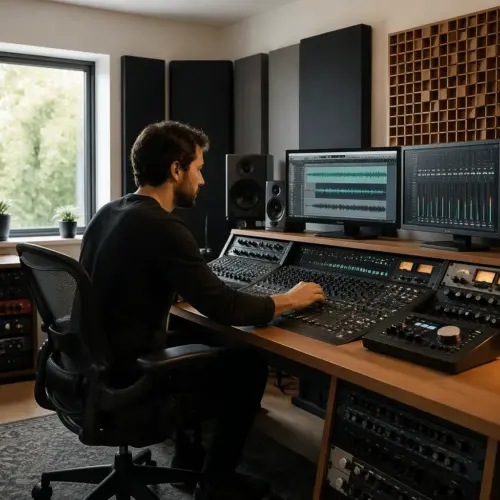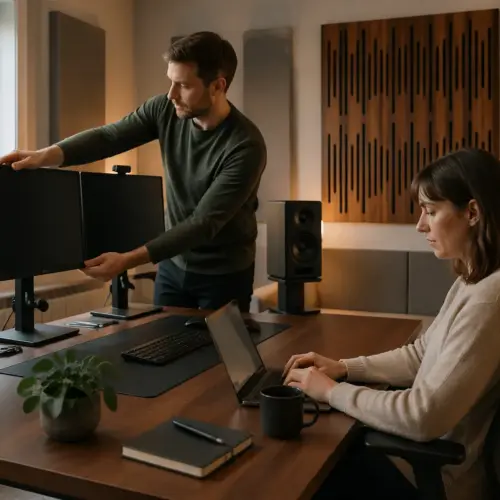

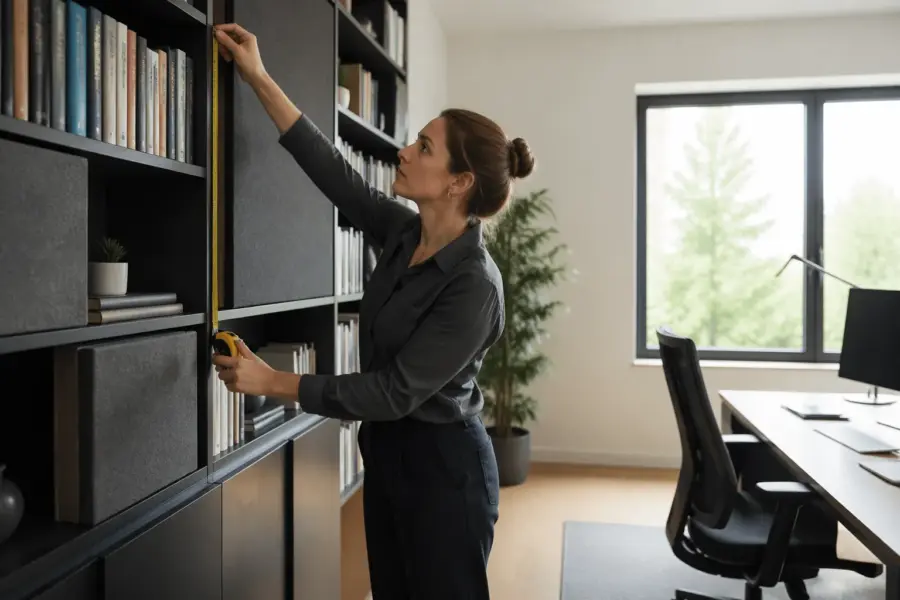
A bookshelf wall can be a gift in a home office studio, or it can quietly wreck your imaging if you put it in the wrong spot. The trick is treating it as part of your studio geometry with bookshelf wall, not as random furniture you hope will “diffuse.”
Most people talk about diffusion vs absorption like you must pick a side, but a loaded shelf does both in a messy, frequency dependent way. That mess can be useful, yet it can also create lopsided rear wall behavior and weird comb filtering if you ignore symmetry checks.
If you mix remote work with recording, calls, or editing, you need clarity at the desk and calm behind you. A bookshelf can help with both, but only if you decide what the wall needs first and then choose the shelf style and placement.
In small rooms, the bookshelf is often the biggest object you can add without losing floor space, which is why it matters more than people assume. When you treat it like an acoustic surface with depth, edges, and reflectivity, you stop guessing and start steering the room.
The goal is not to make the room dead, it is to make it predictable so your monitors and your voice translate. A shelf can be part of that predictability when you understand what it does at different distances and angles.
When a bookshelf helps your room, and when it hurts
A bookshelf helps when it breaks up strong reflections that would otherwise bounce between two hard, parallel surfaces. It hurts when it creates a big, flat reflective face near your speakers or when it makes one side of the room behave differently than the other.
People love the idea that books equal diffusion, but most shelves are not true broadband diffusers. A typical shelf is a mix of partial absorption from paper, mid and high frequency scattering from uneven spines, and hard reflections from the shelf frame.
The worst case is a tall shelf with glass doors or glossy laminate, because it acts like a vertical mirror for sound. If that surface sits at a first reflection point, you can get a sharp, phasey top end that no EQ fix will make pleasant.
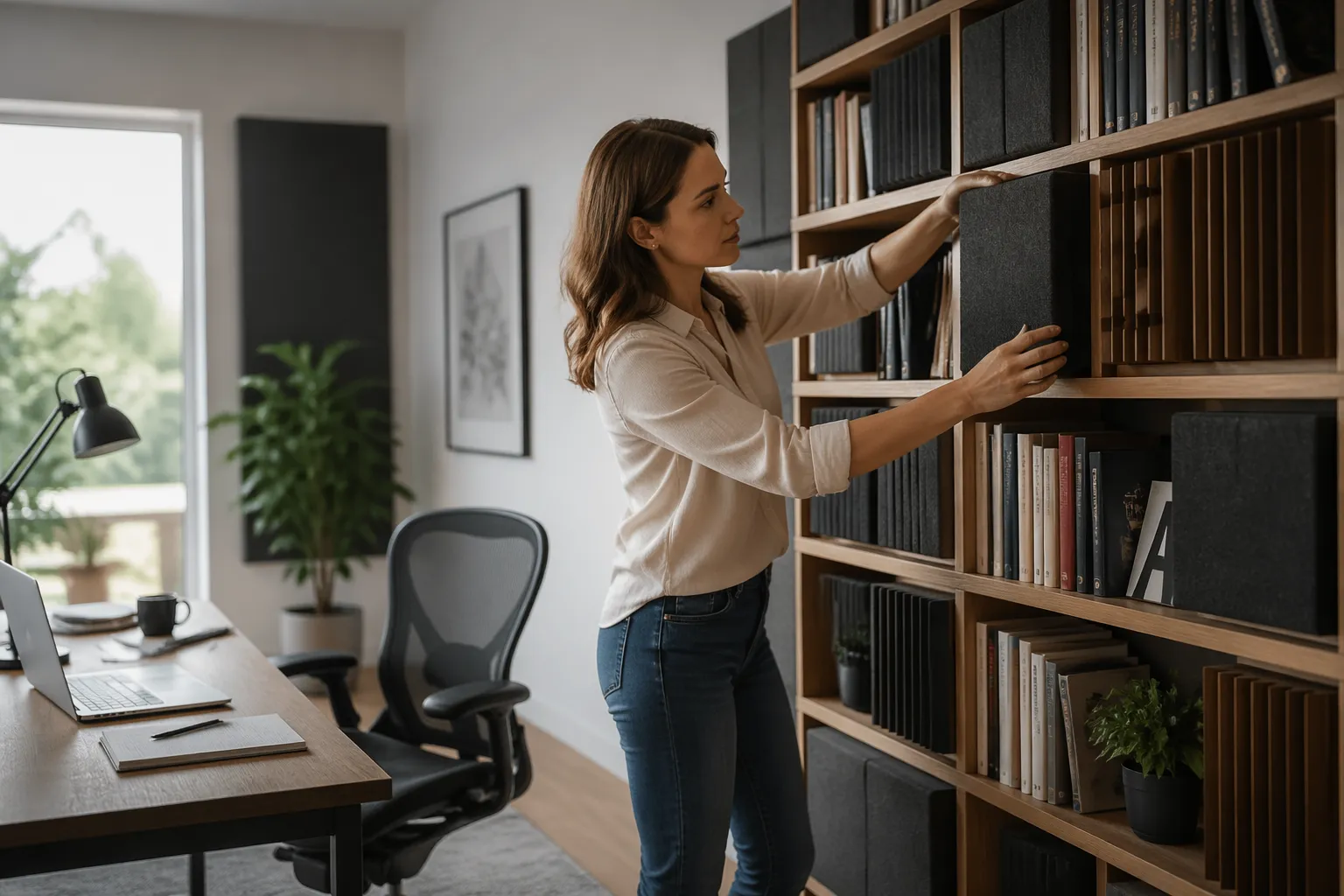
The best case is a deep shelf with uneven depth, varied book heights, and some porous items mixed in, placed where you want less specular reflection. Think of it as controlled clutter that can soften rear wall behavior or calm a slap echo without killing the room.
A bookshelf also helps when it adds texture to a wall that is otherwise a single uninterrupted plane, especially drywall or plaster that tends to throw back a clean reflection. That texture can reduce the sense of a hard boundary without needing you to cover the whole wall in foam.
It hurts when you expect it to fix low frequency problems, because shelves do almost nothing for true bass control unless they are paired with real trapping. If your room has boomy corners or nulls at the desk, a bookshelf will not replace bass traps, it will just change the midrange story.
Books absorb a little in the upper mids, but they are not thick porous absorbers, and the shelf itself is often rigid enough to reflect energy back into the room. That is why a shelf can make the room feel smoother while still leaving a low mid ring that shows up on male voice and guitars.
Another way a shelf hurts is by creating a strong reflection at an odd angle that only one ear hears clearly. That can make the stereo field feel wide but unstable, which is a fun effect for a minute and then exhausting for long editing sessions.
It helps when it reduces the level of a single dominant reflection, even if it does not fully randomize it. In practical home offices, reducing the worst offender is often the difference between a workable room and a room that constantly distracts you.
It also helps if you use the shelf as a place to hide small absorbers or soft storage that you would otherwise never install. A few fabric bins and a couple of thick, ugly items can do more than a perfectly color matched row of hardback spines.
Finally, it hurts when it forces your desk or speakers into a compromised position just to make the furniture fit. If the shelf placement makes you sit off center or pushes one monitor closer to a wall, the acoustic trade is usually not worth it.
Pick the best wall for the bookshelf: front, side, or rear
Start with the job your room needs done, because the same bookshelf behaves very differently on the front wall, side walls, and rear wall. Your listening position, speaker distance to boundaries, and desk layout decide whether the shelf is a helper or a problem.
On the front wall, behind the speakers, a bookshelf is usually a bad bet unless you have plenty of distance and the shelf face is not reflective. Early reflections from the front wall can blur the phantom center, and a shelf full of uneven objects can make left and right reflections less predictable.
On a side wall, a bookshelf can be great if it sits behind the first reflection zone, or if you pair it with a real absorber panel at the reflection point. If the shelf sits exactly where a mirror shows your tweeter from the listening spot, you are gambling with imaging.
On the rear wall, a bookshelf is often the safest and most useful place, especially in small rooms where the back wall is close. Rear wall behavior matters a lot for low mid buildup and late reflections, and a deep, irregular shelf can reduce the “shout back” you hear on claps and spoken voice.
Front wall placement can work in a larger room when the shelf is far enough away that the reflection arrives later, but most home office studios do not have that luxury. If your monitors are within a couple feet of the front wall, you are better off keeping that surface simple and treating it with absorption if needed.
If you must put a shelf on the front wall for practical reasons, keep it low and keep the area directly behind the speakers as clean and matte as possible. A low shelf below tweeter height tends to be less destructive than a tall shelf that spans ear level.
Side wall placement is often about workflow, because shelves end up next to the desk for easy reach. If you want that convenience, you can still make it work by ensuring the shelf starts behind your shoulders rather than beside your ears.
A good rule is that anything beside the desk should either be clearly in front of you and symmetrical, or clearly behind you and not in the first reflection zone. The awkward zone is the half-behind, half-beside position where the shelf becomes a surprise reflector.
Rear wall placement is also nice because it can double as visual background for calls while doing something useful acoustically. The trick is not to over-credit it as a diffuser, but to use it to reduce the strength of the rear wall return.
If your chair is very close to the rear wall, a shelf can still be too reflective if it is mostly hard surfaces and empty bays. In that case you may want a thicker absorber behind your head, with the shelf offset to the sides or pushed farther back if the layout allows.
Corner placement is a special case, because shelves often get shoved into corners by default. A corner shelf can be fine for storage, but corners are where bass builds up, so it is a missed opportunity if you could instead fit a bass trap there.
Sometimes the best wall is simply the wall that keeps the room symmetrical at the desk. If the only place a shelf fits forces you to sit off center, consider splitting storage into two smaller shelves to keep your listening geometry intact.
Keep left-right balance even with uneven shelf contents
Studio geometry with bookshelf wall lives or dies on symmetry checks, because your brain locks onto tiny differences between left and right reflections. A shelf that is packed on one side and empty on the other can pull your stereo image off center even if your speakers measure perfectly placed.
You do not need identical books on both sides, but you do need similar acoustic weight and similar reflection strength. That usually means matching the overall density, matching the amount of exposed hard backing, and keeping big reflective objects from appearing on only one side.
Balance also applies to height, because an empty top row on one side can behave like a hard wall while the other side stays broken up. If you want a shelf to look styled, try to style it in mirrored zones rather than random zones.
It helps to think in blocks of area rather than individual items, because sound does not care about your favorite book title. If the left half of the shelf is mostly paper and the right half is mostly plastic and glass, you have built an acoustic EQ curve into the room.
Depth symmetry matters too, and it is easy to miss because you see spines, not recesses. If one side has books pushed all the way back and the other side has them flush, the reflection timing changes enough to tilt the image.
Try to avoid putting your most reflective items at ear height on only one side, like framed photos, glossy magazines, or a monitor screen parked on a shelf. Those objects can create a focused reflection that is louder than the rest of the shelf content.
If you store gear on shelves, keep the gear symmetrical too, because metal and plastic faces are strong reflectors. A single audio interface with a flat face can act like a little mirror if it sits at the right angle.
Symmetry does not mean sterile, and you can keep personality while keeping balance. You can place different objects left and right as long as their size, hardness, and placement relative to ear height is roughly matched.
When you change the shelf, treat it like you changed the room, because you did. Even swapping a few binders for paperbacks can change the brightness of a reflection path and make the desk feel more or less sharp.
| What changes on the shelf | What you may hear | Quick symmetry fix |
|---|---|---|
| One side has empty cubbies | Image shifts toward the fuller side | Fill empties with books or fabric bins |
| One side has glossy binders | Brighter, splashier highs on that side | Move binders to the center or add matte covers |
| One side has a big flat box face | Sharper early reflection and combing | Turn the box sideways or break the face with objects |
| One side has deep recesses | Less upper mid energy and softer presence | Match depth with a second row of books elsewhere |
If you are unsure whether a shelf difference is audible, listen in mono and move your head slowly left and right. A balanced setup keeps the center stable, while an unbalanced shelf makes the center smear or lean.
You can also record a short spoken phrase at the desk and play it back while you sit in the same spot. If the voice sounds brighter on one side of your head than the other, you likely have a shelf reflection imbalance.
One practical trick is to keep the most uniform, book-heavy area near the outer edges of the shelf and the more decorative, reflective items near the center. That way the left and right boundaries of the room behave more similarly, which helps imaging.
If you have only one large shelf in the room, you can still create balance by adding a smaller soft element on the opposite side, like a thick curtain or a freestanding absorber. The point is not to match the furniture, it is to match the acoustic effect.
Control early reflections around tall shelving
Tall shelving changes the way early reflections hit your ears because it creates a large vertical surface near head height. If that surface is close to your desk, it can act like a side wall even when it is slightly behind you.
Do a simple mirror check on each side wall, and treat the first reflection point like sacred ground. If the shelf intrudes into that zone, put a 2 to 4 inch absorber panel in front of the shelf at ear height, even if you keep the rest of the shelf exposed.
This is where diffusion vs absorption stops being a debate and turns into a practical decision. Absorption at the first reflection point usually wins because it reduces comb filtering, while diffusion there can still leave strong energy arriving early, just spread out.
If you cannot mount panels, you can cheat with thick moving blankets or a dense curtain hung on a stand, but keep it tight and close to the shelf face. A loose drape flaps and looks cozy, yet it does less than people expect above the low mids.
Early reflections are not just about left and right walls, because tall shelves can also create angled reflections that bounce off the desk and into your ears. If you notice a brittle upper mid glare, check whether the shelf face is reflecting into the desk surface like a ping-pong shot.
Distance matters, because a shelf that is a foot from your ear behaves very differently than a shelf that is four feet away. The closer it is, the more it acts like a direct sound source, which is why near-field listening can be sabotaged by nearby reflective furniture.
If your shelf is beside the desk, try rotating it slightly so it is not perfectly parallel to your listening axis. A small angle can reduce the strength of a direct reflection without forcing you to rebuild the room.
Pay attention to the top of the shelf as well, because a flat top can reflect sound up to the ceiling and back down as a short delay. If the top is bare and glossy, adding a soft runner or a few thick items can take the edge off.
Another common issue is a shelf that extends forward past the plane of the desk, creating a hard edge that reflects and diffracts sound. If you can, keep the front face of the shelf behind the front edge of the desk so the desk remains the dominant nearby surface.
If you use a microphone at the desk, the shelf can also create early reflections into the mic, not just into your ears. That is why a shelf that sounds fine for mixing can still make voice recordings sound boxy or splashy.
For voice work, a simple absorber placed on the shelf at mouth height behind the mic can be more effective than treating the whole wall. You are trying to stop the first bounce into the mic capsule, not redesign the room.
When in doubt, treat the reflection point first and then decide whether you want the rest of the shelf exposed for liveliness. This approach keeps the room clear at the desk while still letting the rear of the room feel natural.
Use shelf depth and spacing to avoid harsh flutter paths
Flutter echo happens when two hard, parallel surfaces trade fast reflections back and forth, and shelves can either break that path or accidentally reinforce it. A shallow shelf with a flat back and neat, flush book spines can behave like a semi reflective wall that still allows flutter between the opposite surface.
Depth matters more than most people think, because deeper cubbies create time spread in the reflections and reduce the “ping” you hear on claps. If your shelf is only 8 inches deep, push some books back, pull others forward, and let a few objects sit proud of the shelf line.
Spacing also matters, especially if your shelf has wide open bays that expose a hard wall behind it. Those open bays can create repeatable reflection paths, so add fabric bins, stacked books, or even a rolled towel to break the straight shot.
If you have a choice, avoid shelves with a single continuous backing panel that is glossy or thin wood. A thicker backing, or a shelf that leaves the wall partially exposed in a broken pattern, usually produces less harshness in the upper mids.
Flutter can also happen vertically between the floor and ceiling, and a tall shelf can either help or make it worse depending on how uniform it is. A shelf with varied heights and protrusions interrupts that vertical path, while a tall, flat-faced shelf can act like a reflector that feeds it.
Try not to line up shelf edges with other hard edges in the room, like a cabinet face directly opposite the shelf face. When two large surfaces are parallel and similar in height, they tend to trade the same reflection back and forth.
Even small changes in spacing can matter, because flutter is about repeated timing. If you move a shelf a few inches off a perfect parallel alignment, you often reduce the audibility of the flutter without adding any new treatment.
One overlooked trick is to mix in a few soft, irregular items that do not look like acoustic treatment, like folded blankets, canvas bags, or fabric storage cubes. These items reduce the sharpness of the reflection while keeping the shelf functional.
Another overlooked trick is to avoid making every book spine flush, because that creates a clean reflective plane. A random pattern of a half inch forward and back is messy visually, but acoustically it often sounds smoother.
If the shelf has a hard back and you hear a papery ring, try putting a thin layer of felt or cork on the back panel inside a few bays. You do not need to cover everything, you just need to interrupt the most repeatable paths.
Be careful with empty decorative objects like vases or bowls, because they can ring or reflect in a narrow band. If you love the look, place them away from ear height or nest them among books so they do not present a clean reflective face.
Spacing between the shelf and the wall can also change the sound if the shelf is freestanding and not flush. A small air gap can create a cavity effect, so if the shelf is rattling or sounding hollow, stabilizing it and reducing gaps can help.
Finally, remember that flutter is easiest to hear when the room is otherwise quiet. If you hear it on claps, you will also hear it as fatigue during long sessions, so it is worth chasing down even if it seems subtle at first.
Simple ways to test and adjust placement by listening
You can get surprisingly far with listening tests if you stay consistent about level and position. Use speech, hand claps, and a few reference tracks you know well, and only change one thing at a time.
Rear wall behavior is easy to hear with speech, because the room will sound like it answers you from behind when the back wall is too reflective. When you move a bookshelf to the rear and that “answer” gets quieter and less sharp, you are moving in the right direction.
For imaging checks, use a mono vocal or a mono snare and listen for a locked center that does not wobble as you breathe or shift slightly. If the center image feels like it is swimming, you likely have a strong early reflection or an asymmetry problem.
For tonal checks, use a bright but familiar track and listen for a brittle edge that appears only when you turn your head a few degrees. That is often a clue that a shelf face is reflecting into one ear more than the other.
When you move a shelf, move it in small increments and re-listen from the exact same seated position. A six inch change can be audible, especially on the rear wall where timing differences show up as a change in clarity.
Do not forget to listen at normal working volume, because reflections that seem obvious on loud claps may be less relevant at moderate levels. The goal is to improve what you actually experience during calls, editing, and mixing, not just win a clap test.
If you have measurement software, you can confirm what you hear, but you do not need it to make progress. The most important thing is to correlate a change in placement with a change in a specific perception like center stability or rear wall slap.
A useful habit is to keep a simple log of what you changed and what you heard, because memory lies fast when you are moving furniture. Two notes like “shelf moved right 8 inches, vocal center steadier” can save you from circling back later.
- Clap test at the desk, then 2 feet behind the chair
- Mirror test for tweeter visibility on both side walls
- Mono vocal track, listen for center drift during head turns
- Pink noise sweep, note harsh bands near 2 to 6 kHz
- Swap shelf contents left to right, recheck imaging
- Move shelf 6 inches at a time, mark tape lines on the floor
If the shelf is on the rear wall, try listening for the sense of depth in reverbs and delays, because rear reflections can mask that depth. When the shelf is working, reverbs tend to feel more separated from the dry signal instead of smeared into a bright haze.
If the shelf is on a side wall, listen for cymbals and sibilance, because those elements reveal early reflection problems quickly. A good setup keeps the top end present but not splashy, and it stays consistent as you move your head slightly.
For voice calls, record a short sample with your normal mic position and compare before and after changes. If the shelf is causing trouble, you will often hear a papery flutter or a boxy emphasis that disappears when you add absorption or change angles.
If you are unsure whether the shelf is helping at all, temporarily cover it with a thick blanket and listen again. That quick A/B test tells you whether the shelf is mostly reflecting or mostly breaking things up in your specific room.
Once you find a good placement, lock it in with felt pads, furniture stops, or a simple tape mark so it does not drift over time. Small drifts are common in home offices, and they can slowly undo the balance you worked for.
Conclusion
A bookshelf wall can be a smart acoustic tool, but only when you treat it as part of studio geometry with bookshelf wall and not as decoration. Put it where it helps rear wall behavior or breaks up late reflections, and keep it away from the first reflection points unless you add absorption.
Keep doing symmetry checks as you load and unload shelves, because the room changes when the shelf changes. When you balance diffusion vs absorption with a clear goal, you end up with a home office studio that images cleanly and still feels like a real room you can work in.
The most useful mindset is to treat the shelf like a variable acoustic surface that you can tune with placement, depth, and contents. That mindset keeps you from chasing myths and keeps you focused on what you can actually control.
If you get the rear wall under control and protect the first reflection points, the rest of the room becomes easier to live with. A bookshelf can be part of that solution, as long as you make it serve the room instead of forcing the room to serve the shelf.