
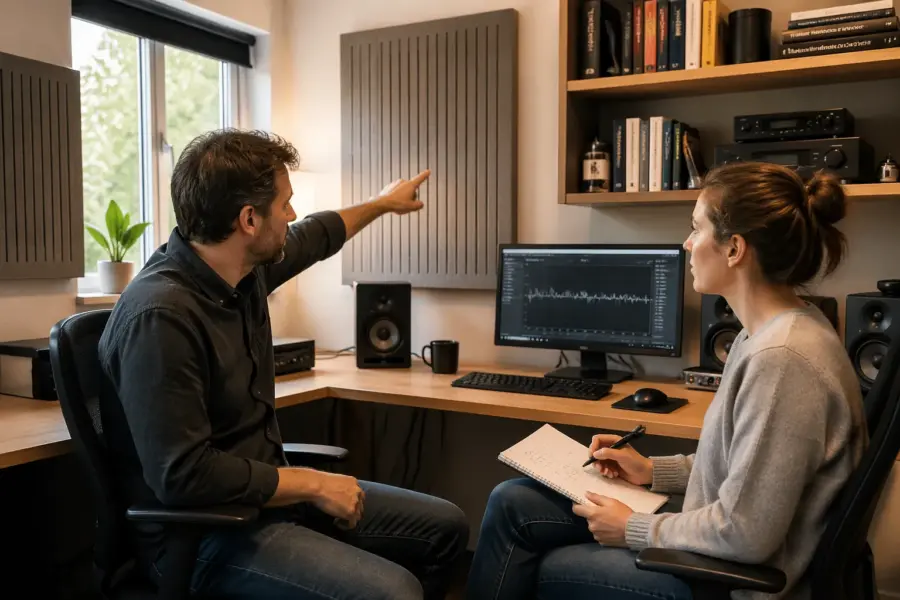
L-shaped home offices are convenient for real life, but they can be brutal for low end accuracy. If you have ever mixed a track that sounded tight at your desk and boomy everywhere else, you already met the problem.
Bass does not care that one leg of the room is your work nook and the other leg is a walkway or storage. It loads the whole volume, bounces off boundaries you forgot to count, and piles up where geometry tells it to.
This article is about bass control for an L-shaped home office room without turning your place into a foam cave. The goal is a layout and treatment plan that respects asymmetrical rooms, locks in a sane listening position, and uses treatment zoning so you spend money where it changes the bass.
Why L-shaped rooms create uneven bass
An L shape acts like two connected spaces that share low frequencies but do not share them evenly. The long wavelengths below about 150 Hz wrap around corners, then meet reflections coming back from different distances.
In a rectangle, the strongest axial modes line up with three simple dimensions, length, width, and height. In asymmetrical rooms, those modes still exist, but the L adds extra paths that shift where peaks and nulls land.
The inside corner of the L often becomes a pressure hotspot because two walls and often a partial wall meet there. You will hear that as a one note boom at the desk or a weird swell when you stand in the corner.
The open leg of the L can act like a bass leak, but it rarely leaks evenly across frequencies. Some notes spill out and decay faster, while others reflect back from the far end and create a deep dip at your chair.
Picking the best wall to face (and when to break the rule)
The default rule is to face the short wall so you fire speakers down the longest dimension. That usually gives smoother bass because the first front to back mode is lower, and the early reflections arrive more predictably.
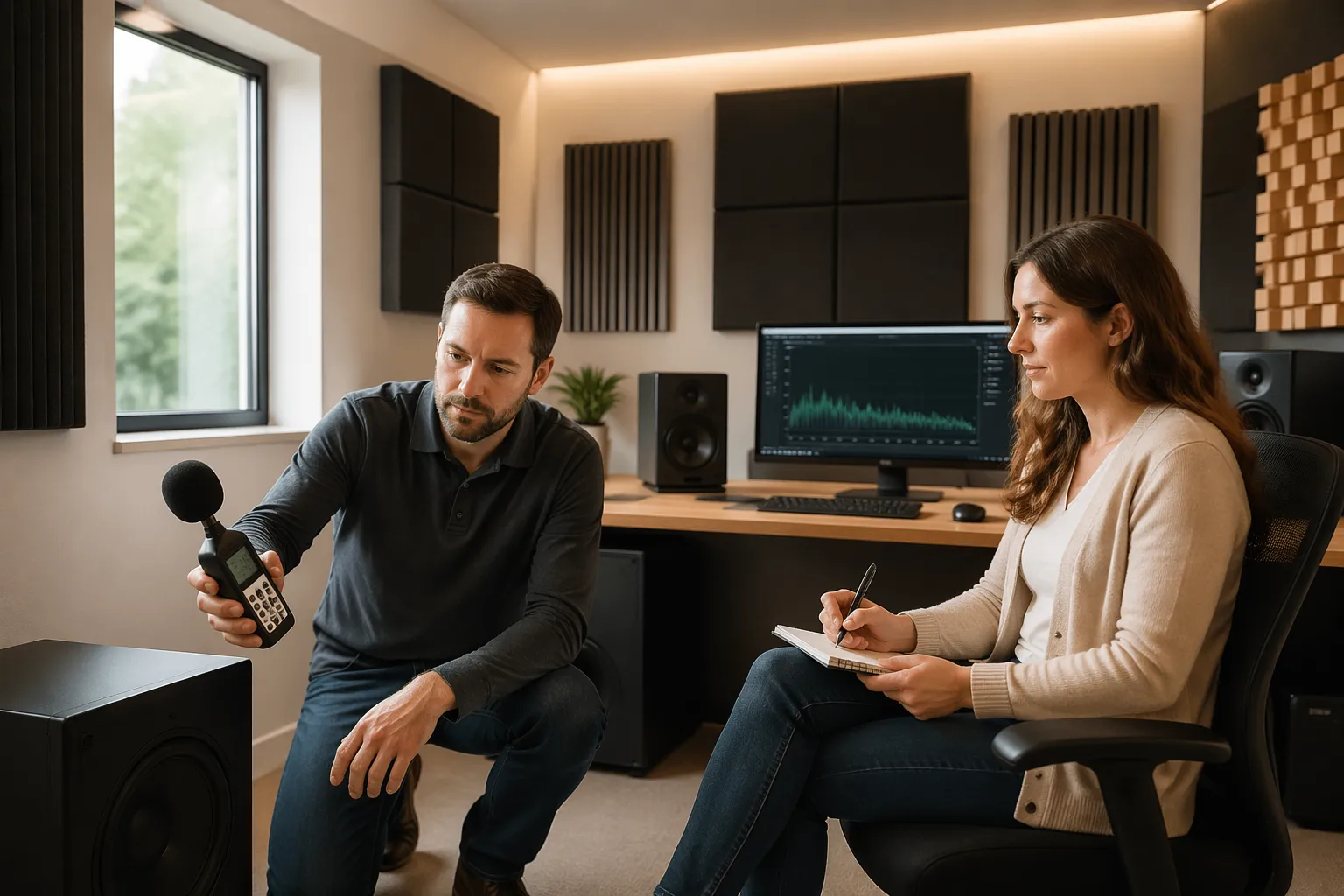
In an L-shaped home office, the “short wall” might dump one speaker into the open leg while the other speaker sees a solid boundary. That imbalance can pull the phantom center to one side and make bass control for an L-shaped home office room harder than it needs to be.
I prefer facing the wall that gives both speakers the most similar side conditions for the first six feet. If that means facing a longer wall so both sides are equally weird, that is often better than one side being a hallway and the other being drywall.
Break the rule when the only “short wall” option forces your desk into the inside elbow of the L. That spot is where pressure builds, and you will end up chasing bass with EQ instead of fixing the room.
Finding a listening position that avoids the worst dips
Your listening position is the biggest bass decision you make, because a null at the chair cannot be fixed with more trap thickness. Move the chair a foot and the 70 Hz hole can turn into a 70 Hz mountain.
Start by avoiding the exact center of any main dimension, because that is where many axial nulls sit. In asymmetrical rooms, “center” is fuzzy, so measure from the wall you face and use that as your baseline.
| Check | What to do in an L-shaped office | What you are trying to avoid |
|---|---|---|
| Front wall distance | Place ears about 35% to 40% of the main run from the front wall | Deep front to back null around 60 to 90 Hz |
| Side symmetry near speakers | Keep left and right speaker-to-side boundary distances within a few inches | Shifted imaging and uneven bass between channels |
| Inside corner proximity | Keep the chair at least 3 feet from the L’s inside corner line | Pressure buildup that exaggerates one or two notes |
| Open leg alignment | Avoid placing ears on the line where the open leg begins | Sharp dips where reflections cancel at the elbow |
Treating the “open leg” vs the “closed leg” of the L
Treatment zoning matters in an L, because the two legs behave differently even if they share the same ceiling height. The closed leg usually stores bass longer, while the open leg tends to create uneven decay and strange cancellations.
On the closed leg, prioritize thick corner trapping and front wall absorption behind the speakers. That area sets the tone for the whole room because it controls the first big pressure zones your monitors create.
On the open leg, you often get more improvement by adding broadband absorption on the first surfaces that “see” the speakers than by adding random traps deep in the hallway. If the open leg is a doorway to another space, treat the near side of the opening like a boundary that needs damping.
If the open leg is full of furniture, use it on purpose and stop pretending it is acoustically invisible. A packed bookcase, a couch, and a thick rug can act like messy broadband damping, and that mess can help bass control for an L-shaped home office room when placed in the right zone.
Using partial walls and inside corners effectively
Partial walls are common in L-shaped offices, like a half wall that separates a desk area from a dining space. Acoustically, that edge is a reflector at some frequencies and a diffuser at others, which is why you hear bass change as you lean left or right.
The inside corner of the L is almost always worth treating, even if you cannot make it pretty. A floor to ceiling bass trap there reduces the pressure spike that makes kick drums sound like they have one note.
If you cannot build a full trap, stack two 4-inch rockwool panels across the corner with a big air gap behind them. The air gap matters, because bass absorption depends on depth more than surface coverage.
Do not ignore the ceiling corner where the partial wall meets the ceiling plane. A simple 2×4 foot panel hung as a corner cloud can calm upper bass ringing that survives even after you treat the floor corners.
What to do when one speaker fires into the bend
Sometimes the only workable desk spot puts one speaker aimed toward the inside bend and the other aimed down a straighter run. That is where asymmetrical rooms punish you with different boundary loading on each channel.
First, get ruthless about speaker distance to the front wall and side boundary, and match those distances left to right as closely as you can. Small mismatches, like two inches, can move a boundary interference dip enough to make bass lines sound lopsided.
Second, treat the near boundaries around the speaker aimed at the bend more heavily, because that side produces stronger early reflections. A thick panel on the wall segment near that speaker and a trap in the adjacent corner often makes the two channels behave closer in the low mids.
Third, consider rotating the whole setup 10 to 20 degrees if it lets both speakers “see” similar geometry for the first reflections. A slightly skewed desk looks odd on paper, but it can beat a perfectly square desk that sounds wrong.
Quick placement moves that change bass before you buy anything
Before you order panels, do two quick experiments, because placement beats product marketing every time. You can often get a cleaner low end with nothing but a tape measure and a willingness to move the desk.
Start by sliding the listening position forward and back in 6-inch steps while playing a slow sine sweep or a bass heavy reference track. Mark the spots where the low end sounds most even, then choose the best compromise for ergonomics and workflow.
- Move the desk 6 to 12 inches off the exact centerline of the main run
- Pull speakers 4 to 10 inches farther from the front wall, then re-check 80 to 120 Hz
- Match speaker-to-side boundary distances within 1 inch
- Try a 10 degree toe-in change, then re-check kick drum weight
- Temporarily block the open leg with a mattress or thick duvet
- Rotate the desk slightly to equalize left and right early reflections
Bass traps that make sense in an L-shaped home office
In an L shape, I would rather see four serious traps in the right places than twelve thin panels scattered like wall art. For bass control for an L-shaped home office room, thickness and placement beat coverage numbers.
Start with the two front vertical corners in the leg where your desk and speakers live, because that is where pressure builds fast. If one of those corners is missing because the room opens, treat the nearest available corner plus the inside corner of the L.
Use at least 6 inches of mineral wool or fiberglass for corner traps, or go thicker if you can, because 2-inch panels do not do much below 150 Hz. If you build superchunks, keep them dense enough to hold shape but not so dense that air cannot move through them.
If you have a back wall close to the listening position, treat it with thick absorption, not just a thin panel. A 6-inch absorber with a gap can reduce the slap of upper bass that makes bass guitars sound like they are stuck to the wall behind your head.
How to handle first reflections without wrecking the room
Even though this article is bass focused, first reflection control changes how you perceive bass, because it cleans up the midrange that defines pitch. When reflections smear the attack of a kick or bass note, you chase “more bass” when the real issue is clarity.
Use the mirror trick on the side walls in the main desk leg, and place 4-inch broadband panels at those points. If one side is open, treat the nearest hard surface on that side, like the partial wall face or a cabinet that sits at reflection height.
Ceiling clouds help a lot in home offices because the desk surface already creates a strong reflection path. Hang a 4-inch cloud above the listening position with a 4-inch gap, and you will usually hear tighter imaging and cleaner low mids.
Do not over-absorb the open leg just because it looks empty, because you can end up with a dead side and a live side. Treatment zoning means you aim for similar decay and reflection behavior left and right near the speakers, even if the architecture is not symmetrical.
Quick checks to confirm you improved the low end
After you move furniture or add traps, you need a reality check that goes beyond “seems better today.” Use repeatable tests, because your ears adapt fast and your brain lies when it wants a win.
Play a sine sweep from 20 Hz to 200 Hz at a steady level and listen for sudden dropouts or notes that jump out. If the sweep sounds smoother at the listening position and less different when you lean side to side, you are heading the right way.
Measure if you can, even with a cheap USB mic like a UMIK-1 and free REW software. You are looking for fewer deep nulls, shorter decay in the 40 to 120 Hz range, and closer left-right matching at the listening position.
Use two or three reference tracks you know well, like a tight kick and bass mix, an acoustic bass recording, and a track with sustained sub notes. When bass control for an L-shaped home office room improves, those references stop changing character every time you shift in your chair.
Conclusion
L-shaped rooms are not a lost cause, but they punish sloppy layout choices and random panel placement. If you treat them like two zones with different behavior, you can make the low end predictable enough to trust.
Start with the listening position, then pick the wall to face based on symmetry near the speakers, not a generic rule about short walls. After that, use treatment zoning to hit the inside corner, the front corners, and the boundaries that shape what each speaker “sees.”
Once the room stops fighting you, mixing gets faster and you stop second guessing bass decisions on every playback system. That is the real payoff of doing bass control for an L-shaped home office room the sensible way.