
Hardwood floors look great in a home office, but they can make low end work feel slippery and unreliable. If you are chasing bass control for a home office with hardwood floors, you need to separate what changes the sound in the air from what only changes vibration through the floor.
I see people buy a thick rug and expect it to fix boomy bass, then wonder why the kick drum still sounds like it is swelling in odd spots. A rug can help, but most of the time it helps the room’s brightness and imaging before it fixes real bass problems.
The good news is you can still get tighter, more readable bass without turning your office into a padded cave. You just have to aim at the right targets, floor reflections, rug thickness, and desk decoupling, then pair those with corner and wall treatment that handles the actual low frequencies.
In a typical home office, you are sitting close to the speakers and close to multiple boundaries, so small changes can feel bigger than they measure. That is why it helps to think in layers, starting with the obvious floor behavior and then moving to the walls, corners, and furniture that actually shape the low end.
You also want to keep expectations realistic, because no rug is going to erase a 40 Hz null caused by your chair being in the wrong spot. The goal is to make the bass easier to judge and less distracting, not to bend physics with a piece of fabric.
What hardwood floors do to perceived bass in a small room
Hardwood is reflective, so a lot of mid and high frequency energy bounces between the floor and ceiling and returns to your ears quickly. That extra brightness can trick you into thinking the bass is weaker than it is, because the top end masks details in the low end.
The bigger bass issue is not the floor acting like a bass mirror, because bass wavelengths are long and do not care much about a thin surface layer. What you hear as “too much bass” is usually room modes, meaning pressure build ups between walls that create peaks and nulls at your chair.
Hardwood does change how the room feels because it reduces damping, so the decay time in the upper bass and low mids can stretch out. That longer decay makes bass notes blur together, so you lose pitch definition even if the level meter says nothing is wrong.
Floor reflections matter most in the 150 Hz and up range, where the bounce off the floor can comb filter with the direct sound from your speakers. That comb filtering can make the bass guitar sound hollow on one note and thick on the next, even though the real culprit is timing and phase, not raw output.
In a small office, the floor bounce is often only a few milliseconds behind the direct sound, which is right in the zone where your ear starts to smear transients. That is why the kick can lose its “click” and the bass can lose its “pluck” even when the speakers are fine.
Hardwood also tends to make the room sound louder at the same volume setting, because less energy is being absorbed by soft surfaces. When the room feels louder, you may turn the speakers down, and that can change how you perceive bass due to normal loudness curves.
If your listening position is centered between side walls or pushed hard against the back wall, you can end up in a deep null that makes bass feel inconsistent. Hardwood does not create that null, but it can make the rest of the spectrum so lively that the missing low end becomes more noticeable.
Another common issue is the desk itself reflecting sound, because the desktop is a big flat boundary close to the speakers. On hardwood floors, people often use lighter desks that resonate more, and that resonance can show up as a midbass “thump” that seems like a speaker problem.
It also helps to remember that “bass” is not one thing, because 60 Hz, 120 Hz, and 200 Hz behave very differently in a small room. Hardwood tends to highlight the 150 to 400 Hz mess first, which is why some people describe the room as “boxy” or “muddy” rather than “boomy.”
If you are working with a subwoofer, hardwood can make setup feel more dramatic because the sub can excite floor and furniture vibration easily. That vibration is not the same as acoustic bass, but it can fool you into thinking the sub is too hot.
The practical takeaway is that hardwood floors mostly change clarity and decay, not the fundamental modal pattern of the room. Once you treat reflections and stop vibration, the remaining bass issues tend to point clearly to speaker placement, chair placement, and corner trapping.
Choosing a rug setup that fits a studio desk area
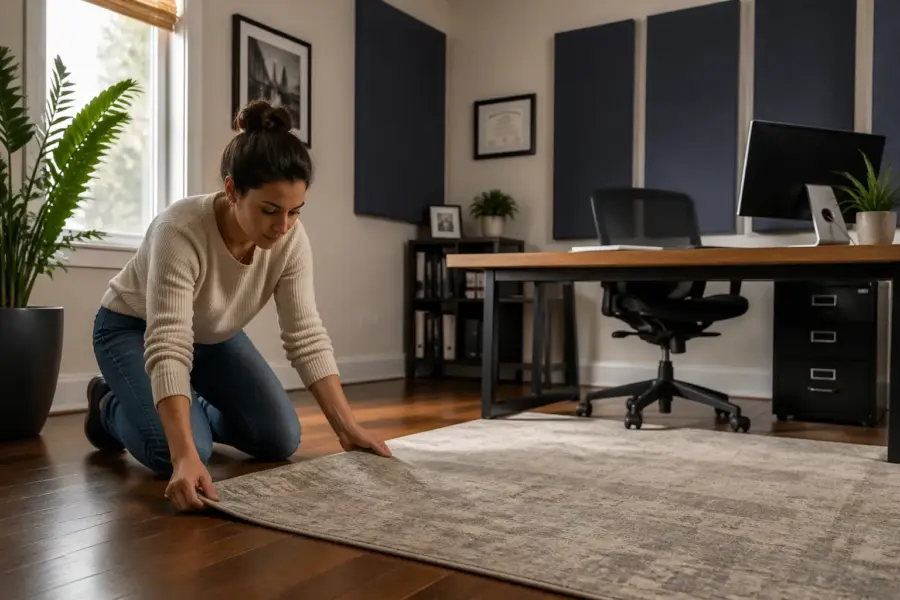
For a desk setup, the rug’s job is to tame early reflections off the floor between your speakers and your ears. You want coverage that starts a little behind the speaker stands and reaches past your chair, because that is the zone where floor reflections hit hardest.
If you can only place a smaller rug, prioritize the area from the front edge of the desk to about a foot behind your seated position. That placement catches the reflection path that messes up imaging and makes bass lines harder to follow.
Rug thickness matters, but not in the way people hope when they want deeper bass control. A thicker pile can absorb more upper bass and low mid energy, which can reduce boominess that lives around 120 to 250 Hz in small rooms.
I like a dense wool rug or a tight synthetic with a heavy face weight, because it behaves more consistently than a fluffy shag. Shag looks thick but often compresses unevenly under chair wheels, and that makes your reflection control patchy across the listening area.
Size is usually more important than style, because a rug that is too small leaves a hard reflective “ring” around it that still sends energy back to your ears. A larger rug gives you a wider zone of consistent absorption, which makes the stereo image and midbass feel more stable.
If you are using a rolling chair, plan for a chair mat or a rug that can handle the wear without creating grooves. Those grooves can become little channels that change how the chair sits, and that changes your ear height and listening angle more than you might expect.
A flatweave rug can be a good compromise if you hate the feel of thick pile under a desk chair. You will not get as much absorption from the rug itself, but you can pair it with a better pad and still reduce the worst floor slap.
Pattern and color do not matter for acoustics, but they do matter for how willing you are to keep the rug in place. A rug you like looking at is a rug you will keep positioned correctly, which is a bigger win than buying the “perfect” material and then sliding it out of the way.
Be careful with very soft rugs that feel like a mattress, because they can make speaker stands less stable if the stands sit on the rug. If the stands sink unevenly, you can end up with tiny tilt changes that shift the high frequency aim and alter the perceived bass balance.
For nearfield monitoring, you generally want the rug centered on the listening axis, not just centered in the room. That means you may end up with the rug slightly off-center relative to the walls, and that is fine as long as the speaker-to-wall distances stay symmetrical.
If your office is also a video call space, a rug can reduce the “hard room” sound in your voice and make the mic less sensitive to room tone. That improvement is mostly in the mids, but it makes the whole space feel more controlled, which helps you trust what you hear.
Do not forget the path between the speakers and your ears includes the space under the desk, which can be a reflective tunnel. A rug that extends under the desk a bit can reduce that under-desk bounce and make the low mids less nasal.
If you have pets, avoid rugs that shed heavily, because fibers can get into speaker ports and under isolation pads. It is not a huge acoustic issue, but it becomes a maintenance problem that quietly ruins your setup over time.
What to put under the rug (and why it matters)
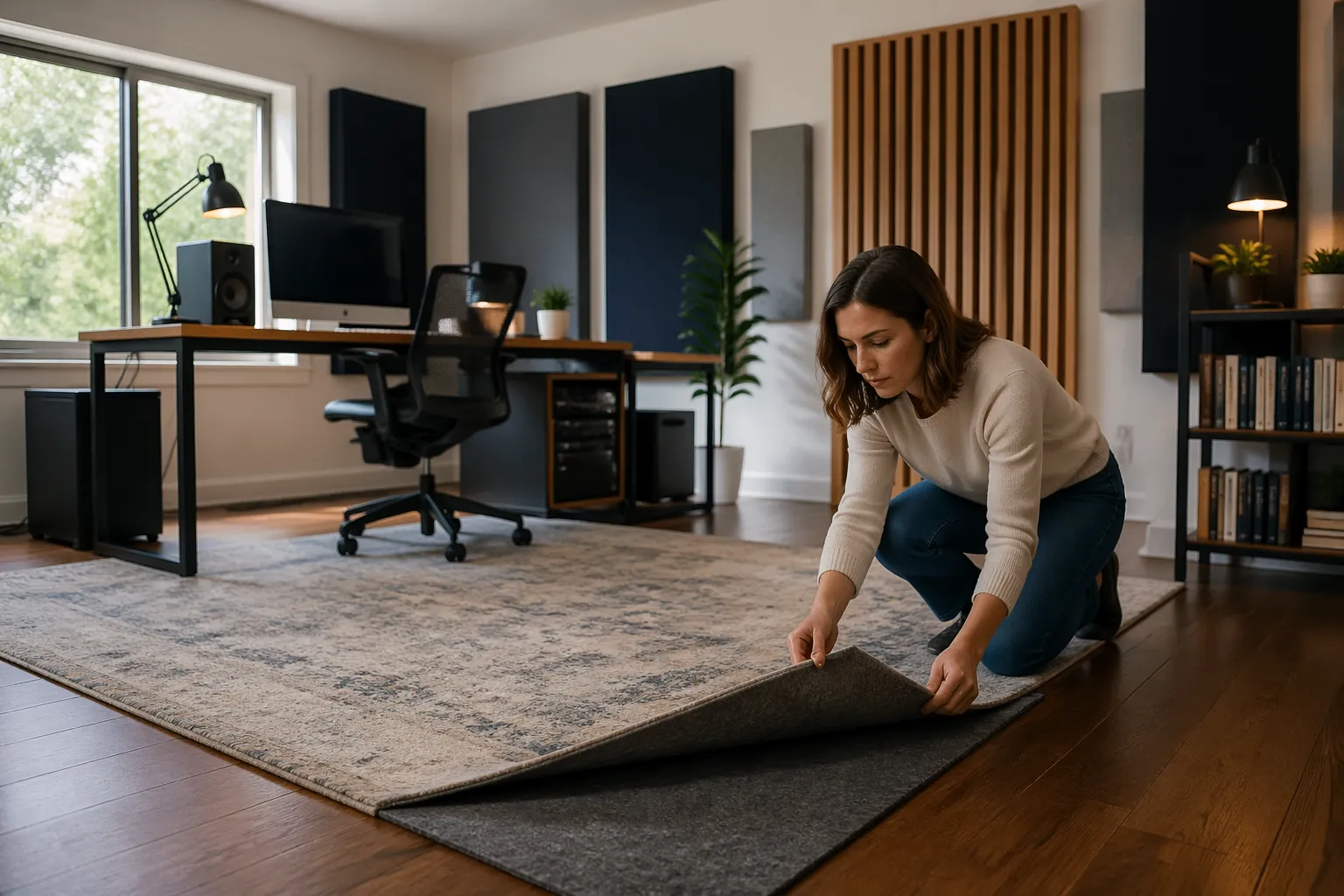
The pad under a rug changes two things, how much the rug can move, and how much air space and compliance you add beneath the fibers. That second part is where you can get a small but real improvement in low mid absorption, especially if the pad is thick and slightly springy.
A cheap thin felt pad mainly keeps the rug from sliding and protects the finish, but it does little for sound. A thicker rebond or rubber pad can help a bit with floor reflections and can reduce some floor transmitted vibration from chair and foot movement.
Think of the rug and pad as a system, because a great rug on a useless pad often performs like a mediocre rug on a decent pad. The pad also keeps the rug from compressing directly onto the hardwood, which helps it stay consistent over time.
In acoustic terms, the pad can add a little bit of “spring” that lets the rug fibers move and dissipate energy. It is not bass trapping, but it can take the edge off the low mid ring that makes small rooms sound stressed.
Rubber pads tend to grip well, which is great if you are constantly shifting your chair and the rug creeps forward. The downside is some rubber pads have a strong smell at first, and that can be annoying in a small office with the door closed.
Dense felt pads are underrated because they add thickness without feeling bouncy under a chair. That matters when you want a stable chair position and you do not want your posture changing every time you lean back.
Rebond pads can add comfort and a bit more absorption, but they can also make chair wheels dig in. If you go rebond, it helps to use a chair mat or switch to softer wheels designed for rugs.
Acoustic underlayment mats are usually sold for impact noise, which is a different problem than bass response at your ears. They can still be useful if you are in an apartment and you want less footfall noise transferring to neighbors, even if your mix position does not change much.
A pad also protects the hardwood finish from grit that gets trapped under the rug and acts like sandpaper. That is not a sound problem, but it is part of keeping the room usable, and a room you can live with is a room you will actually treat properly.
If you want to maximize acoustic value, avoid pads that are basically plastic mesh with holes, because they do not add meaningful thickness or damping. Those pads can stop sliding, but they rarely change reflections in a way you can hear at the desk.
One simple check is to press down with your hand and see if the rug and pad compress evenly across the listening zone. If it feels firm in one spot and squishy in another, you will get uneven reflection control and inconsistent chair height.
| Under-rug option | What it changes most | Best use in a home office |
|---|---|---|
| Thin felt pad (1/8 inch) | Stops sliding, minimal acoustic change | Protecting hardwood, basic comfort |
| Dense felt pad (3/8 inch) | Better reflection softening in low mids | Desk zone coverage without too much squish |
| Rebond pad (3/8 to 1/2 inch) | Adds compliance, slightly more absorption | Rug thickness boost for brighter rooms |
| Rubber pad (1/4 to 3/8 inch) | Grip and some vibration reduction | Under chairs and near stands to cut rattles |
| Acoustic underlayment mat (1/4 inch) | Impact noise reduction, modest damping | Shared floors, apartments, footfall control |
If you are trying to keep the room flexible, consider using two smaller rugs with pads instead of one huge rug. That approach lets you cover the reflection zone and the chair zone separately, and it is easier to reposition when you change the desk layout.
Whatever pad you choose, make sure it is safe for your specific floor finish, because some rubber and latex products can discolor certain hardwood coatings. It is worth checking the manufacturer notes so your acoustic experiment does not become a flooring repair project.
Reducing floor-coupled vibration from stands and furniture
There is a difference between bass in the air and vibration through the building, and hardwood makes the second one obvious. If your desk buzzes, your mic stand rings, or your monitor stand walks, you need isolation, not more absorption.
Start with your speaker stands, because they are the biggest vibration injectors in a small office. Put the stands on isolation pads or small isolation platforms, and make sure the stand itself is stable and not rocking on uneven boards.
Desk decoupling matters when the speakers sit on the desk, because the desktop becomes a radiator and smears the low end. A pair of decent foam or elastomer monitor isolators can clean up the midbass, and it often improves stereo focus right away.
For furniture, check the easy stuff that people ignore, loose drawer faces, cable trays, and the back panel of an Ikea shelf. A small strip of adhesive felt, a bit of Blu Tack, or tightening hardware can remove a rattle that you keep mistaking for “bad bass.”
If you are using a subwoofer, try it on an isolation platform before you change any EQ settings. Sub vibration through hardwood can make the whole room feel like it is overloading, even when the acoustic response at the chair is not that extreme.
Spikes are often misunderstood, because they can couple a stand to the floor rather than isolate it. On concrete that can be fine, but on a suspended hardwood floor it can make vibration transfer worse, so pads are usually the safer bet.
Pay attention to what touches what, because vibration loves bridges. A stand that lightly touches the desk, or a cable that is taut between a speaker and a shelf, can transmit buzz that you will hear as a low end “fuzz” on certain notes.
Cable management helps more than people admit, because loose cables can slap the wall or the back of the desk when bass hits. A few Velcro ties and some slack in the right places can remove noises that are hard to identify by ear.
Printers, external hard drives, and even desk lamps can resonate sympathetically with bass. If something on the desk “sings” at 80 Hz, move it or put a small piece of foam under it before you blame the speakers.
Bookshelves and cabinets can act like big panels that flex and radiate sound. Adding mass inside them, like books or storage boxes, can reduce that panel resonance and make the bass feel less smeared.
If your chair squeaks or rattles, it can mask bass detail because your brain starts focusing on the mechanical noise. A little lubricant or tightening bolts can improve your listening more than another plugin ever will.
When you test isolation, do it with a repeatable signal like a steady kick loop or a 60 Hz tone. You want to hear whether the room stops buzzing and whether the bass becomes cleaner, not just whether it feels different under your feet.
Also watch for monitor screens and desk accessories that wobble, because that motion is a clue that energy is going into the furniture. If you can see it shaking, you can be sure it is adding its own little distortion to what you hear.
Pairing floor fixes with wall and corner treatment
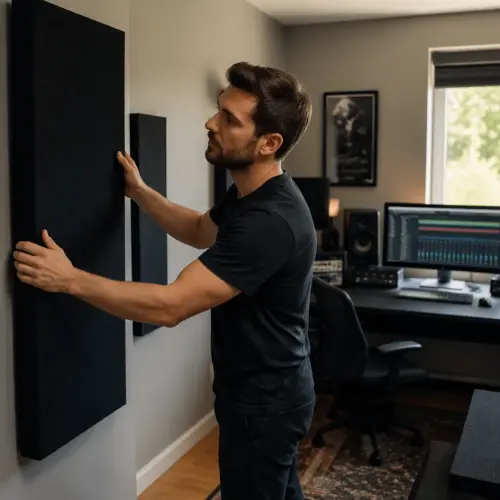
If you want bass control for a home office with hardwood floors, the floor work is only a supporting move. The heavy lifting comes from bass traps in corners and thick absorption at the first reflection points on the walls.
Corner traps work because they sit where pressure tends to build, and that is where small room bass problems live. A four inch thick panel straddling a corner with an air gap beats a thin “foam bass trap” almost every time.
Wall panels handle the early reflections that make the room sound harsh and can mess with bass perception through comb filtering. Treat the side walls and the ceiling cloud if you can, because that lowers the overall decay and makes the low end easier to judge.
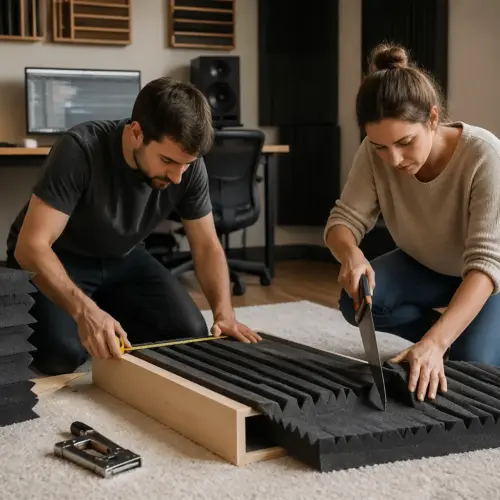
Do not expect a rug to replace treatment that is six inches thick and filled with mineral wool. Rugs are great for floor reflections, but real bass trapping needs depth, surface area, and placement that matches how modes behave.
If you are limited on space, start with the front wall corners behind the speakers, because those corners often take the biggest hit from low frequency buildup. Even two good traps can reduce the “lumpy” feeling where some notes jump out and others vanish.
Back wall treatment matters more than people think in a desk setup, because the reflection off the wall behind you is strong and arrives late enough to blur bass definition. A thick absorber or a combination of absorption and diffusion can make the low end feel less detached from the mix.
First reflection points are not just a high frequency issue, because the timing of those reflections affects the whole tonal balance. When the midrange cleans up, you can set bass levels more confidently and you stop overcompensating with EQ.
A ceiling cloud is especially helpful in rooms with hardwood, because the floor-ceiling bounce is one of the strongest early reflection paths. If you cannot hang a cloud, even a thick absorber mounted high on the front wall can take some energy out of that loop.
Placement is where most DIY treatment fails, because people put panels where they look nice instead of where they work. Use the mirror trick for side walls and aim for symmetry, so the left and right reflections are controlled the same way.
If you are using a subwoofer, consider multiple subs or at least flexible placement, because that can smooth modes more effectively than adding more rugs. The floor can make the sub feel powerful, but the walls and corners decide whether it is accurate.
Do not ignore the door and window surfaces, because they can reflect and also rattle. A heavy curtain can help with brightness and some midrange control, and weatherstripping can reduce buzz that shows up when bass hits.
Once you have basic trapping and reflection control, speaker and chair placement becomes easier to dial in. Small moves, like shifting the desk a few inches off the centerline, can reduce a stubborn null more than any rug change.
The goal is a room that decays evenly, where bass notes stop in a predictable way instead of hanging around. When the decay is controlled, you can hear compression and EQ moves clearly, which is what “bass control” really means in daily work.
Listening checks to confirm improved bass clarity
After you add a rug and pad, listen for changes in the attack of bass notes, not just the amount of bass. Clearer bass usually sounds like the front edge of a kick drum is easier to place in time, and the bass guitar has more pitch and less “one note” bloom.
Use a few tracks you know well and keep the volume consistent, because louder always sounds better for a minute. I like using a simple sine sweep too, because it makes peaks and nulls obvious and shows whether floor reflections were part of what you were hearing.
When you do your checks, sit in your normal working posture, because leaning forward or back changes your ear position relative to modes. A two inch change can shift a null enough to make you think the rug “fixed” something that was really just a seating change.
Pay attention to the low midrange, because that is where rugs and pads often make the most audible difference. If vocals and guitars feel less cloudy, you will usually find that bass decisions become easier right after.
Try listening at a slightly lower volume than usual for a few minutes. If the bass stays readable at low volume, that is a good sign the room is not relying on loudness to feel balanced.
Use a kick and bass heavy track that has clean production, because messy mixes can hide room problems. If the reference track still sounds uneven in your room, that points to placement or treatment rather than the mix itself.
A simple test is to mute one speaker and listen in mono for a moment. If the bass changes drastically when you switch between left and right, you may have asymmetry in the room or uneven reflection control on the floor and side walls.
Another useful check is to play a repeating bass line and rotate your chair slightly left and right. If the bass character changes with small head turns, you are hearing strong early reflections and you likely need better reflection treatment, not more sub level.
If you measure with REW, look at decay plots as well as frequency response. A rug might not flatten the response much, but it can shorten decay in the low mids, and that is often what you perceive as “tighter bass.”
When you run a sweep, listen for buzzing objects as much as you listen for peaks. A clean sweep with fewer rattles is a real improvement, because it means less mechanical noise is riding on top of your bass.
Give your ears time to adjust after each change, because your brain normalizes the sound quickly. A quick A/B is useful, but a longer listen tells you whether the improvement holds up during real work.
- Play a 30 to 300 Hz sine sweep at moderate volume
- Walk the room and note where bass disappears or piles up
- Clap once at the desk and listen for sharp floor slap echo
- Toggle speaker isolation pads on and off for a quick A/B
- Check for desk and shelf rattles with a 60 to 90 Hz tone
- Measure with REW at the chair before and after changes
If you do not have measurement gear, use a phone SPL app just to keep levels consistent between tests. It will not be lab accurate, but it can stop you from accidentally judging “better” as “louder.”
Finally, check translation by listening on headphones right after you listen in the room. If your room improvements are real, the balance decisions you make should feel closer to what you hear on headphones and in the car.
Conclusion
Hardwood floors rarely create bass problems by themselves, but they do make floor reflections and vibration issues easier to hear. A smart rug and pad setup can calm the room down, and it often makes your low end decisions more consistent.
If you want real bass control for a home office with hardwood floors, treat the corners and first reflection points, then use desk decoupling and stand isolation to stop the room from buzzing along. When you confirm the results with a sweep and a few trusted tracks, you end up with bass that is easier to mix and easier to live with.
The best outcome is not a room that sounds dead, but a room that sounds predictable. Once the floor is handled and the low end is supported by proper trapping, you can work faster because you are not second guessing every bass move.
Hardwood can stay part of the look of your office without sabotaging the sound. With the right rug coverage, a sensible pad, and a few targeted treatment pieces, you get clarity and comfort without losing the character of the space.