


Most people shopping for acoustic panels fixate on one number, the NRC, and then wonder why their room still sounds boxy on calls. That confusion is exactly why an acoustic panel NRC rating explained in plain English matters more than another product photo.
NRC can help you avoid junk panels, but it can also trick you into buying the wrong thickness, the wrong material, or the wrong coverage for your home office. If you care about speech clarity, less reverb, and less fatigue at the end of the day, you need to read past the headline rating.
Panels are tested in labs, rooms are messy, and your microphone hears problems your ears ignore. Once you understand how NRC is calculated, and how the sound absorption coefficient changes by frequency, you can predict what a panel will do in your real space.
The goal is not to memorize standards or become an acoustician overnight. The goal is to stop buying panels like they are towels and start buying them like they are tools with specific strengths and limits.
If you have ever added “high NRC” foam and ended up with a room that feels dull but still sounds echoey on the mic, you have already met the limits of the one-number approach. The good news is that the fix is usually about smarter placement and better low-mid absorption, not spending twice as much.
It also helps to separate two different problems that get mixed together online: reducing reflections inside the room versus blocking sound from leaving the room. NRC is about absorption, not isolation, and confusing those two leads to a lot of disappointment.
What NRC actually measures (and what it ignores)
NRC, or Noise Reduction Coefficient, is a single-number average of how much sound a material absorbs in the midrange. In most standards, it averages absorption coefficients at 250, 500, 1000, and 2000 Hz, then rounds to the nearest 0.05.
That means NRC is mostly a speech-band summary, and it is why it correlates with “less slap echo” when you clap in a bare room. It also means NRC can look great while bass and low mids still bounce around and make your voice sound thick and boomy on Zoom.
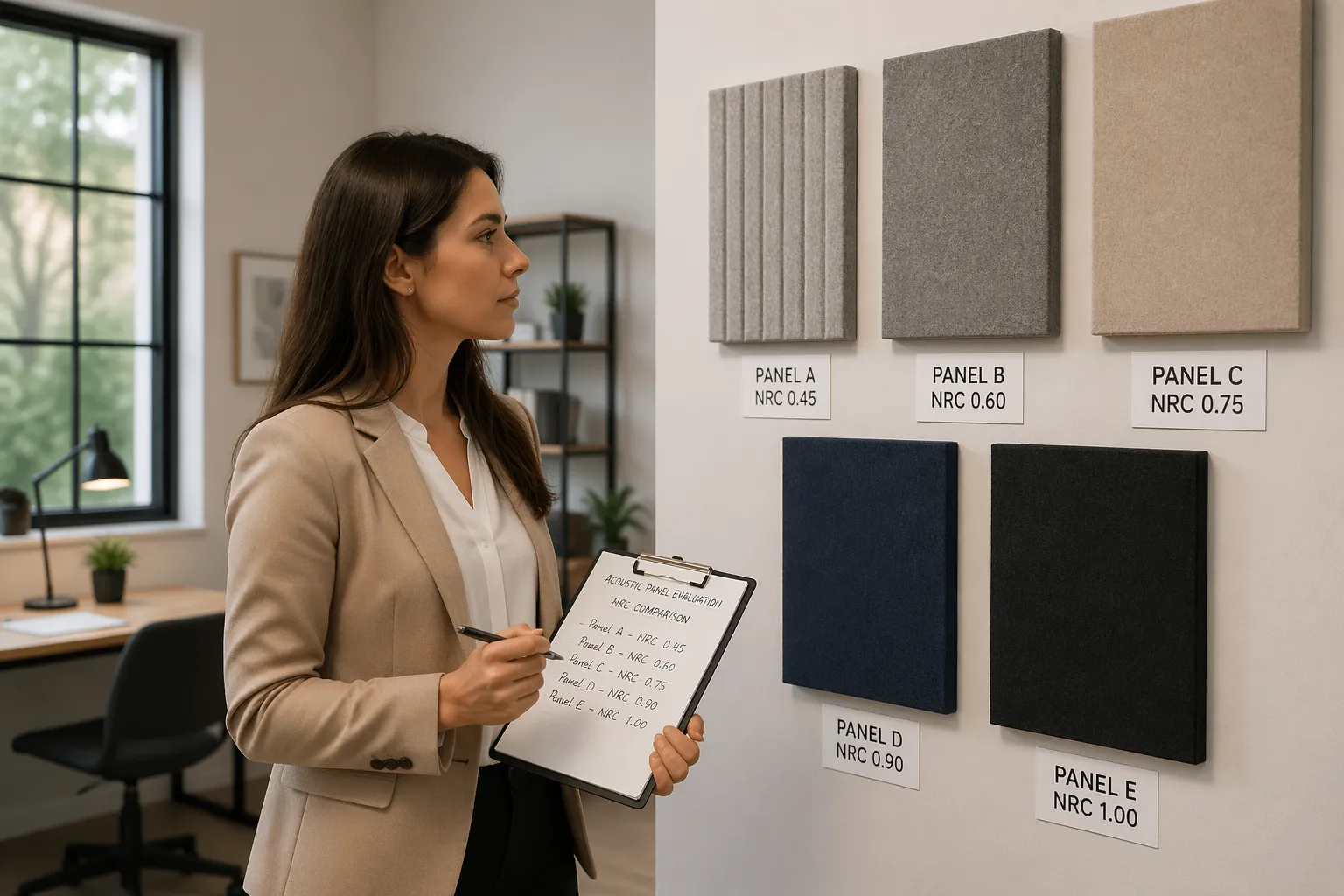
NRC ignores what happens below 250 Hz, where small rooms often have the worst problems. If your office is 9 by 11 feet with an 8-foot ceiling, the room modes that make certain notes or syllables swell live far below what NRC reports.
NRC also ignores direction, placement, and coverage, which are the make-or-break factors in home offices. A high-NRC panel behind your chair does little if the main reflections are coming off the wall in front of your mic and the ceiling above your desk.
Another thing NRC ignores is time, meaning how long the sound hangs around after you speak. Two rooms can have the same “general” loudness but very different decay, and that decay is what makes speech feel clean or smeared.
NRC also does not tell you anything about diffusion, which is a different strategy that scatters sound instead of soaking it up. Some rooms feel better with a bit of scattering on the back wall, but NRC will not help you decide that.
Even within absorption, NRC does not tell you whether the panel is broadband or narrowband. A panel can earn a strong midrange average while being weak at 250 Hz, and that weakness is often where “cardboard box voice” lives.
People also assume NRC is capped at 1.00, but you will sometimes see numbers like 1.05 or 1.10. That does not mean the panel breaks physics, it usually means the test method and mounting allow the panel to absorb more than the area-based reference in that band.
The test environment matters too, because NRC is measured in a reverberation room with specific assumptions about random incidence. Your office is not a random-incidence space, it is a set of strong early reflections from nearby boundaries.
Finally, NRC does not account for what your microphone emphasizes, which is why it can feel like the room sounds “fine” until you hear a recording. Mics tend to make early reflections and comb filtering obvious, and those are more about placement than a single rating.
How to read absorption coefficients by frequency
The real data lives in the absorption coefficients, sometimes called the sound absorption coefficient, listed by frequency band. These numbers run roughly from 0.00 to 1.00, where 0.70 at 500 Hz means about 70 percent of incident energy is absorbed in that band under the test method.
A frequency absorption chart shows you whether a panel is only “brightening” the room by soaking up highs, or actually controlling the lower mids that make speech muddy. For calls and voice recordings, the 250 to 1000 Hz region matters more than many people expect, because that is where room coloration shows up as honk and boxiness.
When you see a chart where 125 Hz is 0.10, 250 Hz is 0.30, and 500 Hz jumps to 0.85, you are looking at a panel that will tame flutter echo but will not touch the “thump” of a desk, floor, or corner buildup. That can still be the right choice if your goal is less harshness, but it is a bad surprise if you expected “studio sound.”
Watch for suspiciously smooth curves with no test standard named, because real lab data has bumps and quirks. If a seller refuses to show a frequency absorption chart, treat the NRC like a marketing sticker and shop elsewhere.
Start by finding the 125 Hz and 250 Hz numbers, because those are the early warning signs for whether a panel is basically thin treatment. If those numbers are low across the board, the panel is likely to reduce hissy reflections but leave the room’s weight and bloom untouched.
Next, look at 500 Hz, because it is the pivot point where many panels go from mediocre to effective. If 500 Hz is strong but 250 Hz is weak, you can expect a room that sounds less “zingy” but still a bit congested.
Then check 1000 Hz and 2000 Hz, because these bands affect intelligibility and the sense of “closeness” on a mic. Too much absorption only up high can make speech feel lisped or overly dry while still leaving low-mid reflections to smear the body of words.
It also helps to notice whether the chart includes 4000 Hz, because that is where cheap foam often looks impressive. If the panel is only a hero at 4000 Hz, it may be doing the least important work for voice and the most obvious work for “deadening” the room.
Be careful with charts that do not list the exact mounting condition, because the same panel can measure very differently when spaced off a wall. A panel that looks average when mounted flat can become meaningfully better in the low mids with a gap, and you want to know what you are actually buying.
If you want a simple mental model, think of absorption coefficients as a “where does it work” map rather than a grade. The best panel for your room is the one that targets your problem bands, not the one that wins a generic average.
Also remember that coefficients are measured per panel area, so they do not automatically tell you how much coverage you need. A great chart does not save you if you only treat a tiny patch of wall and leave the main reflection paths untouched.
NRC vs SAA vs “studio grade” marketing claims
NRC is common because it is easy to print, but SAA, or Sound Absorption Average, uses more frequency points and avoids the rounding that can hide differences. When you compare NRC vs SAA, you are basically comparing a coarse average to a slightly more detailed average, and neither replaces the full coefficient table.
“Studio grade” is not a standard, and it often means “we used thicker fiberglass” or “we wrapped it in nicer fabric,” not that it solves your specific room problems. If you want an acoustic panel NRC rating explained in a way that protects your wallet, treat “studio grade” as a vibe until you see real test data.
SAA can be helpful when two products have the same NRC but clearly different curves, because the extra bands make it harder to hide a weak spot. It still will not tell you whether the panel is good at 125 Hz, but it can reduce the chance that rounding masks a real difference.
Some brands also lean on phrases like “professional acoustic treatment” or “broadcast quality,” which sound reassuring but do not define performance. If the listing does not show thickness, core type, and a real test report, those phrases are basically decoration.
Another common claim is “soundproofing,” which is almost always the wrong word for what a wall panel does. Absorption reduces reflections inside the room, while soundproofing requires mass, sealing, and decoupling to stop sound transmission.
If you are trying to keep your voice from bothering the next room, NRC will not answer that question. You would need isolation data like STC, plus construction details, and even then the weak link is usually the door, vents, or gaps.
Be skeptical of “blocks bass” claims, because bass is the hardest part to absorb with thin panels. Real bass control usually means thicker treatment, corner traps, or a lot of surface area, and the data should show improvement down low.
Even the word “fiberglass” gets used loosely, and there is a difference between dense rigid boards and fluffy insulation. The core density and thickness interact, and a vague material description makes it hard to predict performance.
One more marketing trick is to show a single impressive number without explaining the mounting, because the mounting can inflate results. If the test used a big air cavity behind the sample, the panel may not perform that way when you hang it like a picture frame.
| Label you see | What it usually means | What to ask for |
|---|---|---|
| NRC 0.90 | Rounded average at 250-2000 Hz | Full absorption coefficients table by frequency |
| SAA 0.95 | Average over more bands, less rounding | Test standard (ASTM C423, ISO 354) and mounting type |
| “Studio grade” | Marketing term, no fixed definition | Core material, thickness, density, edge construction |
| “Blocks bass” | Often confusion between absorption and isolation | Data below 250 Hz, plus room layout recommendations |
When you see a table like this, the key is to treat it as a translation guide rather than a verdict. You are converting a sales label into a list of questions that force the product into measurable terms.
If a brand answers those questions clearly, it is usually a sign they have nothing to hide. If they dodge, you are probably looking at a panel that is fine for decoration but unpredictable for acoustics.
Matching NRC to your home office goals (calls, voice, listening)
For video calls, you want less early reflection energy hitting the mic, especially from the wall behind your monitor and the ceiling above the desk. A panel with NRC around 0.70 to 1.00 can work well if it also has decent 250 Hz absorption, because that is where “roomy” speech starts.
For spoken-word recording, your tolerance for coloration is lower, and you should care more about the frequency absorption chart than the headline NRC. I would rather have a slightly lower NRC panel that holds up at 250 Hz than a flashy NRC 1.05 panel that only wins at 1000 and 2000 Hz.
For music listening at a desk, the goal shifts toward balanced decay, not dead highs with lingering low mids. If you treat only with thin foam, cymbals and consonants get dull while kick and lower vocals still smear, and that mismatch is tiring.
Room size matters, because small offices push more energy into the low mids and bass relative to the space. In a typical spare-bedroom office, you often need a mix of broadband panels and at least some corner treatment, even if your main use is meetings.
For calls specifically, you can often get a big improvement with a modest amount of treatment if you hit the first reflection points. That usually means the wall you face, the side wall nearest the mic, and the ceiling area above the desk.
If you use a laptop mic or a webcam mic, the mic is farther from your mouth and it hears more of the room. In that case, absorption and placement matter even more than they do with a close dynamic mic on a boom arm.
If you use a cardioid mic, remember that cardioid rejects the rear more than the front, so reflections in front of the mic can be the real problem. A lot of people treat the wall behind the mic and then wonder why the recording still sounds like a bedroom.
For voiceover, you are usually chasing a controlled, repeatable sound that survives compression and noise reduction. A room that is slightly reverberant can sound fine live, but it often falls apart once you start processing the audio.
For listening, you may care about stereo imaging and center clarity, which can be harmed by strong sidewall reflections. A couple of well-placed broadband panels can do more than a whole wall of thin foam when the goal is accuracy rather than “deadness.”
It also helps to decide whether you want the room to feel quiet or just sound clean on mic, because those are different experiences. A treated room can still have outside noise, and an untreated room can still feel quiet while sounding reflective on recordings.
If your office has hard floors, a rug can reduce high-frequency bounce, but it will not replace wall and ceiling treatment. Floors tend to create strong early reflections into desk mics, and that is why ceiling panels or a cloud can be surprisingly effective.
If your office is full of bookshelves and soft furniture, you might already have some high-frequency absorption and scattering. In that case, you may need fewer “NRC hero” panels and more targeted low-mid control with thicker pieces.
A useful way to think about goals is to pick one primary use case and optimize for it, then accept tradeoffs. A room optimized for voice can feel too dry for casual music, and a room optimized for music can leave a little more life than you want for narration.
Why thickness and air gap change real-world performance
Thickness changes where a panel starts to work, and it is the reason two panels with similar NRC can behave very differently in your room. A 1-inch panel can score a respectable NRC because it absorbs well above 500 Hz, but it usually struggles where speech warmth and room boom live.
A 2-inch mineral wool or fiberglass panel is the practical baseline for home offices, because it starts to bite into 250 Hz in many mountings. A 4-inch panel goes lower still, and it is often the first step that makes a small room sound less “closet-like” on recordings.
An air gap behind a panel acts like free thickness, and it can shift absorption downward without changing the face size. If you mount a 2-inch panel with a 2-inch gap, you often get noticeably better low-mid control than the same panel glued flat to drywall.
Mounting details are why lab results can mislead, because the test might use a specific backing condition that you never replicate at home. When a product page shows great numbers, check whether the test used a Type A, Type E, or other mounting method, because that can be the difference between “helps a bit” and “finally sounds clean.”
The physics behind this is simple enough to use without overthinking it: lower frequencies have longer wavelengths and need more depth to be absorbed effectively. Thin panels can only interact strongly with the pressure changes near the surface at higher frequencies.
That is why a thin foam tile can make a room feel less bright while leaving the “chest” of the voice untouched. The mic still hears the low-mid reflections, and those are the ones that create the hollow, room-in-a-room vibe.
Density matters too, but it is not a simple “more is better” rule. Very dense material can reflect more at some frequencies, while very fluffy material can underperform if it is too thin, so thickness and density have to be considered together.
Air gaps work because they move the absorber away from the wall where particle velocity can be higher at certain frequencies. In practical terms, spacing a panel off the wall helps it “grab” more of the energy that would otherwise bounce back into the room.
Ceiling clouds are basically air-gap treatment by default, because they hang below the ceiling. That is one reason a cloud can make a desk mic sound dramatically cleaner even when wall panels alone did not finish the job.
Framing and backing also change performance, because a rigid frame can reduce edge absorption while a breathable wrap can keep it more broadband. If a panel has a hard backer, it may behave more like a reflector at some frequencies when mounted with no gap.
There is also a comfort and aesthetics angle, because thicker panels stick out more and can feel visually heavy. If you cannot tolerate 4-inch panels everywhere, a smaller number of thicker panels in key spots can beat a larger number of thin panels spread randomly.
Corner placement is a special case, because corners tend to accumulate low-frequency pressure in small rooms. Even if your panels are not “bass traps” in the strict sense, putting thicker absorption in corners can still reduce the low-mid buildup that makes speech sound congested.
If you are renting and cannot drill, you can still create an air gap by using stand-off mounts, freestanding gobos, or even leaning panels safely with a spacer. The performance difference between flush-mounted and gapped is often larger than people expect.
All of this is why two panels can share an NRC but deliver totally different results in a home office. NRC compresses the story into one number, while thickness and mounting determine where the panel actually does the work.
A simple way to compare panels before you buy
If you only compare NRC, you will overpay for panels that win on paper while missing your problem frequencies. A better quick test is to compare the 125, 250, and 500 Hz absorption coefficients side by side, because those bands predict whether the room will still sound thick after treatment.
I use a short checklist and I stick to it, because shopping pages are designed to distract you with fabrics and “pro” language. If a seller cannot answer these items clearly, I assume the data is weak and I move on.
When I compare two panels, I also normalize for thickness, because a 4-inch panel should not be judged like a 1-inch panel. If a thick panel has only a slightly better low-mid coefficient than a thin one, that is a red flag that the numbers may be inflated or the construction is not doing what you think.
I also look for the test report date and the lab name, because serious brands usually have that paperwork ready. A screenshot of a chart with no context is not the same as a report tied to a standard.
Another quick comparison is weight, because it hints at the amount of real absorber material inside. Two panels with the same dimensions but very different weights are rarely equivalent in performance.
Dimensions matter in a practical way too, because coverage is what turns absorption into audible change. A couple of tiny panels can have perfect coefficients and still do almost nothing if they do not intercept the main reflection paths.
I also pay attention to whether the fabric is acoustically transparent, because some decorative fabrics can reflect highs and reduce the panel’s effective bandwidth. If the fabric feels like a windbreaker, it is probably not helping your absorption.
Edge construction is not just aesthetics, because open edges can add a bit of extra absorption area. A fully sealed frame can be durable, but it can also reduce how much the panel breathes at the sides.
If you are trying to treat a call setup, I would rather see a seller provide placement guidance than a bigger NRC number. Good placement advice signals they understand the real-world problem, which is reflections hitting a mic, not just reverberation in a lab room.
- Full absorption coefficients table (125 to 4000 Hz)
- Named test standard, ASTM C423 or ISO 354
- Mounting type used in the test report
- Panel thickness and core material type
- Edge style, wrapped, framed, or open edge
- Real dimensions and weight per panel
Once you have this information for a few options, you can make a fair comparison without getting hypnotized by branding. You are basically building a simple spec sheet in your head that reflects how the panel will behave in your room.
If you want to go one step further, sketch your desk and mark the likely reflection points, then estimate how many square feet of coverage you can realistically add. That makes the shopping decision feel less like gambling and more like matching parts to a plan.
It also helps to set a target like “treat the wall in front of the mic and the ceiling above the desk first,” because that prevents random panel placement. Random placement is how you end up with a room that looks treated but still sounds reflective where it counts.
If you are on a budget, prioritize fewer better panels over many weak ones, especially if you can add an air gap. A small amount of effective low-mid absorption beats a large amount of high-only absorption for voice clarity.
Conclusion
NRC is useful, but it is a blunt tool, and it can hide the exact frequencies that make home offices sound cheap on calls. When you want the acoustic panel NRC rating explained in a way that leads to good results, you always end up back at the sound absorption coefficient data by frequency.
Use NRC and NRC vs SAA as quick filters, then read the frequency absorption chart, check thickness and mounting, and buy panels that match your goal instead of a single number. Do that, and your room will sound calmer, clearer, and more natural without turning into an over-deadened cave.
If you remember only one rule, make it this: prioritize performance at 250 to 500 Hz, because that is where most “home office boxiness” lives. High-frequency absorption is easy to buy, but low-mid control is what makes the room sound expensive.
After you install panels, give yourself a day to adjust and then do a simple before-and-after recording from your normal seating position. Your ears adapt quickly, but recordings do not lie, and they will tell you whether you treated the right surfaces.
If the room still sounds roomy, it usually means you missed a reflection path, not that you need a higher NRC number. Move one panel to the wall in front of the mic or add a ceiling cloud, and you will often hear a bigger change than swapping brands.
Acoustic treatment is one of the few upgrades that improves every call, every recording, and every hour you spend working. When you shop with coefficients, thickness, and mounting in mind, you stop chasing numbers and start getting predictable results.