
Low bass is the part of home office audio that makes people swear their panels “did nothing.” Most of the time the panels did something, just not where the problem lives.
If you mix, edit podcasts, or take calls in a small room, the low end can swing from boomy to thin just by moving your chair a foot. That swing comes from room size and geometry, not from a lack of foam on the wall.
This article is about acoustic panels for low frequencies home office setups, and what you can realistically fix without turning your workspace into a construction site. I will also be blunt about bass absorption limits, because bass physics does not care about your aesthetic mood board.
You can get real gains with smart choices, especially if you focus on corners, air gaps, and the listening position. You just need to stop expecting a 2 inch panel to behave like a 12 inch bass trap.
Why low frequencies are harder to control than echo
Echo and flutter are mid and high frequency problems, and they respond fast to porous absorption. Bass is slow, long, and stubborn, so the same surface area barely moves the needle.
A 60 Hz wave is about 18 to 19 feet long, which is longer than many home offices. When a wavelength is comparable to room dimensions, pressure builds and cancels in predictable spots.
That is where room modes basics matter, because modes create peaks and nulls that feel like “random” bass. They are not random, they are tied to the room’s length, width, and height.
Porous panels work by letting air move through fibers and turning motion into heat. At modal pressure hot spots, air movement is low, so thin panels mounted flat on a wall do little for deep bass.
People also confuse bass ringing with reverb, but they are different problems. Bass ringing is a resonance that hangs on at specific notes, while reverb is a broadband decay across many frequencies.
If your room is a typical 10 by 12 by 8 foot office, you will get strong modes around the 40 to 80 Hz area and again higher up. Those are exactly the spots where “standard” panels start to lose authority.
What standard wall panels can and can’t do for bass
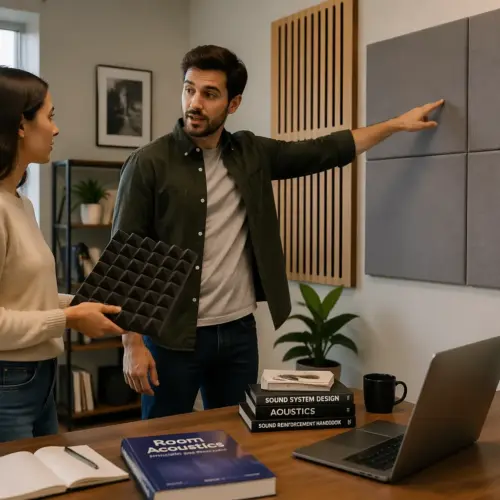
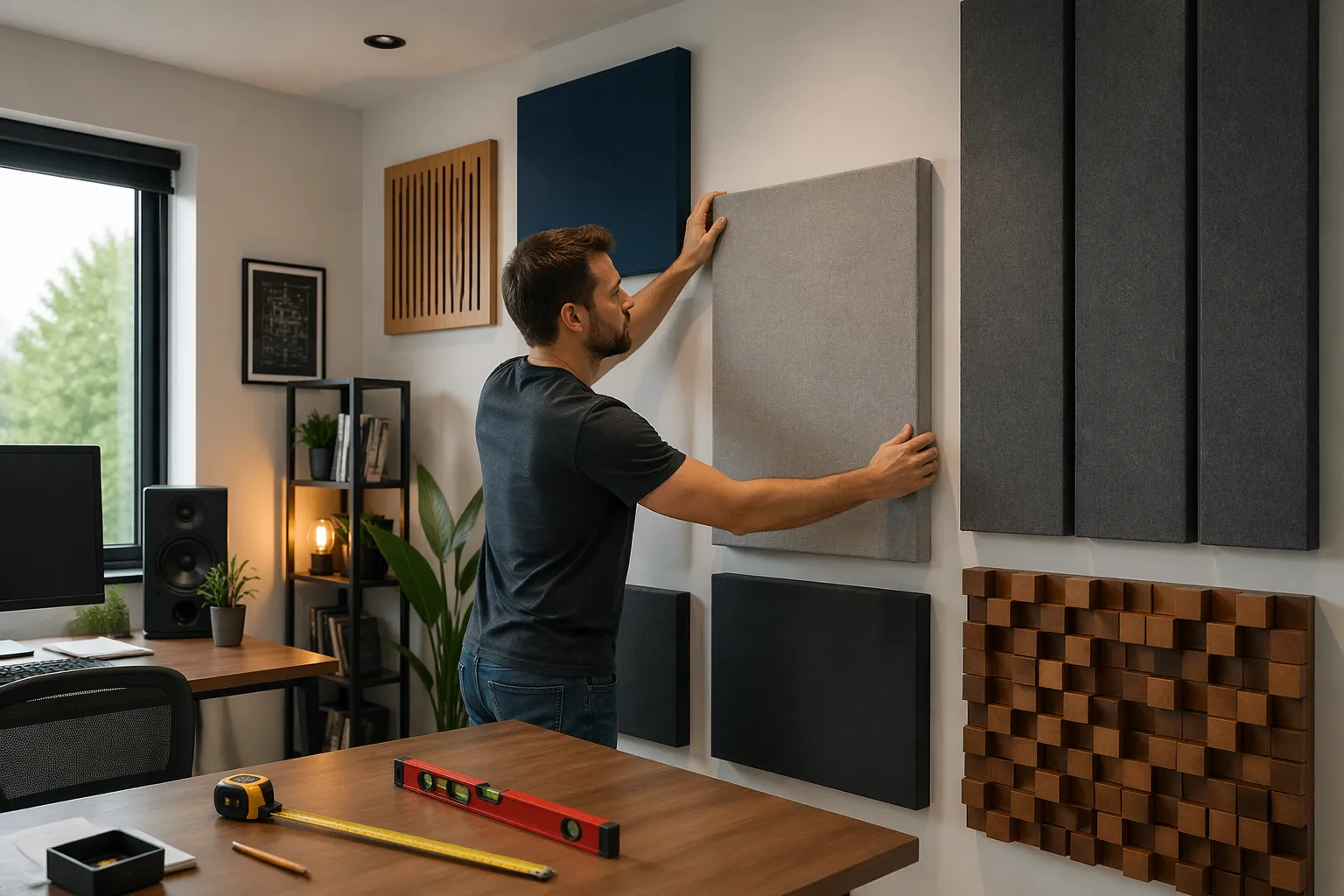
Most decorative acoustic panels are 1 to 2 inches thick and made from foam or light fiberglass. They can tame slap and brighten up speech, but they barely touch the sub 100 Hz range.
If you clap and hear zingy flutter, standard panels fix that fast, which is why they get good reviews. If you play a sine sweep and hear one note explode, that is a bass problem and the same panels will disappoint.
Even a solid 2 inch mineral wool panel has limited absorption below about 125 Hz when it is flush mounted. That is not a quality issue, it is a depth issue tied to panel thickness for bass.
Standard panels also do not solve deep nulls at the listening position, because nulls are cancellations. You cannot absorb your way out of a cancellation without changing geometry, position, or adding large amounts of absorption in the right places.
That is the heart of bass absorption limits in small rooms, because you are fighting both physics and square footage. You can reduce peaks and shorten decay, but you cannot make a tiny room behave like a large control room with a few wall hangings.
Where standard panels still help is in the upper bass and low mids, roughly 120 to 300 Hz, which affects warmth and muddiness. Cleaning that range can make bass problems feel less severe, even if the lowest octave still misbehaves.
Thickness, density, and placement choices that matter most
If you want acoustic panels for low frequencies home office use, start by thinking in inches, not in brand names. Depth and placement beat marketing copy every time.
Density matters, but people obsess over it in the wrong way, because “denser” does not automatically mean “better for bass.” A panel that is too dense can reflect more and absorb less at certain ranges, so you want a proven material like 3 to 6 pcf mineral wool or fiberglass.
| Panel build | Typical mounting | Realistic low-end effect |
|---|---|---|
| 2 inch foam tile | Flat to wall | Negligible below 200 Hz |
| 2 inch mineral wool (3 to 6 pcf) | Flat to wall | Some control around 125 to 250 Hz |
| 4 inch mineral wool (3 to 6 pcf) | Flat to wall | Useful into 80 to 125 Hz in good spots |
| 4 inch mineral wool | 4 inch air gap | Stronger into 70 to 110 Hz depending on placement |
| 6 inch mineral wool | Corner straddle | Noticeable peak and decay reduction into 60 to 100 Hz |
Using air gaps and corners to extend low-end absorption
An air gap behind a porous panel is the cheapest “extra thickness” you can buy. It moves the absorber into a region where particle velocity is higher, which is where porous absorption works.
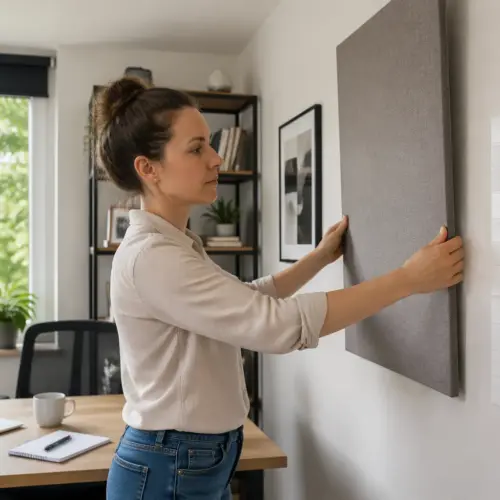
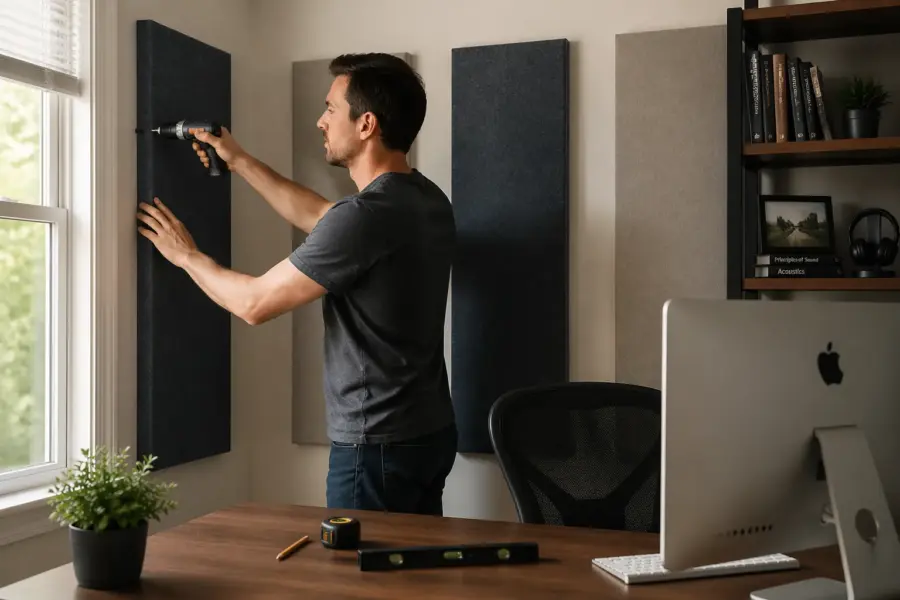
A common mistake is mounting a 4 inch panel flat because it looks tidy, then wondering why the low end still blooms. If you space that same panel 3 to 6 inches off the wall, you often hear tighter kick and less one note bass on music playback.
Corners are where bass pressure piles up across many modes, so corner treatment is the highest leverage move in most home offices. If you can only build or buy two big pieces, put them in the front vertical corners behind the speakers.
Straddling a corner with a thick panel creates a deep air cavity behind it, and that cavity is part of the absorber. This is why a 4 inch panel across a corner can outperform a 4 inch panel on a flat wall for bass.
Wall to ceiling corners also matter, especially in short rooms where the height mode is strong. If you can add a ceiling corner trap above the desk, you can reduce low frequency hangover without touching your floor space.
Do not ignore the back wall, because the distance behind your head sets up strong reflections and low frequency buildup. A thick absorber with an air gap on the back wall often cleans up the 80 to 160 Hz region that makes voices sound chesty and mixes sound cloudy.
How to prioritize treatment when you can’t treat everything
Most home offices have limits, because you have doors, windows, bookshelves, and the fact that it is still an office. The trick is to prioritize the spots that change what you hear at the chair.
Start with speaker and desk placement, because moving furniture is free and it changes the modal pattern you excite. Pull the desk off the exact center of the room and avoid placing speakers the same distance from side walls if you can.
Next, treat the front corners and the first reflection points, because that improves both bass and clarity. First reflection panels do not fix sub bass, but they tighten imaging and reduce the sense of smear that makes bass decisions harder.
After that, go after the back wall with thickness, because that is where small rooms often sound worst. A 6 inch absorber with a gap is not subtle back there, and it can reduce the “pressure” sensation that makes you turn bass down too far.
If you are choosing between more thin panels or fewer thick ones, pick fewer thick ones for low end work. Thin coverage makes the room less echoey, but it can leave the bass untouched and the tonal balance still wrong.
Accept that bass absorption limits mean you may still need EQ, especially below 60 to 80 Hz. Use treatment to reduce decay and tame peaks, then use EQ to smooth what remains, because that combo works better than either alone.
Room modes basics you can use without doing math
You do not need to calculate modes to benefit from room modes basics, you just need to know what a mode sounds like. It sounds like one or two notes that jump out, linger, and change a lot when you move around.
Walk around the room while playing a slow bass sweep or a repeating bass line, and notice where the bass vanishes or doubles. Those spots map your peaks and nulls better than guessing from a floor plan.
Modes show up strongest between parallel boundaries, so the front to back and side to side distances matter most. If your desk faces the short wall, you often get smoother bass at the listening position because the speakers fire down the longer dimension.
Sitting with your head near the back wall is a common home office layout, and it is also a common bass trap. Moving the chair forward even 8 to 12 inches can change the low end more than adding another thin panel.
Ceiling height modes are real too, especially with an 8 foot ceiling and speakers on stands. A ceiling cloud that is thick and spaced down a bit can reduce low mid buildup and make the room sound less boxy.
If you hear a bass note that rings for a second after it stops, that is a decay problem and absorption helps. If you hear a bass note that disappears at your chair but comes back two feet back, that is a null and placement matters more than panels.
A realistic shopping and DIY plan for home office bass control
If you want a plan that works, budget for thickness first and looks second, because bass does not care about fabric color. I would rather see two ugly corner traps than eight pretty 1 inch panels.
A solid baseline is four 4 inch panels, two for front corners and two for early reflections, plus one thicker back wall piece if space allows. If you can build, 1×4 frames with mineral wool and breathable fabric like Guilford of Maine style material or simple burlap can be cost effective.
For buying, look for published absorption data and avoid vague claims like “studio grade bass control” with no numbers. If a product does not tell you thickness and material type, assume it is aimed at echo control, not low frequencies.
Do not overstuff a panel with random insulation scraps and expect magic, because airflow resistance matters. Use a consistent batt, keep the face fabric breathable, and do not wrap it in plastic or vinyl if you want absorption.
If you have a bookshelf, you can use it as a back wall diffuser in the midrange, but it is not a bass trap. Put thick absorption near it if the back wall is still booming, because books do not soak up 80 Hz.
When people ask about acoustic panels for low frequencies home office setups on a tight budget, I point them to corner straddles and air gaps. Those two moves stretch every dollar because they increase effective depth without buying more material.
Common mistakes that waste panels and patience
The biggest mistake is covering every flat wall with thin panels and leaving corners bare. That makes the room dull on top while the bass still sloshes around underneath.
Another mistake is treating only one side of the room, usually the side you see on camera. Symmetry matters for stereo, so mismatched treatment can pull the image and make EQ decisions harder.
People also mount panels too high because they want them out of the way, then they miss the reflection points that matter. Use the mirror trick at ear height, and put panels where you actually see the speaker from the chair.
Corner traps that stop halfway up the wall leave a lot of low frequency energy untouched. If you can, stack to the ceiling, because the upper corner still holds pressure and it is free real estate.
Buying “bass traps” that are really 2 inch foam wedges is another classic trap, and it feeds unrealistic expectations. Foam can work higher up, but for true bass you need thickness, air volume, and placement that matches the room modes basics.
Finally, do not trust your memory between changes, because your brain adapts fast. Record before and after measurements or clips, even if it is just your phone mic for rough comparisons.
Practical listening tests to confirm improvement
You can do meaningful tests without fancy gear, as long as you repeat them the same way. Use a few tracks you know well, plus a sine sweep or warble tone from a free generator app.
The goal is to hear fewer “one note” moments and less bass hangover after notes stop. You are also listening for a more stable balance when you lean forward and back a little.
- Play a 20 to 200 Hz sine sweep at moderate volume
- Walk the room and mark big peaks and deep nulls
- Repeat the sweep from the chair and note the worst frequencies
- Listen for decay on kick drums and bass guitar stops
- Compare left and right speaker balance with mono bass content
- Recheck after moving panels, especially corner pieces and air gaps
Conclusion
Acoustic panels for low frequencies home office rooms can work, but only if you respect bass absorption limits and build for depth, not decoration. Thick porous traps, smart placement, and air gaps do more for bass than covering every wall with thin tiles.
Use room modes basics to guide where you sit and where you treat, because geometry decides what you excite. If you tame peaks and shorten decay with treatment, then clean up the last bits with careful EQ, your office can sound genuinely controlled without becoming a full studio build.