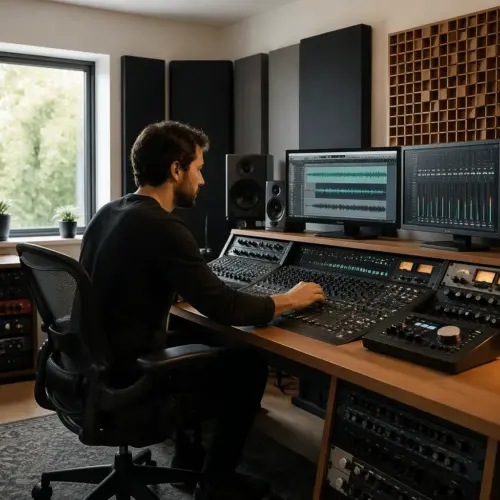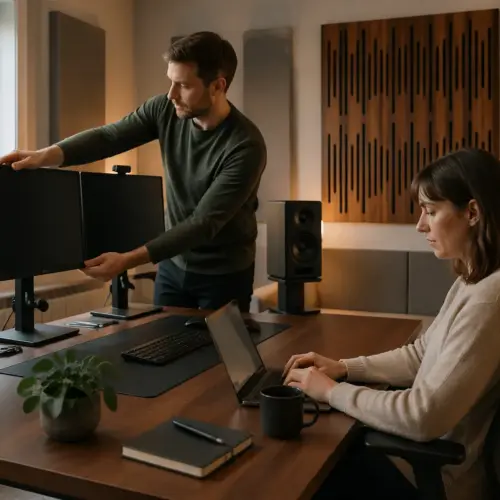

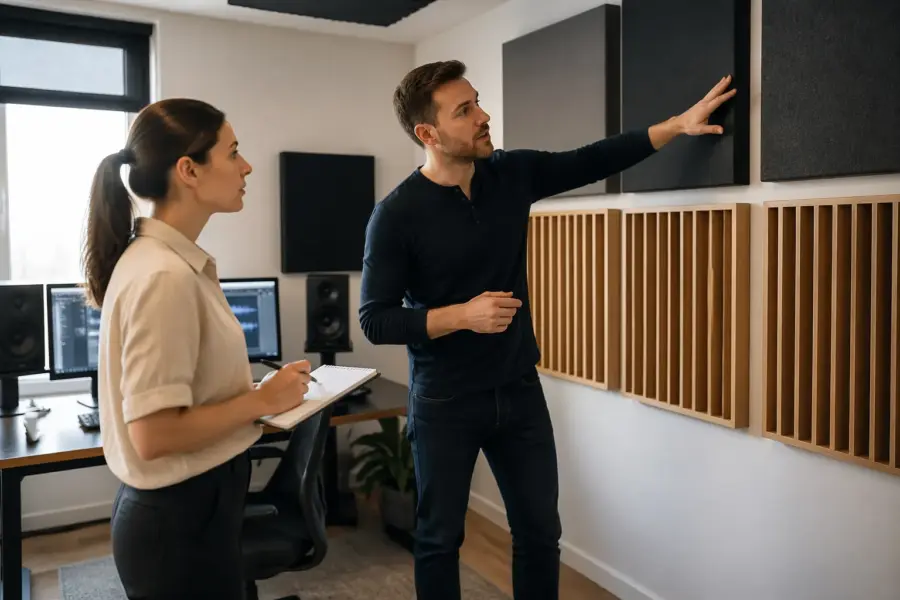
Most home offices sound worse than they need to, and it is usually the room, not your speakers or microphone. Before you buy panels or swap monitors, you should understand the home office room geometry basics that decide what your ears hear all day.
Room geometry is the plain, boring stuff like room dimensions, where the desk sits, and whether the left and right sides match. That boring stuff controls early reflections, bass buildup, and the weird comb filtering that makes voices sound phasey on calls.
I have seen people treat a room heavily and still hate the sound because the desk was jammed into a corner or the listening position was stuck at the exact worst spot. A little geometry awareness can save money and make acoustic treatment work the way it is supposed to.
This article keeps it practical for typical apartments and spare bedrooms, not purpose built studios. You will learn what to measure, what to avoid, and what to accept when the room is not ideal.
What “room geometry” means for sound in a home office
Room geometry is the shape of the room and the placement of big boundaries like walls, ceiling, floor, windows, and closets. For sound, those boundaries act like mirrors at mid and high frequencies and like pressure containers at low frequencies.
When you clap in a bare room and hear a zing, that is geometry and surfaces working together. When bass notes seem louder in one spot and vanish in another, that is geometry turning into room modes.
In a home office, geometry also includes the desk, shelves, and even a big monitor because they create strong early reflections. If your speakers sit on the desk, the desk reflection often arrives fast enough to smear imaging and make the center image wander.
Home office room geometry basics start with a simple idea, you cannot treat what you do not understand. If you know where the big reflections and bass pressure zones are likely to form, your panels and bass traps stop being random decorations.
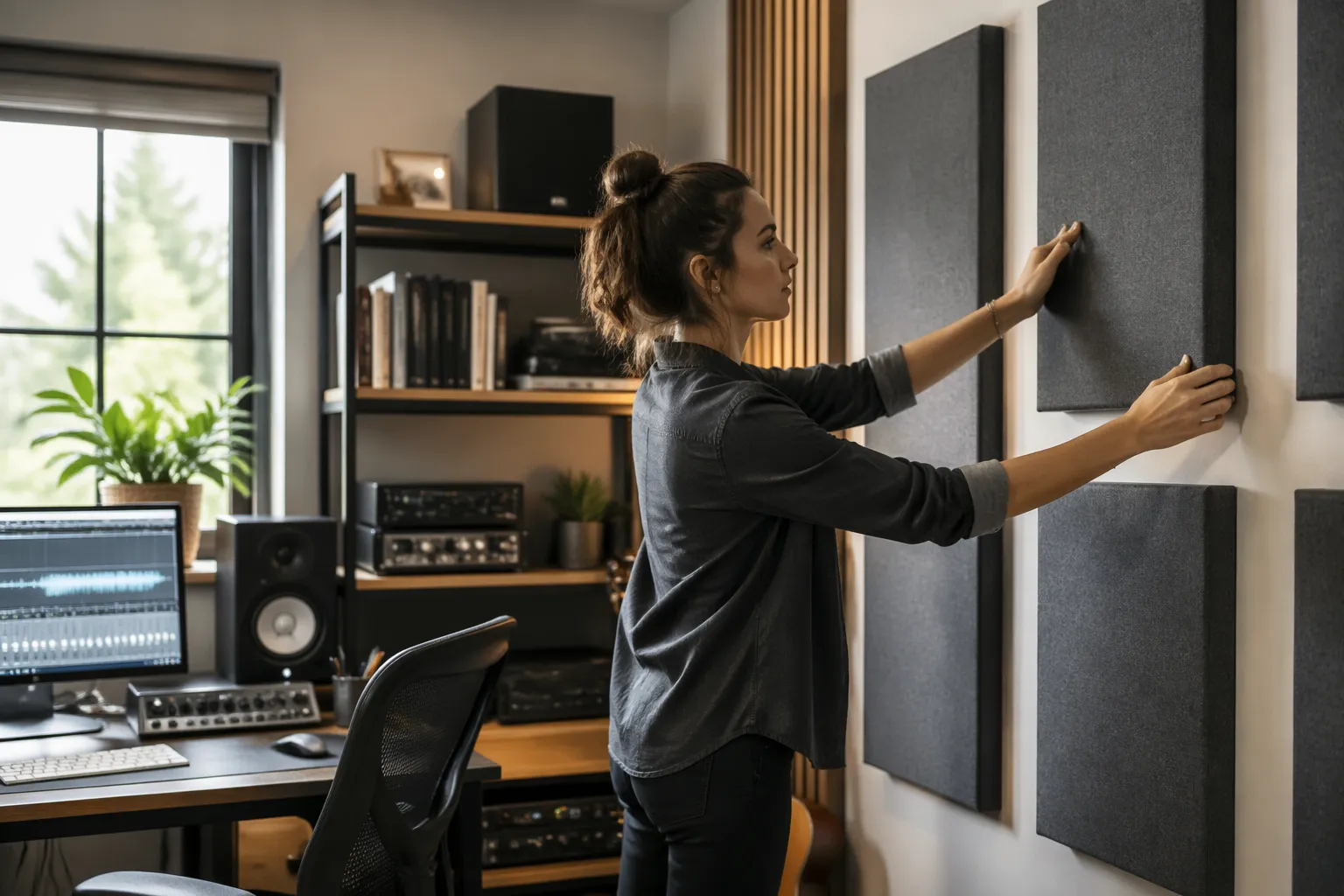
How length, width, and height shape what you hear
Your room dimensions set the frequencies where standing waves pile up, and those peaks and nulls are what make bass sound uneven. Two rooms with the same volume can sound totally different if one has better spaced dimensions.
Small rooms push modal problems higher in frequency, which means the mess creeps into the low mids where voices and guitars live. That is why a tight 10 by 10 bedroom can feel boxy even with thick carpet and curtains.
Height matters more than people think, because the floor to ceiling mode often lands right in the kick drum and bass guitar neighborhood. If your ceiling is 8 feet, you will often fight a strong resonance around the low 70s Hz region, and it can ring longer than you expect.
If you can choose between rooms, avoid perfect cubes and avoid near squares when possible. A room that is 11 by 14 by 9 usually behaves more predictably than 12 by 12 by 8, even before you add treatment.
Why symmetry matters (and when it doesn’t)
Symmetry in studios is mostly about left right balance at the listening position, not about making the whole room look even. When the left wall is close and reflective but the right side opens into a hallway, stereo imaging gets lopsided fast.
For mixing or detailed editing, you want the first reflections to be similar on both sides so the phantom center stays centered. For video calls and general office work, perfect symmetry matters less, but it still affects fatigue because your brain keeps compensating.
| Symmetry situation | What you hear | Practical fix |
|---|---|---|
| Desk centered between side walls | Stable center image and clearer panning | Match left and right reflection panels |
| One side wall close, other side open | Image pulls toward the reflective side | Add absorption on the close wall, add a bookcase or curtain on the open side |
| Window on one side, solid wall on the other | Different brightness and timing side to side | Use a thick curtain over the window during listening |
| Closet door on one side, bare drywall on the other | Small tonal shift and flutter on one side | Treat the drywall side, leave the door or add a thin panel to it |
| Asymmetric furniture near one speaker | Uneven early reflections and midrange blur | Move the furniture back or make both sides similarly cluttered |
Choosing a practical listening position in a typical room
Your listening position is the one decision that can make a mediocre room workable or make a good room annoying. If you sit in a deep bass null, you will keep turning up low end and your mixes will come out boomy everywhere else.
A reliable starting point is to face the short wall so sound travels down the long dimension of the room. That usually gives you more distance to the back wall and spreads modal issues out in a way that is easier to treat.
Many people use the 38 percent guideline as a first guess, sitting about 38 percent of the room length away from the front wall. It is not magic, but it often lands you away from the strongest front to back null that forms at the center of the room.
Keep the listening position off the exact centerline of the room height too, because ear level at half the ceiling height can line up with a strong floor to ceiling mode. In an 8 foot room, a normal chair puts your ears around 4 feet, so raising or lowering the chair slightly can change what you hear in the low end.
How desk and speaker placement interact with geometry
The desk is a giant reflector, and it sits right where you do not want one, between the speakers and your ears. If you place speakers on the desk, the reflection off the desktop can cause a dip in the upper bass or low mids that makes voices sound hollow.
Pulling the speakers forward so the front baffle is close to the desk edge can reduce that reflection path length. Using sturdy stands beside the desk is even better, but only if you can keep the triangle tight and the speakers at ear height.
Speaker distance to the front wall matters because of boundary interference, and you can hear it as bass that changes when you move the speakers a few inches. If you cannot use deep bass trapping, you often get better results placing speakers closer to the front wall rather than halfway into the room.
Try to keep the left and right speaker distances to nearby surfaces matched, because geometry differences show up as tonal differences. When one speaker is 18 inches from a side wall and the other is 48 inches, your brain hears that as a skewed stereo picture even at moderate volume.
Common geometry mistakes that make treatment harder
The most common mistake is pushing the desk into a corner because it feels efficient and gives you more floor space. Corners are where bass pressure stacks up, so you end up sitting in the loudest, least controlled low end in the room.
Another mistake is placing the listening position right against the back wall, which makes low frequencies jump and makes rear wall reflections arrive too soon. Even 12 to 24 inches of breathing room behind your chair can lower the intensity of that back wall slap.
People also ignore ceiling geometry because it is out of the way, then wonder why the room still sounds sharp after adding wall panels. The ceiling reflection is often one of the strongest early reflections in a home office, especially with hard floors and a flat desk surface.
Finally, a lot of setups chase visual symmetry while ignoring acoustic symmetry, like putting a tall bookcase beside one speaker and a bare wall beside the other. Symmetry in studios is about what sound sees, not what your webcam sees.
A simple checklist to evaluate your room in 15 minutes
You can learn a lot fast with a tape measure, painter’s tape, and your ears. This quick pass is meant to flag geometry problems before you buy treatment or commit to furniture placement.
Write down your room dimensions and sketch the door, windows, and any open closet, because openings change low frequency behavior. Then mark your current listening position and speaker locations so you can compare changes later.
- Measure length, width, and height in feet and inches
- Face the short wall and check if it is realistic for your desk
- Mark 38 percent of room length from the front wall
- Check left right distance to side walls from each speaker
- Clap test for flutter between parallel bare walls
- Listen for bass changes while walking the room perimeter
- Identify first reflection points on side walls and ceiling
How to use room dimensions without chasing perfect ratios
You will see ratio charts online that suggest ideal room dimensions, and they can be useful when you are building from scratch. In a home office, you usually inherit the room, so the goal is to work with what you have and avoid self inflicted problems.
If your room is close to a square, you can still get good results by choosing a listening position that avoids the worst nulls and by trapping corners aggressively. If your room has one weird dimension, like a low soffit or a sloped ceiling, that can actually help by breaking up parallel surfaces.
Measure the room and note any big alcoves, bay windows, or closets, because they change effective volume and can act like bass absorbers or bass amplifiers depending on the opening. A walk in closet with clothes can tame some low mid buildup, but a small empty closet can ring like a drum.
When you compare rooms, pick the one that gives you the most flexibility behind the listening position and the most consistent side boundaries. A room with an extra two feet of depth behind your chair often beats a slightly larger room that forces you against a wall.
Geometry friendly treatment priorities for home offices
Good geometry makes treatment easier, but treatment still matters because drywall and glass reflect a lot of energy. If you fix only one thing, handle first reflections so your brain gets a clean direct sound from the speakers.
Side wall panels at the first reflection points are usually the best value, and the ceiling cloud often matters just as much. If you sit under a flat ceiling, a 2 to 4 inch thick cloud with an air gap can calm the brightness and sharpen imaging.
Bass trapping is where geometry and budget collide, because small rooms need a lot more trapping than people expect. Thick corner traps in at least two vertical corners, plus some treatment on the back wall, usually does more than scattering thin foam everywhere.
Diffusion is tempting because it looks cool, but in small home offices it often ends up too close to work well. If you want a cheap form of diffusion, a messy bookcase on the back wall can break up reflections without forcing you to do math.
When you cannot get symmetry, use smart compromises
Plenty of real rooms are asymmetrical, especially in apartments where one side opens to a kitchen or hallway. You can still get a solid working setup if you control the early reflections and keep the listening position consistent.
If one side is open, you can sometimes create a fake boundary with a thick curtain on a ceiling track or a movable gobo panel. The goal is not to seal the room, it is to make left and right early reflections closer in level and timing.
If you have a window on one side, treat it like a hard wall during listening by closing a heavy curtain, and accept that daylight wins the rest of the day. If the other side is a bare wall, match the curtain with a panel or a bookshelf so the tonal balance stays similar.
For voice work, you can cheat even more by turning the desk so the mic points into absorption, like a thick curtain or a closet full of clothes. That does not fix the whole room, but it makes calls and narration sound cleaner without rebuilding the space.
Conclusion
Home office room geometry basics come down to a few choices that you can control, even in a rental, like orientation, desk placement, and a sane listening position. When you get those choices right, your room dimensions stop fighting you as hard and your treatment starts paying off.
Keep left right balance in mind where it counts, because symmetry in studios is really symmetry at your ears. If you take 15 minutes to measure, sketch, and test a couple positions, you can build a workspace that sounds clearer and stays comfortable for long days.