
When people compare acoustic panels vs moving blankets home office setups, they usually ask one question: which one makes me sound better on calls and recordings. The honest answer is that both can help, but they help in different ways and at different frequencies.
If you have a spare bedroom office with a desk shoved against a wall, you probably hear a papery echo when you clap or talk. That echo is what makes your voice sound thin, harsh, and “roomy” on Zoom, Meet, or a portable recording setup.
I like moving blankets for quick experiments and for renters who cannot drill holes. I like real panels when you want predictable results and you are tired of rearranging fabric every time you work.
What panels and moving blankets are designed to do
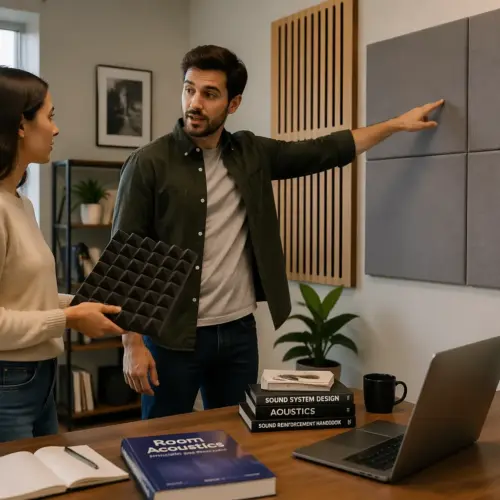
Acoustic panels are built to absorb sound energy in a controlled way, usually with fiberglass or mineral wool behind a fabric face. Most consumer panels target mid and high frequency absorption, which is where speech intelligibility lives.
That “controlled” part matters because the material density, thickness, and air gap are chosen to hit specific ranges. When you buy a decent panel, you are paying for predictable absorption instead of hoping a soft thing on the wall will do the job.
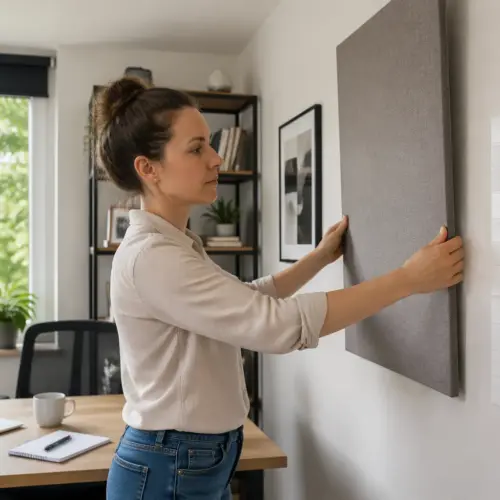
Panels are also designed to be rigid enough to mount flat and stay put, which keeps your setup consistent week to week. Consistency is underrated, because your mic settings and noise reduction work better when the room is stable.
Moving blankets are built to protect furniture, not to tune a room, so their acoustic behavior is a side effect of thickness and density. They can act as temporary sound treatment by adding soft, lossy material that reduces reflections.
The key word is “temporary,” because most blanket setups rely on clamps, stands, or doors, and those change a little every time. Even a small change in how the blanket drapes can change how much high end gets absorbed.
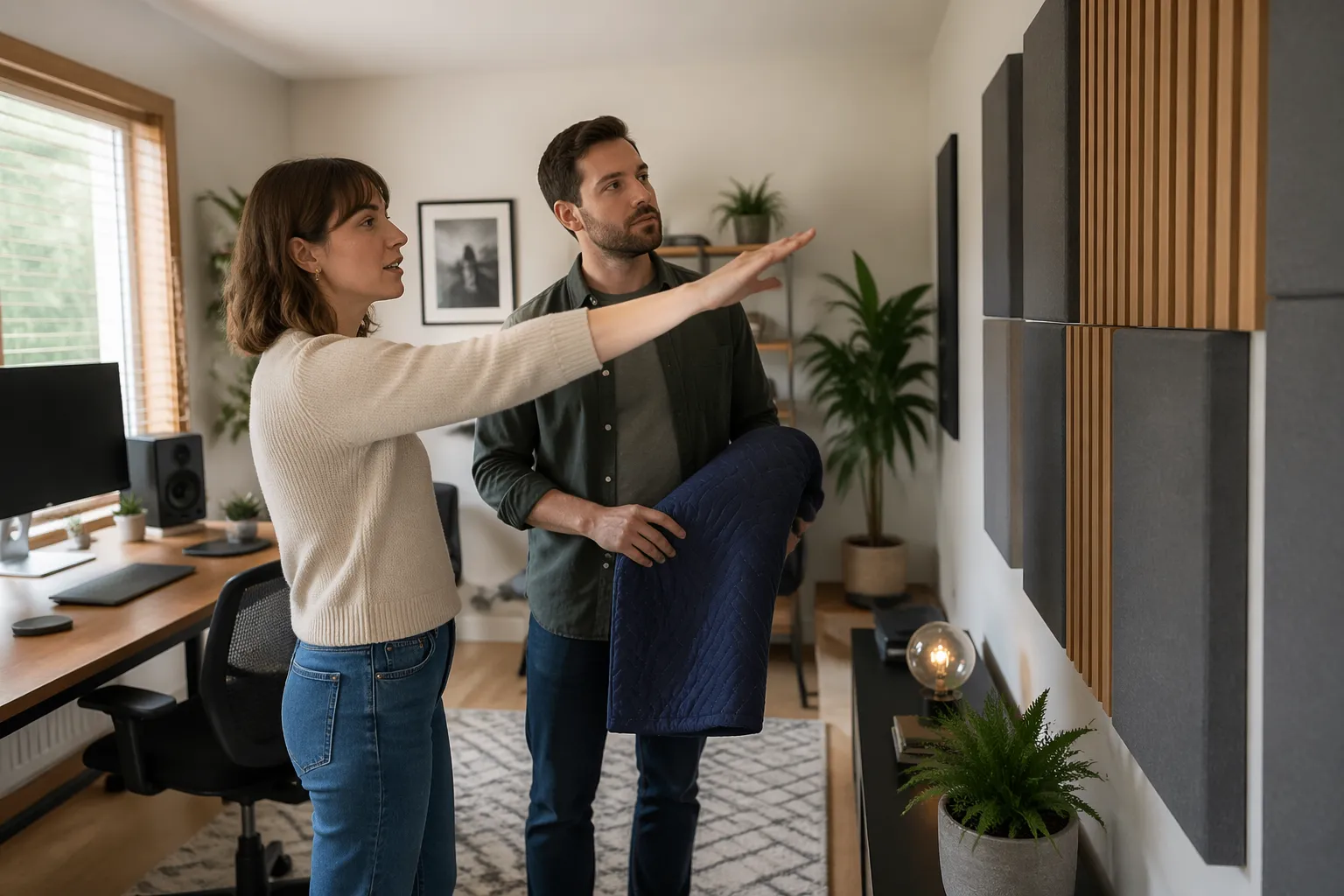
Blankets also vary wildly in weight and weave, so two blankets that look similar can behave differently. The heavier “pro” moving blankets tend to perform better than thin quilted ones, but neither is a true substitute for thick broadband absorption.
Panels work best when they are thick enough and placed where reflections are strong, and that usually means 2 to 4 inches thick on walls. Blankets work best when they hang with air behind them, since a tight, flat drape often absorbs less than people expect.
That air gap acts like extra thickness, which helps the material interact with slightly lower frequencies. If you press any absorber directly onto drywall, you are usually giving up performance for convenience.
It also helps to remember that “absorption” is not the same as “blocking,” and that’s where people get disappointed. You can make your room sound less echoey without making it quieter for your neighbors.
Neither option is true soundproofing, because stopping sound through walls needs mass, sealing, and decoupling. What panels and blankets do is change the sound inside the room, so your mic hears less room and more voice.
This is why you can spend money on treatment and still hear traffic outside, and that is normal. The goal for calls and voice work is usually to reduce reflections and reverb, not to turn your office into a bunker.
If your biggest problem is other people hearing you, you are in soundproofing territory and panels will not solve it. If your biggest problem is your mic hearing the room, then panels and blankets are the right category of fixes.
How each option affects echo, clarity, and room tone
In a typical home office, the annoying part is flutter echo between parallel walls and the hard bounce off a bare desk. Both panels and blankets can reduce that, but panels usually do it with fewer square feet on the wall.
Flutter echo is that “zing-zing” you hear when you clap, and it is basically a reflection ping-pong match. Breaking up one or two of those reflection paths can make the room feel calmer immediately.
Panels tend to improve clarity because they reduce early reflections that smear consonants like T, K, and S. That is why a couple of properly placed panels can make your voice sound closer and more direct.
Early reflections arrive milliseconds after your direct voice, and your mic captures them as part of the same “word.” When you reduce those reflections, you often need less EQ and less aggressive noise reduction to sound polished.
Clarity also shows up in how well people understand you at low volume, like when someone is listening on laptop speakers. A treated room can make you sound louder and clearer without actually turning up your mic gain.
Moving blankets can tame a bright room fast, but the result can lean dull if you hang them everywhere like curtains in a recording booth. You lose some high frequency absorption in the right places and end up killing the top end in the wrong places.
Blankets are easy to overdo because they cover big areas quickly, and “more” feels like it should be better. The problem is that an uneven, improvised setup can create a weird balance where the highs are damped but the low mids still bounce around.
If your voice suddenly sounds like you are under a comforter, that is usually too much blanket too close to the mic. You want less reflection, not a muffled tunnel.
Room tone is where the difference shows up on recordings, especially when you pause between sentences. Panels usually keep the room sounding natural while lowering the “bathroom” tail, while blankets can add a slightly boxy, muffled character if they crowd the mic.
That “boxy” sound is often a midrange buildup, and it can happen when you treat only inches from the mic but leave the rest of the room reflective. The mic hears a strange mix of dead-close absorption and lively far reflections, which can sound unnatural.
On calls, room tone matters because conferencing apps compress and gate audio in ways that exaggerate changes. A cleaner room makes those algorithms behave more gently, which means fewer chopped syllables and fewer robotic artifacts.
If you do any editing, a stable room tone also makes it easier to cut and rearrange audio without obvious seams. When the room is echoey, every edit sounds like a jump because the reverb tail changes from clip to clip.
Where blankets work surprisingly well (and where they fail)
Blankets can work shockingly well when you need a fast fix for a portable recording setup, like a laptop, USB mic, and a stand in a guest room. If you hang two blankets behind the mic and one behind you, you can cut the slapback that makes narration sound amateur.
This is especially true if the room has bare floors, big windows, or a big empty closet door that reflects like a mirror. A couple of blankets can knock down the harshest reflections enough that your voice stops sounding like it is bouncing off tile.
Blankets also shine when you are traveling and do not control the room, like recording in a rental or a hotel. You can pack clamps and a couple of blankets and build a “good enough” zone around the mic.
They are also useful when you are testing mic placement, because you can change the room quickly and hear what matters most. That kind of experimenting helps you avoid buying panels for the wrong wall.
They fail when you expect them to handle low end problems like boomy notes, HVAC rumble, or the thump you hear when you talk close to a wall. They also fail when they are stretched tight against the wall, because thin fabric on drywall does not absorb much below the top end.
Low frequencies have long wavelengths, so they do not “see” a thin blanket as much of an obstacle. If your room sounds like it has a constant whoom-whoom resonance, blankets will not fix it, and you will chase your tail with placement.
Blankets also fail when you need repeatable results, like a weekly podcast where you want every episode to match. If your blanket is hung a little differently each time, your EQ and compression settings will feel inconsistent.
Another failure mode is noise, because blankets do not block outside sound and they do not stop keyboard clacks from traveling through the desk. They can reduce the “room” around those noises, but they do not remove the noises themselves.
| Scenario | Moving blankets | Acoustic panels |
|---|---|---|
| Zoom calls in a reflective office | Good quick improvement if hung behind you | Better improvement with less coverage |
| Voiceover with a dynamic mic | Works if you create a loose U-shape with air gaps | Works well with 2-4 inch panels at reflection points |
| Low frequency boom from corners | Poor, blankets are too light | Moderate with thick panels, best with bass traps |
| Frequent teardown and travel | Excellent, folds and clamps easily | Fair, portable panels exist but cost more |
| Clean, professional background on camera | Often looks improvised | Looks intentional, color options help |
If you read that table and think “I only care about calls,” you can lean lighter on treatment than a full voiceover setup. Calls are forgiving, but they still benefit from removing the worst reflections that make you sound far away.
If you read it and think “I care about recordings people will replay,” then repeatability matters more than speed. That is where panels start to feel less like a luxury and more like basic infrastructure.
Practical setups: behind you, side walls, and around a desk
If you do one thing, treat the wall behind you, because your voice hits that surface and bounces straight into the mic. A pair of 2×4 foot panels at head height usually beats a single big panel hung too low.
People often treat the wall behind the monitor instead, but that is not always the strongest reflection path. If the mic is in front of you, the wall behind you is often the one feeding the mic the most obvious “room” sound.
It also helps to keep panels centered around where your head actually is during calls, not where you imagine you sit. If you lean back or turn to a second monitor, your reflection points shift, so treat the area you really use.
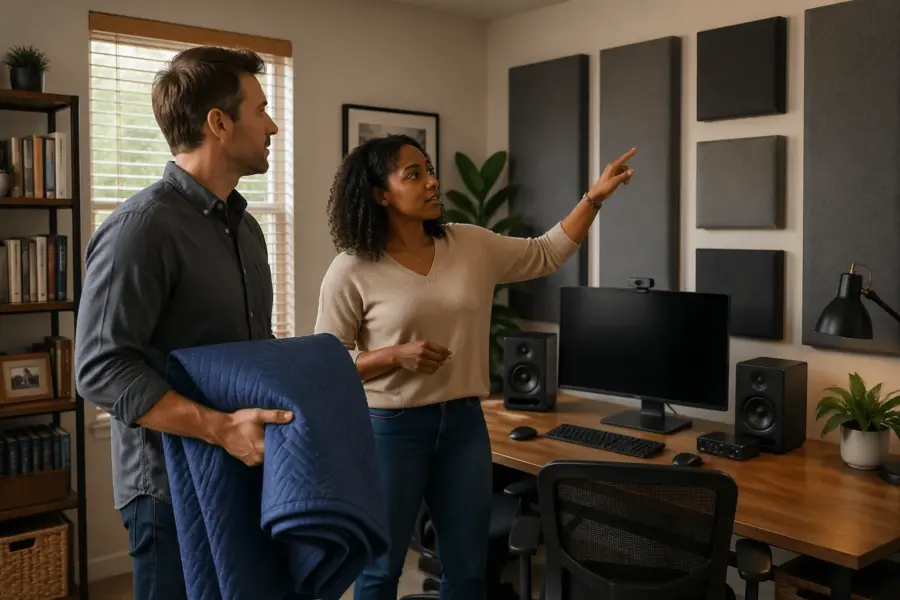
With moving blankets, hang them like theater curtains with folds, not like a bedsheet, and leave a few inches of air behind them. I use spring clamps and a cheap garment rack when I need temporary sound treatment without drilling.
A door frame can work too, but doors rattle and move, so it is not as stable as a rack. If you use a rack, weigh the base down a bit so it does not tip when you adjust the blanket.
Try to avoid having the blanket touch the mic stand, because vibrations can travel and show up as low thumps. A small gap between the stand and the blanket keeps the setup quieter.
Side wall reflections matter when your mic is sensitive, especially with condenser mics and wide pickup patterns. Find the first reflection points by sitting at your desk and having someone slide a mirror along the wall, then treat where you can see the mic in the mirror.
If you work alone, you can do the mirror trick with your phone in selfie mode and a little patience. The point is to treat the “line of sight” bounce from your mouth to the wall to the mic.
In small rooms, the side reflections can be almost as loud as the direct voice because the walls are so close. That is why two small panels at the side points can sometimes beat four random panels scattered around the room.
Desks are sneaky reflectors, so a big bare tabletop can bounce your voice right back up into the mic capsule. A desk mat, a thin felt pad under the keyboard, or even a folded towel during recording can reduce that sharp “ping” without changing the whole room.
This is also why boom arms help, because they let you place the mic closer to your mouth and farther from the desk plane. The closer the mic is to you, the less it needs to “listen” to the room and desk reflections.
If you cannot use a boom arm, angle the mic so it is not pointing straight at the desk surface. A small tilt can reduce the amount of desk reflection that lands directly in the pickup pattern.
For blanket setups around a desk, a simple approach is a three-sided “U” with the open end facing your monitor. Keep the blankets a little behind the mic rather than wrapped tightly around it, so your voice still has space to sound natural.
For panel setups around a desk, think in zones instead of full coverage, like behind you and the two side reflection points. If you want to go further, a ceiling cloud above the desk can be a bigger upgrade than adding more panels at random heights.
Durability, appearance, and long-term maintenance differences
Panels hold their shape for years, and decent fabric wraps do not shed fibers into the room when they are built correctly. If you mount them with impalers, Z-clips, or French cleats, they do not sag or drift out of place.
That stability matters because a panel that stays flat keeps its air gap and placement consistent. When a panel shifts or bows, the sound changes a little, and you end up chasing settings again.
Good panels also tend to be fire-rated or at least made from materials that behave better than random fabric in an office. If you are hanging anything large on walls, it is worth thinking about safety and not just acoustics.
Moving blankets take a beating, and the stitching and grommets on cheap ones can rip when you keep re-hanging them. They also collect dust and pet hair fast, which is not fun if the blanket sits behind you on camera.
They also pick up smells, especially if they live in a closet between sessions or get stored in a garage. If you are sensitive to dust or allergies, a blanket booth can become annoying over time.
If you do wash them, they can come out stiffer or thinner depending on the fill and the stitching. That changes how they drape, which changes the acoustic result more than most people expect.
Visually, panels can look like part of the office, especially if you match colors to the wall or pick a neutral gray. Blankets usually read as “set dressing,” which is fine for a closet booth but odd in a home office you use all day.
On camera, panels also look intentional because they have straight lines and consistent texture. If you care about a professional look, panels can double as decor instead of something you hide between meetings.
Blankets can look better if you use a neat rack and keep the folds even, but it still signals “temporary.” That is not a dealbreaker, but it is something to consider if clients see your background often.
Maintenance is simple with panels because you can vacuum the face lightly and move on. Blankets need washing or at least lint rolling, and frequent washing can change how they hang and how thick they stay.
Panels also do not require you to clear floor space every time you need them, which matters in smaller offices. Blankets often take up space with stands and racks, and that can make the room feel cluttered fast.
If you are someone who likes a tidy workspace, panels are easier to “set and forget.” If you are someone who likes to reconfigure the room, blankets fit that flexible style better.
A decision guide based on budget and how permanent you want it
Budget is real, and panels can get expensive fast if you cover a whole room like a studio. The good news is you rarely need full coverage for a home office, so you can start with a few pieces and place them where they count.
A small starter set can be enough if your goal is simply to stop sounding like you are in a hallway. Most of the time, fixing two or three reflection paths beats covering every inch of wall.
Blankets are cheaper per square foot, but they can become a false economy if you keep buying more to chase low end issues they cannot solve. If you find yourself stacking blankets and still hearing boom, you are probably at the limit of what they can do.
If you rent, move often, or record only once in a while, blankets are a reasonable first step in the acoustic panels vs moving blankets home office debate. If you record weekly, host webinars, or want consistent sound, panels pay you back in time saved and fewer retakes.
Time saved is not just editing time, but also the mental overhead of setting up and tearing down. A permanent setup makes it easier to hit record without turning it into a project.
Another budget angle is resale and reuse, because panels can move with you and still look good in the next place. Blankets can move too, but they often end up as storage items once you upgrade.
If you are unsure, a hybrid approach works well: use blankets to test positions and then replace the best spots with panels. That way you are not guessing where your money should go.
- Start with treatment behind your chair at head height
- Use side wall first reflection points before covering random areas
- Hang blankets with folds and an air gap, not tight to drywall
- Pick 2 to 4 inch panels for speech, thicker if you can
- Add corner treatment only after you fix early reflections
- Test changes with a short voice memo before buying more
The voice memo test is simple, but it keeps you honest because your ears adapt quickly. Record ten seconds before and after, and listen on headphones so you can hear the room tail clearly.
If the room still sounds sharp after treating behind you, the next most common win is the side reflection points. If the room sounds dull but still boomy, you probably overused blankets or underused thickness where it matters.
Also pay attention to mic technique, because treatment cannot fix a mic that is too far away. A closer mic position often gives you a bigger improvement than adding another blanket to the wall.
Conclusion
Panels and blankets both reduce echo, but they do it with different tradeoffs in predictability, looks, and how much wall coverage you need. For most people chasing cleaner calls and better recordings, panels win long term and blankets win when you need temporary sound treatment today.
If you want the simplest upgrade, treat the wall behind you first and stop there until you listen to the change. Once you hear that improvement, it gets easier to choose whether your next step is more high frequency absorption with panels or a flexible blanket setup for a portable recording setup.
If you are stuck between the two, remember that the best option is the one you will actually keep using. A perfect plan that you never set up is worse than a simple plan you use every day.
Start small, measure the change with your own voice, and build from there based on what you still hear. That approach keeps the acoustic panels vs moving blankets home office decision practical instead of theoretical.