
If you work in a long, narrow home office, you already know the low end can turn weird fast. Bass piles up in some spots, disappears in others, and makes mixing or even casual listening feel like a moving target.
Bass control in a long narrow room is less about buying one magic panel and more about choosing positions that cooperate with physics. Get the geometry and placement right first, then use treatment to tame what the room insists on doing.
I see the same mistakes over and over, desk shoved against a wall, speakers too wide, and a chair parked in a bass null. Fixing those basics usually gives a bigger improvement than swapping monitors or adding a sub.
This guide focuses on practical moves for home offices where you cannot rebuild walls or float a floor. You will learn how axial modes, rear wall behavior, and speaker spacing interact so you can make smart compromises.
What long, narrow rooms do to bass response
A long, narrow room exaggerates the distance between the front wall and the rear wall, so the strongest low-frequency swing often runs front to back. That single dimension can dominate what you hear at the desk, even when the side walls feel close.
The bass problems are mostly axial modes, which are standing waves between two opposing surfaces. In a narrow room you get strong width modes too, but the length mode often hits harder because the room supports it cleanly.
Here is the annoying part, small movements matter more than you expect. Sliding your chair six inches can move you closer to a pressure null where 60 to 90 Hz seems to vanish.
Long rooms also encourage you to sit deep in the space, which can put your ears near the middle of the length. The middle is often where the first length mode creates a big dip, so the kick drum can sound thin even when your speakers are fine.
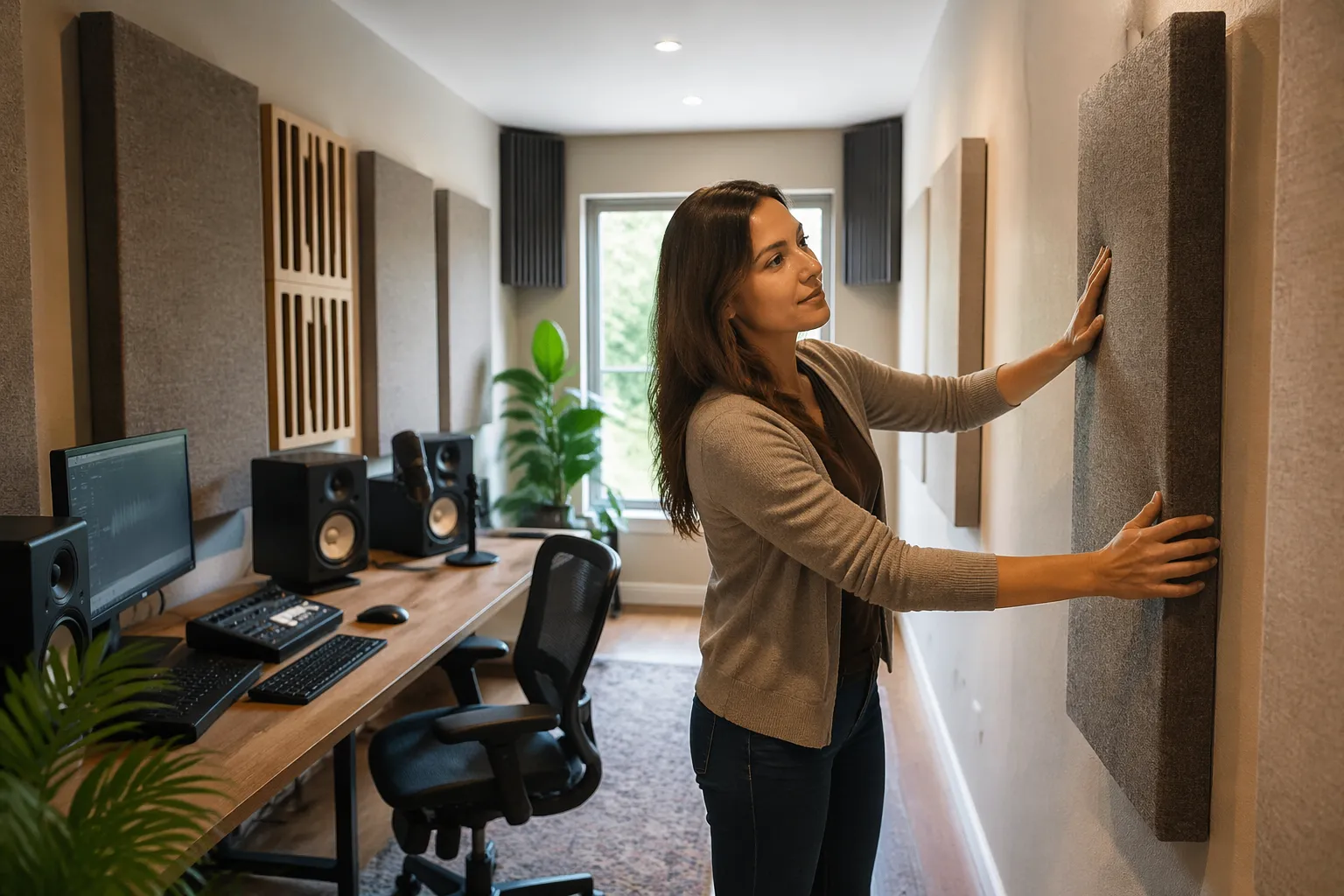
When people say the bass sounds boomy, they usually mean one or two notes hang on longer than the rest. That is modal ringing, and it makes EQ decisions unreliable because you start cutting bass that only exists at your chair.
Before you buy anything, measure with a simple sweep or REW and a cheap USB mic like the UMIK-1. Seeing the peaks and nulls on a graph makes the room’s behavior less mysterious and keeps you from treating the wrong problem.
Best desk orientation for smoother low end
In most long, narrow rooms, the best starting bet is to face the short wall and fire speakers down the length. That orientation gives you left to right symmetry, which helps imaging and keeps the side wall reflections more predictable.
Facing the long wall can look convenient for furniture, but it often forces the speakers close to one side wall and the desk close to the other. That asymmetry can skew bass and smear the phantom center, and it makes treatment harder.
Once you face the short wall, do not park the desk flush against it unless you have no choice. A little breathing room, even 8 to 16 inches, can reduce the worst speaker boundary effects and give you space for front wall absorption.
A useful rule of thumb is to place your ears around 35 to 40 percent of the room length from the front wall. That position often avoids the dead center null for the first length mode, and it usually lands in a more stable bass zone.
If the room is extremely narrow, you may be tempted to rotate the setup to make more elbow room. I only do that if the short-wall setup forces the speakers into corners, because corners are where bass builds fast and stays loud.
Keep the desk surface as low and shallow as you can manage for work, because big tabletops reflect midrange and upper bass back to your ears. That reflection does not create the deepest bass problems, but it makes the overall response harder to trust.
Speaker spacing and toe-in for consistent bass
Speaker spacing is where narrow rooms trick people into going too wide, because you want a big stereo image while you sit close. If you spread the speakers toward the side walls, you excite width axial modes harder and you increase boundary interference.
Start with an equilateral triangle between your head and the two tweeters, then tighten it slightly if the side walls are close. A smaller triangle often gives smoother bass because both speakers stay farther from the corners and the side wall pressure zones.
| Setup choice | What you change | Common bass result |
|---|---|---|
| Speakers wider than the desk | Push each speaker near side wall | Stronger width mode peaks, uneven low end |
| Compact triangle | Bring speakers closer together | Smoother bass, less side wall loading |
| Heavy toe-in | Aim tweeters at your ears | Tighter center, less side wall energy |
| Minimal toe-in | Aim speakers straight ahead | More side wall splash, bass may feel looser |
Managing the strong front-to-back mode
The front-to-back axial mode is the one that makes long rooms sound like they have two bass settings, too much or none. You usually hear it as a big peak near one note and a deep null near another, often in the 40 to 90 Hz range depending on length.
The first fix is position, because you cannot absorb your way out of a deep null at the listening spot. Move the chair forward and backward in small steps while playing a sine sweep, and stop where the biggest dip fills in.
Next, set the speaker distance from the front wall with intention, because that boundary creates speaker boundary interference response in the upper bass. If you can, try a close placement like 4 to 8 inches from the front wall, because it pushes the cancellation higher where treatment works better.
If you cannot go close, go decisively far, like 24 inches or more, and measure the result. The worst spot is often the vague middle distance where the cancellation lands right in the kick drum zone.
In a narrow office, people often shove a couch or storage behind the chair, which changes the rear wall behavior without planning. Soft clutter can help a little, but it can also create uneven absorption that leaves the low end lopsided.
If you use a subwoofer, do not assume it automatically fixes the length mode. A sub can help if you place it using a crawl test and align phase and crossover carefully, but a badly placed sub can double down on the same peak.
Rear wall absorption vs diffusion for low-frequency comfort
The rear wall matters more in a long room because it is far enough away to create a distinct bounce back to the listening position. That bounce reinforces the length axial modes and can add a sense of bass pressure that feels tiring after an hour.
Diffusion on the rear wall is popular in photos, but it rarely fixes bass control in a long narrow room. Most diffusers do very little below 300 to 500 Hz, so the low end stays lumpy even if the room sounds “bigger.”
If you sit close to the rear wall, absorption usually wins because it reduces the strongest reflection and shortens decay time. Thick absorption, think 6 to 8 inches with an air gap, can make the room calmer without killing all the life.
If you sit far from the rear wall, you can mix absorption and diffusion, but keep the priorities straight. Put the thickest traps where the bass pressure is, then add diffusion above that if you want a less dead sound.
A bookshelf stuffed with uneven books is not real diffusion in the technical sense, but it can break up mid and high reflections. It is still basically transparent to deep bass, so treat it as a comfort add-on rather than a bass solution.
When I have to pick one rear wall move for a home office, I pick absorption behind the chair almost every time. The rear wall is where you can get a lot of audible improvement without touching the desk area.
A realistic treatment priority list for narrow rooms
People waste money by treating what they can see instead of what the room needs. For bass control in a long narrow room, you want fewer pieces that are thicker, placed in the right spots, rather than a bunch of thin foam.
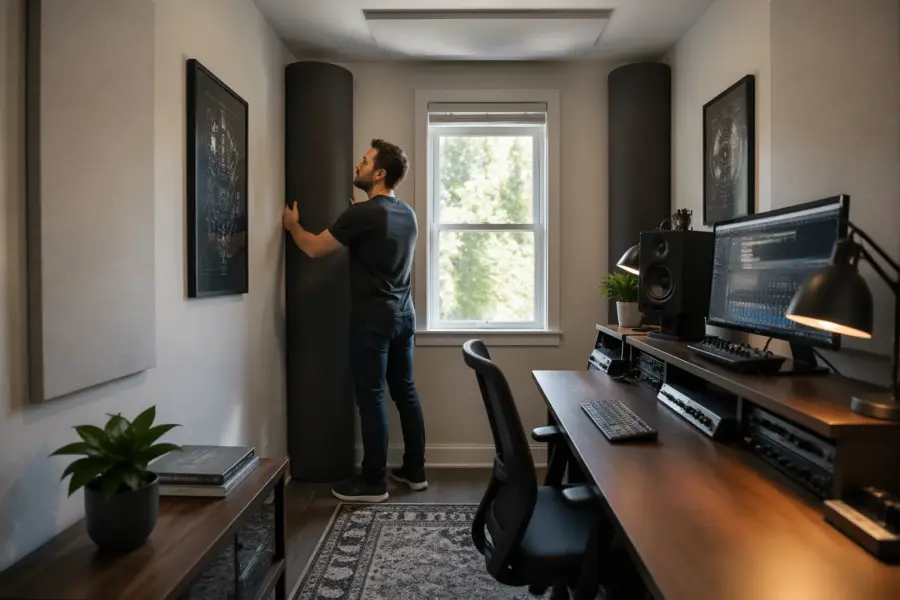
If you do only one thing, treat corners and the rear wall before you chase tiny tweaks. Corner traps attack multiple axial modes at once, and the rear wall treatment reduces the strongest lengthwise reflection.
- Front corner bass traps, floor to ceiling if possible
- Rear wall thick absorption behind the chair
- Side wall first reflection panels at ear height
- Ceiling cloud above the desk and speakers
- Back corners treated with thick traps or soffit style
- Front wall absorption between and behind speakers
What to do with corners when the room is tight
In narrow rooms, corners are often blocked by doors, wardrobes, or a standing desk. That does not mean you give up, it means you get creative with shapes and placement.
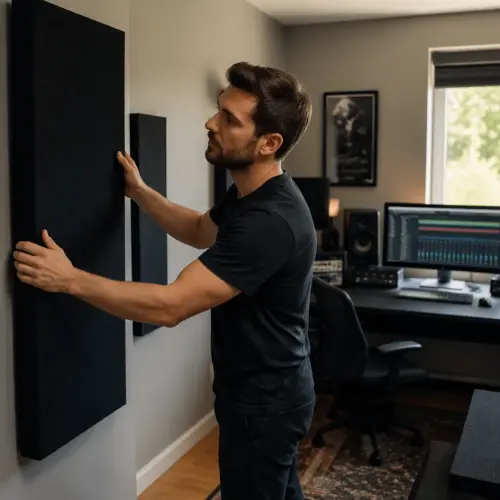
If a door eats one front corner, trap the other front corner aggressively and add a panel on the door itself. A removable door panel with mineral wool can help, and you can take it down when you need access.
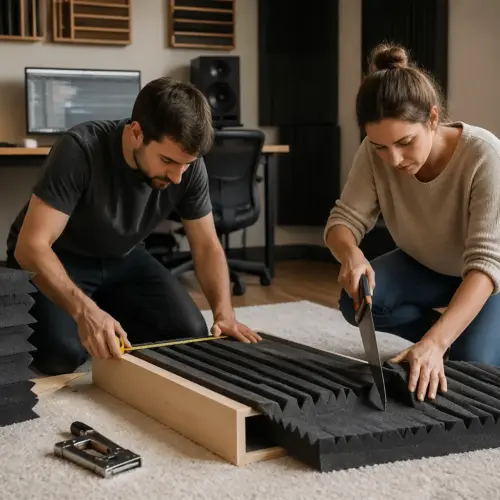
Triangular corner traps work, but big flat panels straddling the corner often work almost as well and are easier to build. Leave an air gap behind the panel, because that gap increases low-frequency absorption without adding thickness.
Do not ignore the wall to ceiling corners just because they are out of reach. Lightweight soffit traps or even thick panels mounted high can reduce boom without stealing floor space.
Rear corners are usually easier to treat because you do not need legroom back there. If you can fit two big traps in the back corners plus rear wall absorption, the room often stops acting like a bass megaphone.
When budget is limited, I would rather see two deep corner traps than six thin panels spread around randomly. Bass needs depth, and narrow rooms punish shallow treatment.
Front wall strategy, boundary gain, and the desk problem
The front wall is the surface behind your speakers, and it controls a lot of early low-frequency behavior. If you place speakers close to it, you get boundary gain that can sound fuller, but you also risk upper bass cancellations if the distance is awkward.
I like either very close placement or a clearly measured mid-field placement, and I avoid the “somewhere around a foot” habit. That in-between spacing often lands the cancellation right where bass guitar fundamentals live.
Put absorption on the front wall if you can, especially between and behind the speakers. A 4-inch panel with a 2-inch air gap can reduce the front wall bounce and make the low end less smeared.
The desk itself creates a reflection path that can combine with front wall issues, especially if the monitors sit on the desk. Use stands or isolation pads to raise the speakers and keep the tweeters at ear height, then pull them forward so the front baffle clears the desk edge.
Keyboard trays and monitor arms are not acoustic treatment, but they can reduce how much hard surface sits between you and the speakers. In narrow rooms, small ergonomic changes can buy you space for better placement.
If you want a simple test, move the speakers forward and back in 2-inch steps and re-measure. The best spot is usually obvious in the 80 to 200 Hz region, where the response smooths out and the punch returns.
Using measurement to find the least bad listening position
Room correction software cannot fix a deep null, because you cannot boost what cancels in the air. Measurement helps you avoid the null in the first place, then EQ can polish the remaining peaks.
Start with the listening position, then lock speaker placement, then treat, and only then consider EQ. If you reverse that order, you will chase your tail and keep second-guessing every change.
In REW, look at frequency response and waterfall plots, because decay time matters as much as the curve. A narrow room can measure “flat enough” but still ring at 50 Hz for a long time, which makes bass notes feel slow.
Take measurements in a small grid around your head position, like a six-inch cube, and average them mentally. That keeps you from optimizing for a single point that changes the moment you shift in your chair.
Do not obsess over smoothing settings or perfect target curves. Your goal is simpler, reduce the biggest peaks, avoid the worst nulls, and shorten the decay so the room stops arguing with the music.
Once you treat, re-measure and then decide if room correction is worth it for the last bit of cleanup. Software like Sonarworks or Dirac can help with broad peaks, but it performs best after you already handled the physical problems.
Conclusion
Bass control in a long narrow room comes down to stacking small advantages, smart orientation, careful speaker spacing, and a listening position that avoids the worst axial modes. When those basics are right, treatment starts working with the room instead of fighting it.
Focus on the lengthwise behavior first, because the front-to-back mode and the rear wall are usually the main troublemakers. Thick corner trapping and rear wall absorption beat thin panels every time in a narrow office.
If you want one practical plan, face the short wall, sit around 38 percent of the room length, keep speakers reasonably close together, and measure before you buy more gear. You will still have a small-room sound, but you will stop guessing where the bass went.