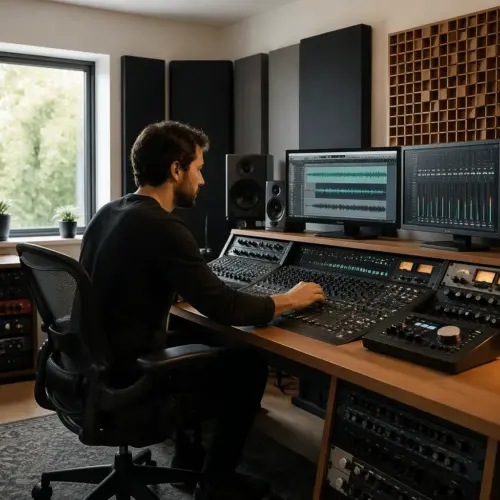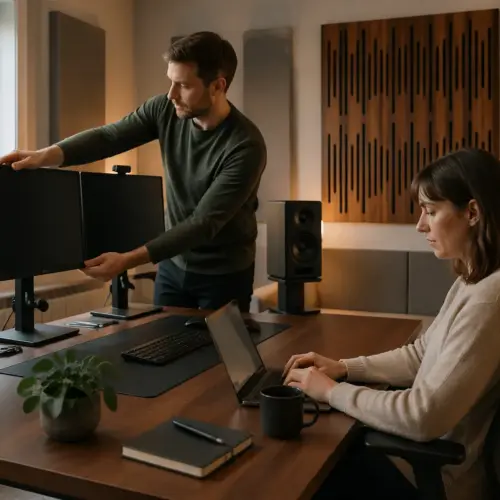

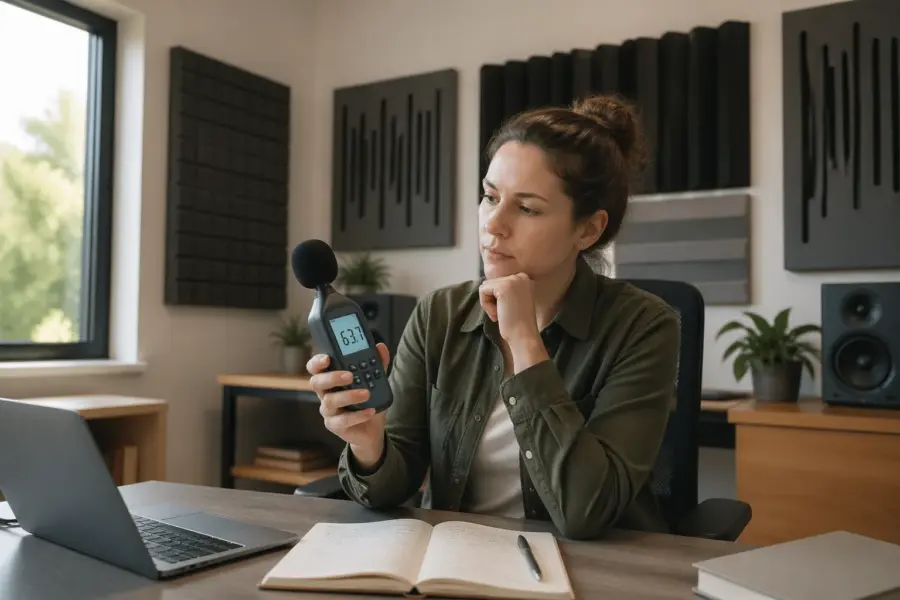
You can find room modes with nothing more than tones and careful listening, and I think every home office studio owner should try it at least once. It teaches you what your room is doing instead of what a graph says it is doing.
If your mixes have bass that swings between too much and not enough, room modes are usually the reason. The good news is that learning how to find room modes without software is straightforward if you work slowly and stay consistent.
This article sticks to simple listening tests, a sine sweep, and a few repeatable positions in the room. You will end up with a practical map of bass hotspots and weak spots you can use to move your desk, chair, or speakers before you buy treatment.
What room modes are and what they sound like
Room modes are resonances caused by standing waves between boundaries like the front and back wall, side walls, and floor and ceiling. At certain bass frequencies, the sound piles up in some places and cancels in others.
When you hit a modal frequency, bass can suddenly get louder, slower, and kind of one note, like the room is humming along with the speaker. When you land in a cancellation, the same note can almost disappear even though the speaker is working.
The easiest way to recognize modes by ear is to play a steady low tone and walk around. You will hear the level change in a way that feels disconnected from distance to the speaker, because the pattern is tied to the room geometry.
In a typical home office, the strongest problems are below about 200 Hz, where wavelengths are long enough to interact with the room size. That is why you can EQ a kick drum forever and still feel like the low end will not sit still.
A good way to think about it is that the room is adding its own EQ curve, but only at certain positions. Two people in the same room can honestly disagree about how much bass there is, because they are sitting in different parts of the pattern.
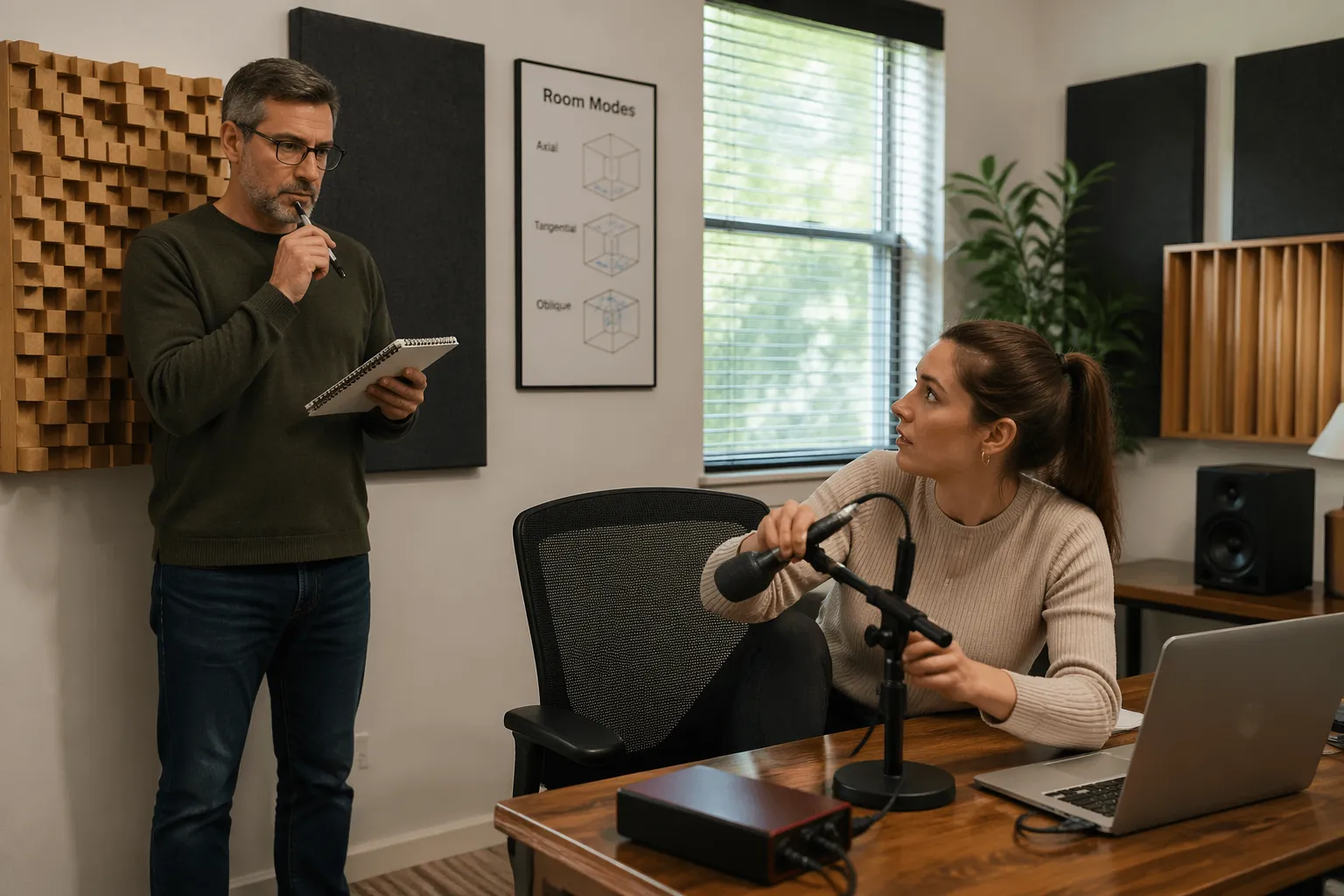
Modes do not just change loudness, they also change timing and decay. A resonant note can hang on longer than the notes around it, which makes bass lines feel smeared and makes kick drums lose their punch.
Some modes are narrow and obvious, like a single note that jumps out every time it appears in music. Other modes are broader and feel like the whole low end is tilted or lumpy, which is why people often blame their monitors instead of the room.
You might also hear a strange fluttering or “beating” effect when two nearby modes interact. That can make sustained bass notes sound like they are wobbling even when the source is perfectly steady.
It helps to remember that your ears are very sensitive to changes in bass balance, but not always great at assigning a cause. The goal of these listening tests is to connect what you hear to where you are standing or sitting, so the room stops being a mystery.
When people say a room has “boomy bass,” they are usually describing a strong peak plus long decay at one or two modal frequencies. When people say a room has “no bass,” they are often sitting in a null and turning up the low end to compensate.
Most home studios are small enough that a handful of axial modes dominate what you hear. Those are the ones bouncing between two parallel surfaces, and they tend to be the easiest to identify with simple tones.
Tangential and oblique modes exist too, and they can fill in the gaps in a way that makes the room feel uneven rather than obviously resonant. You do not need to classify them to benefit from this process, but it helps to know why the pattern can feel messy.
If you only take one thing from this section, it is that modes are position-dependent problems. That is why walking around with a tone is so revealing, because it turns the invisible pattern into something you can hear immediately.
Tools you can use: phone tones, test tracks, and your ears
You do not need measurement software to get useful results, but you do need repeatable signals. A phone tone generator app, a YouTube sine sweep, or a downloaded test track works fine if you control the volume.
I prefer a slow sine sweep from about 20 Hz to 200 Hz because it exposes peaks and dips without you guessing which note you are hearing. If you cannot do a sweep, use individual sine tones at common problem spots like 40, 50, 63, 80, 100, 125, and 160 Hz.
Use speakers you actually mix on, and set them at a moderate level that will not trigger limiter behavior or rattle the desk. If your room buzzes at certain notes, fix the buzz first or it will mask what the bass is doing.
Bring a notepad, painter’s tape, and a pen, because you are going to mark the floor and write down what you hear. This is low tech on purpose, and it is the simplest way to learn how to find room modes without software in a repeatable way.
A tone generator app is fine as long as it can play a stable sine wave and let you change frequency in small steps. If the app only jumps in big increments, you can still learn a lot, but you might miss the exact center of a narrow peak.
If you use YouTube, download the sweep or make sure your connection is stable so it does not change quality mid-test. Compression artifacts can add harmonics that confuse the listening, especially when the fundamental is near a null.
Set your system to mono for these tests if you can, because it simplifies what you are hearing. Stereo can create left-right differences that are useful later, but first you want to understand the basic room response without extra variables.
Turn off room correction, “bass boost,” and any loudness settings while you test. Those features can move the target around while you are trying to map the room, which makes your notes less reliable.
It also helps to close doors and windows and keep the HVAC off for a few minutes. Low frequency noise from outside can mask quiet parts of the sweep and make nulls seem less dramatic than they are.
Use a consistent starting volume and do not chase the sweep with the knob. If the very low end is too quiet to hear, raise the level a little and restart from the beginning so the whole test stays consistent.
Headphones are not a substitute for this, because the whole point is to hear how the room loads the speakers. You can use headphones to double-check that the sweep file is clean, but do the mapping on speakers.
If you have a friend who can change frequencies while you stand in different spots, it makes the process smoother. If you are alone, set up a loop and learn the timing so you can move without constantly running back to the computer.
Do not worry about perfect frequency labeling at first, because your ears are the main instrument here. What matters is that you can say, “this band gets loud here and weak there,” and then confirm it by repeating the same test later.
A simple metronome click track can also help you keep your movement consistent, because it gives you a steady pace. Consistency is what turns a casual listen into a repeatable method you can trust.
Step-by-step: mapping bass hotspots in your room
Start with your speakers in their normal spots and your chair pushed out of the way so you can move freely. Play a sine sweep slowly, then loop it, and keep the volume steady for the whole test.
Walk a simple grid pattern, front to back and side to side, and stop every couple feet to listen for bass that suddenly blooms. When you find a bass hotspot, put a small piece of tape on the floor and write the frequency range that jumped out.
Begin along the centerline of the room, because it is easy to remember and easy to repeat. Start near the front wall, then take a step back each sweep cycle so you can compare the same frequencies at different distances.
When you hear a peak, pause your movement and let the sweep pass that frequency again. You want to confirm that the “woof” is tied to the room position and not just a momentary distraction.
After the centerline, do the same walk about one to two feet off the left wall, then repeat one to two feet off the right wall. This helps you catch strong side-wall related patterns that might not show up in the middle.
Spend extra time in the corners, because corners tend to collect low frequency pressure. Even if you never sit in a corner, corner behavior tells you where bass trapping will be most effective later.
Try not to judge the room with music yet, because music changes too fast. The sweep is boring on purpose, because it makes it obvious when one frequency is misbehaving.
If you are using single tones instead of a sweep, hold each tone for five to ten seconds. Walk slowly while it plays, then switch to the next frequency and repeat the same path.
Keep your head at roughly ear height for your normal listening position when you do the main mapping. If you crouch or stand tall without meaning to, you can accidentally mix vertical mode changes into your notes.
Use simple labels on the tape like “80 loud” or “63 weak” so you can read them later. You can always rewrite cleaner notes afterward, but you cannot recover information you forgot to mark.
Once you have a few hotspots marked, connect them mentally into zones rather than single points. Modes usually create bands or stripes of louder bass, so the tape should start to look like a pattern instead of random dots.
Do at least two full passes of the room, because the first pass teaches you what to listen for and the second pass confirms it. If a hotspot shows up both times at the same place, it is real enough to act on.
If the sweep makes you feel like the bass is moving around your head, slow down your walking speed. Fast movement can make the changes feel exaggerated, and you want to hear the shape of the room rather than a blur.
When you are done, stand still in your best guess “mix position” and listen to the sweep one more time. This gives you a baseline impression you can compare against after you move furniture or speakers.
| What you do | What you listen for | What it usually means |
|---|---|---|
| Loop a 20 to 200 Hz sine sweep | Sudden loud “woof” at one pitch | Modal peak, likely axial between two walls |
| Stand near the room center | Bass gets weirdly uneven across notes | Multiple modes stacking and canceling |
| Move into corners | Big overall bass rise | Pressure buildup, corner hotspots |
| Move along a wall midline | One note dominates more than others | Side wall or front wall mode emphasis |
Use the table as a quick translator between what you are doing and what you are hearing. The goal is not to diagnose every acoustic detail, but to make your next move obvious.
If you keep hearing the same frequency jump out near the same wall, you are probably dealing with a strong axial mode tied to that dimension. That is useful because it tells you which direction in the room is the main culprit.
If the hotspots feel scattered and change with tiny steps, you might be hearing a combination of modes plus boundary reflections from furniture. In that case, simplify the room a little by moving big objects away from the speakers before you redo the test.
Do not ignore the spots where bass gets quieter, because those are often the places you accidentally choose for your chair. A good map includes both the “too much” zones and the “where did it go” zones.
Identifying nulls at your chair and at the desk
Nulls are the spots where standing waves cancel, and they are the reason you can lose the fundamental of a bass note at the listening position. A null is harder to notice than a peak because it feels like the speaker got quieter or the mix got thin.
Put your chair exactly where you normally sit, and play single tones or a very slow sine sweep through the bass region. When a note drops out, do not touch the volume, just mark the frequency and keep going.
Now do the same test with your head moved forward and backward by about 6 to 12 inches while staying centered left to right. If the bass comes back fast with small movement, you are sitting in a sharp cancellation and you should treat it as a positioning problem first.
Check the desk area too, because large desktops can create reflections that change what you hear around the crossover region. If your null changes when you lean over the desk, the desk surface and speaker height may be part of the issue.
When you find a likely null, confirm it by moving your chair a small amount and repeating the same tone. A true null will change dramatically with small position shifts, while a general lack of bass will not.
Pay attention to whether the null is mostly on one speaker or both, because that changes the fix. If it is worse on one side, you may have an asymmetry like a doorway, a closet, or a big piece of furniture changing the boundary conditions.
Try the test with only the left speaker playing, then only the right speaker playing, at the same volume. This can reveal whether the dip is caused by a room mode that affects both speakers or a reflection path that is different for each one.
Also listen for the “kick drum illusion” where the click sounds fine but the weight is missing. That usually points to a null around the fundamental region, which makes you overcompensate with EQ and end up with boomy mixes elsewhere.
If you have a subwoofer, do these null checks with the sub on and off. A sub can fill in some dips if it is placed well, but it can also create new cancellations if it is fighting the mains.
Desk reflections can create a comb-filter effect higher up, but they can still influence what you perceive as bass balance. If your speakers are sitting on the desk, consider that the desk is acting like a big reflective surface right under them.
Try raising the speakers a few inches or angling them slightly so the main axis clears the desk edge. Even small changes can clean up the low-mid transition and make the bass feel more consistent.
Do not forget to check your listening height, because your ears move vertically when you adjust your chair. If the bass changes a lot when you sit up straight versus slouch, you are likely crossing a vertical node.
Write down not only the frequency but also how wide the problem feels. A narrow null might only affect one note, while a wide dip can make the entire bass range feel underpowered and misleading.
Once you have two or three suspect frequencies, play a bass-heavy song you know well and focus on those notes. You are training yourself to recognize the room’s fingerprints in real music, which is the practical payoff.
How room shape and seating position create the problem
Room modes follow the dimensions of the room, so a 10 foot or 12 foot length often creates a strong low frequency resonance right where you care about kick and bass. Square rooms are usually worse because multiple modes pile up at similar frequencies.
Your seating position matters because pressure patterns have predictable nodes and antinodes, and your ears are sampling one point in that pattern. Sit halfway between front and back wall and you often land near a cancellation for the length mode, which can gut bass around one key note.
Speaker distance to the front wall also changes how much boundary reinforcement you get, especially below 100 Hz. Pulling speakers far into the room can reduce some boundary buildup, but it can also create a deep dip if the front wall reflection arrives out of phase.
Ceiling height sneaks in too, because the floor to ceiling mode can hit right in the upper bass, especially in rooms with 8 foot ceilings. If your bass changes when you stand up versus sit down, you are hearing that vertical pattern in real time.
Parallel surfaces are the main reason modes are so strong in typical bedrooms and offices. The room does not have to be perfectly rectangular to have problems, it just has to have a few strong opposing boundaries.
Alcoves, closets, and open doors can change the effective dimensions of the room at certain frequencies. Sometimes that helps by letting energy leak out, and sometimes it makes one side behave differently than the other.
Furniture placement matters more than people expect, because big objects can act like partial boundaries. A tall bookshelf or a filled closet can stiffen one wall acoustically, while a thin door can flex and absorb a bit of low end.
When you sit close to a wall, you are often closer to a pressure maximum for some modes. That can make bass feel louder but also less accurate, because you are hearing the room’s buildup rather than the speaker’s balance.
When you sit in the exact center of the room, you often avoid some peaks but fall into some nulls. That is why “center is best” is not a reliable rule, even though it can feel symmetrical and convenient.
Small rooms also tend to have sparse modal distribution, which means there are bigger gaps between resonances. That can make certain notes feel strangely disconnected from the rest of the bass line, like the instrument changes size as it plays.
Speaker placement interacts with modes because the speaker is the source feeding the room. If the speaker is placed at a node for a particular mode, it may excite that mode less, which can be good or bad depending on what you need.
Listening position interacts with modes because your ears are the receiver. You can have a room with a strong mode, but if you sit at a spot that happens to be relatively even for that frequency, you might not notice it until you move.
It is also common to have left-right differences even in a “rectangular” room because real rooms are not perfectly symmetrical. A window, a radiator, or a desk shoved into one corner is enough to make one channel feel heavier.
All of this is why the listening tests are so valuable, because they bypass the theory and show you what your specific room is doing. Once you can hear the pattern, the fixes start to feel logical instead of random.
What to change first: position before treatment
Before you buy panels, move the chair and speakers because free changes beat expensive ones. I treat bass hotspots and nulls as a geometry problem first, then I use treatment to smooth what is left.
Start by moving your listening position forward or backward in small steps, then repeat the same sine sweep and note changes at the same frequencies. A move of even 4 inches can turn a nasty null into a workable dip, especially in short rooms.
Try to keep the listening position off the exact center of the room length, because that is a common null zone. A simple starting point is roughly 35 to 40 percent of the room length from the front wall, then you fine-tune by ear.
Keep your speakers symmetric to the side walls while you experiment, because symmetry helps stereo imaging and makes the bass response easier to interpret. If you must break symmetry due to a door or closet, do it intentionally and document what changes.
Move the speakers closer to the front wall and listen again, because boundary reinforcement can sometimes fill a dip at the listening position. The tradeoff is that it can also increase a peak, so you are listening for the best overall compromise.
Move the speakers farther from the front wall and listen again, because it can reduce some buildup and shorten decay. If the bass gets tighter but a specific note disappears, you have learned something important about that reflection path.
Adjust toe-in and speaker spacing only after you have a decent front-back position, because those changes can distract you from the main low-frequency issues. Once the bass is more stable, imaging tweaks become more meaningful.
Consider the height of the speakers relative to the desk and your ears, because that can change the perceived punch region. A small stand or isolation pad can lift the speaker and reduce the desk’s influence.
If you have a subwoofer, experiment with sub placement after you have the mains in a reasonable spot. The sub can be moved independently, which gives you another lever to reduce peaks and fill dips without touching the desk layout.
Do not chase perfection with position alone, because small rooms will always have some unevenness. The goal is to get out of the worst nulls and reduce the most obvious peaks so your mixes translate better.
Once you find a better spot, live with it for a day and play normal music quietly and loudly. A position that seems great on a sweep can still feel strange with music if it shifts the tonal balance too far.
- Move the chair 4 to 8 inches at a time, then retest
- Keep speakers symmetric to the side walls
- Try speakers closer to the front wall, then retest
- Adjust speaker height to reduce desk reflections
- Mark the best spot with tape before you commit
- Recheck with familiar bass heavy music at the end
The list is meant to keep you from making five changes at once and getting lost. If you change one thing, you can hear what that one thing did, and your notes stay meaningful.
When you retest, use the same sweep file, the same volume, and the same listening height. Consistency is what makes the “before and after” comparison real instead of wishful thinking.
If you end up choosing between two positions, pick the one with fewer deep nulls even if it has a mild peak. Peaks are often easier to tame later with treatment, while deep cancellations are stubborn and tend to trick your mixing decisions.
After you settle on a position, take photos or make a quick sketch of distances to the walls. That way you can return to the same geometry if you rearrange the room later or move to a new space.
Conclusion
If you can hear bass swell in one spot and vanish in another during a sine sweep, you have already proven the room is shaping your low end. That is the core of how to find room modes without software, and it is more useful than people think.
Once you map bass hotspots and find the worst nulls at your chair and desk, you can make smarter choices about placement and treatment. Move first, measure with your ears again, then add bass trapping where the room keeps misbehaving.
The biggest win is that you stop mixing against a moving target. When the room is more predictable, you spend less time second-guessing the low end and more time making musical decisions.
Even if you eventually buy measurement gear, this skill still matters because it teaches you what the numbers feel like. Your ears are the final judge, and training them in your own room pays off every time you hit play.
Keep your tape marks and notes for a while, because they become a reference when you add a rug, a couch, or bass traps. Small room changes can shift the pattern, and having a baseline makes it easier to tell what improved.
If you do nothing else, at least confirm that your chair is not sitting in a deep null. That one change alone can make your mixes translate better without touching a plugin or buying a single panel.