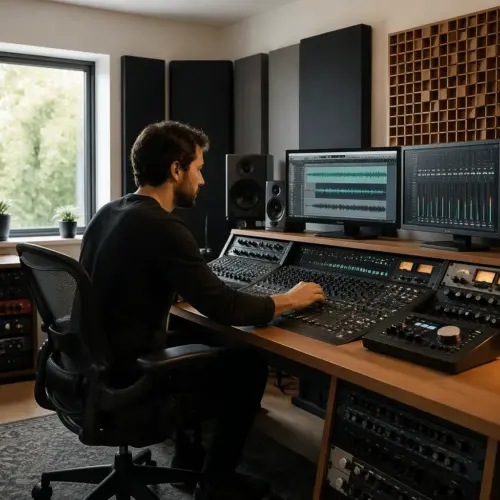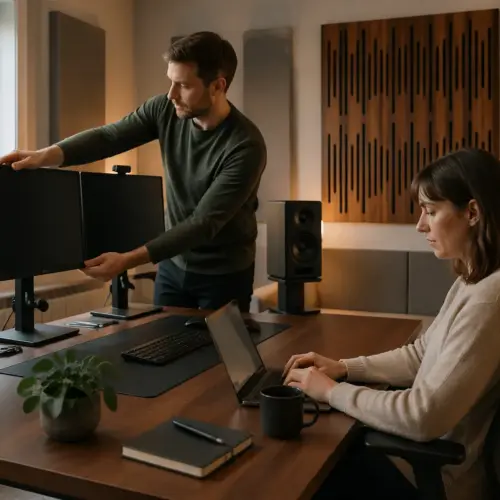

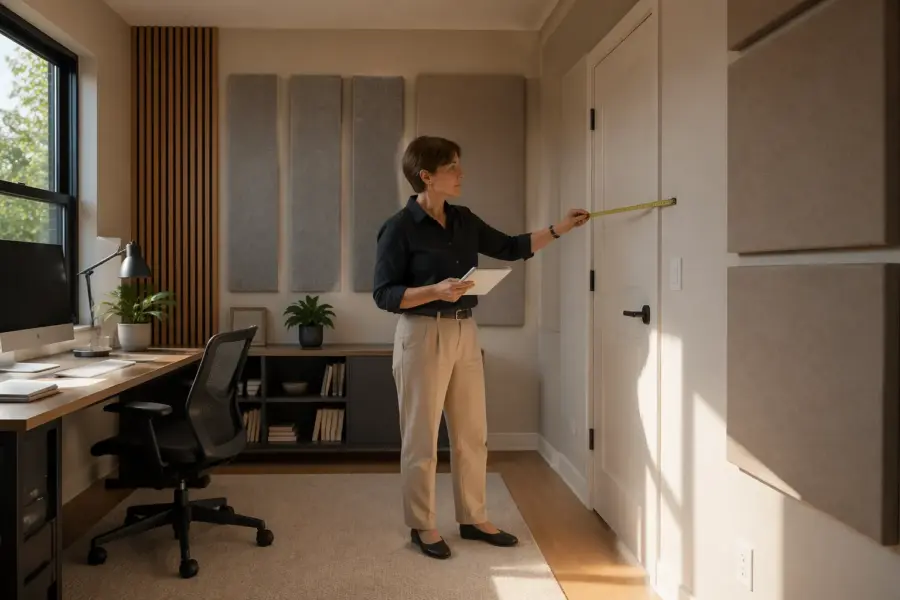
A door can wreck an otherwise sensible home office studio faster than a bad chair or a cheap interface. If your mixes keep leaning left or your voice recordings sound boxy, your home office studio door placement is a quiet suspect.
Doors change how you move through the room, but they also change how sound moves through it. The door itself is a big, reflective panel that sometimes disappears, sometimes swings into the space, and always forces compromises.
I see people obsess over foam tiles while their desk sits inches from a door that opens right into the listening position. Fix the geometry first, then treat the acoustics, because the order matters.
Why doors change your room’s geometry more than you think
A door is a moving boundary, and moving boundaries are hard to predict in a small room. When the door is closed, it is a stiff reflector, and when it is open, it becomes a big angled surface that can throw energy toward your monitors.
That swing changes the effective shape of the room, which changes where standing waves pile up. You can measure a room all day, then open the door and watch the low end shift in a way that makes you doubt your ears.
Doors also break symmetry, and symmetry is your friend when you are trying to judge stereo balance. If one side wall is clean drywall and the other side has a door, trim, and a gap, your left and right reflections will not match.
The door gap matters more than people expect, because it leaks bass and changes decay time in the lowest octave. That leak can be helpful, but it also makes your room response depend on whether the door is latched or just resting against the jamb.
Map your door’s swing and “dead zone” on the floor
Start with painter’s tape and draw the door swing arc on the floor, because you need a physical reminder of what space is actually usable. Mark the fully open position, the half open position, and the spot where the knob would hit a chair back or a mic stand.
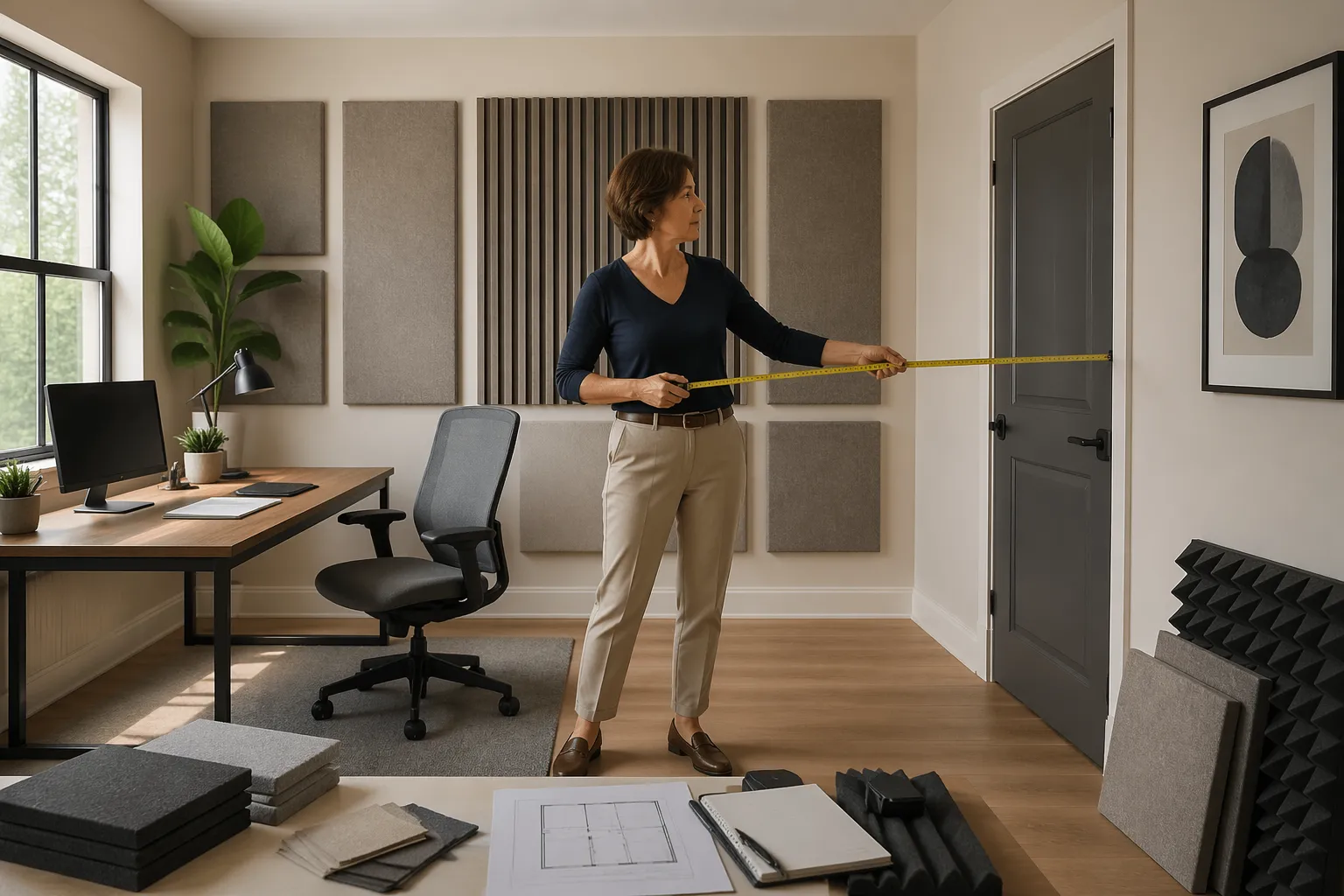
The taped arc creates a “dead zone,” meaning a zone you cannot reliably place gear in without rethinking traffic flow every day. If your chair or rack lives in that arc, you will end up mixing with the door partly open just to make the room usable.
Now stand at your desk and imagine the door opening during a call or a session, because real life happens mid take. If the door swing direction sends the door edge toward your speaker, you have a rotating reflector that changes your early reflections every time someone walks in.
Take one more step and mark your listening triangle on the floor, because geometry beats guesswork here. When the door arc overlaps the listening triangle, your home office studio door placement is actively fighting your monitoring position.
Choose the best wall to use when the door steals symmetry
If the door is on one of the short walls, you often lose the obvious “desk on the short wall” setup. In that case, using the long wall can be the better move, even if it feels wrong at first.
Your goal is simple, keep the left and right boundaries as similar as you can around the listening position. That usually means picking a wall where the door ends up behind you, or at least far enough away that it does not dominate the first reflection points.
| Door location | Best “default” desk wall | Reason to pick it |
|---|---|---|
| Door on front short wall, near a corner | Long wall, centered between corners | Restores left-right similarity at the desk |
| Door on side long wall, near the front | Front short wall, centered | Keeps door out of the main reflection zone |
| Door on side long wall, near the back | Front short wall, centered | Door stays behind the listening position |
| Door on back short wall, centered | Front short wall, centered | Symmetry stays intact, door is behind you |
Keep reflections predictable near the door side
Reflections are not the enemy, unpredictable reflections are the enemy. A door creates a surface that changes angle and distance, so the trick is to make the door side behave more like a normal wall.
Start by finding first reflection points with a mirror test on both side walls, because those spots drive stereo clarity. If the mirror point lands on the door, treat the door like a wall and plan for absorption that can live on it.
A 2 inch or 4 inch absorber on the door can work, but it has to be mounted so it does not rattle when the door closes. I like lightweight rockwool panels in a wood frame with rubber bumpers, because a buzzing panel will ruin your day during quiet edits.
If you cannot mount anything to the door, put a freestanding panel on the hinge side that stays in place when the door opens. That keeps the early reflection path consistent, and it also reduces the temptation to mix with the door half open.
Desk alignment that survives real life door use
Desk alignment is where acoustics and ergonomics collide, because you need a clean stereo field and a room you can enter without doing a sideways shuffle. If your desk forces you to sit off center just to clear the door, your mixes will drift because your brain keeps compensating.
Keep your monitors and chair centered on the room axis you choose, then adjust everything else around that anchor point. I would rather move a bookshelf, a printer cart, and a plant than give up a centered listening position.
Make sure the door swing direction does not point the inside face of the door at your tweeters when it is open. An open door that faces your speakers can act like a reflector that makes the top end sound sharper on one side.
If you must work with the door open for ventilation, lock the door to a repeatable angle with a wedge and treat that angle as the “real” room shape. Consistency matters more than perfection when you are trying to learn a room.
Practical layout options for common door locations
When the door is on the side wall near the front, the cleanest layout is usually desk on the short wall with the door behind the speakers line. That keeps the door out of the first reflection points and reduces the chance that a swinging door changes your imaging mid session.
When the door is on the side wall near the back, you can often keep the classic centered desk on the short wall and treat the door side like the other side. Place absorption at the first reflection points, then add bass trapping in the front corners where it pays off the most.
When the door is on the front short wall, you usually have to choose between symmetry and convenience. If you can, move the desk to the long wall and keep equal side distances, because the stereo image will thank you.
When the door is on the back wall, keep the desk on the front short wall and build a solid rear wall treatment plan. A thick absorber or a hybrid panel behind your chair can tame slapback that otherwise bounces off the door and into your mic.
Small geometry tweaks that make the door less of an acoustic wildcard
You can’t always move a door, but you can control how it behaves, and that is often enough. A few small changes can make home office studio door placement feel less like a permanent compromise.
Most of these tweaks cost less than a pair of monitor stands, and they work even in rentals. They also reduce the day to day variability that makes you second guess EQ decisions.
- Door sweep to reduce low frequency leakage
- Weatherstripping around the jamb for a tighter seal
- Hinge pin door stop to limit swing angle
- Heavy curtain on a tension rod near the door plane
- Freestanding absorber parked at the door reflection point
- Soft door closer to prevent slam induced rattles
When to flip the door swing direction, if you can
Changing the door swing direction can be a bigger win than adding another panel, because it changes the usable geometry every day. If the door currently swings into the room and blocks your chair path, an outward swing can free up space and reduce random reflections near the desk.
In many homes you can reverse the swing by moving hinges and the strike plate, but you have to check clearance and code rules first. Bathrooms and closets have common rules, and you do not want to create a door that hits a hallway wall or blocks an egress path.
From an acoustic angle, I prefer a swing that keeps the door surface closer to parallel with a wall when open. A door that opens flat against a side wall behaves more predictably than one that sits at a 45 degree angle and sprays reflections into the room.
If you rent and cannot change hardware, you can still “fake” a better swing by keeping the door either fully closed or fully open against a wall stop. Half open doors are where you get the weirdest comb filtering at the listening position.
Handling first reflection points when the door is in the wrong place
First reflection points are the spots where sound from your monitors hits a surface once and then reaches your ears, and they shape clarity and phantom center. If one side reflection is off drywall and the other is off a door panel, you get a lopsided image that never quite locks in.
If the reflection point lands on the door, treat the door, or treat the space just in front of it with a panel on a stand. The goal is to make both sides similar in absorption and distance, even if the construction is different.
Pay attention to the trim and the gap, because those small edges can create extra high frequency scatter on one side. Sometimes a thin absorber that covers the door panel and part of the trim cleans up the “spitty” side that people blame on their monitors.
Do the same check with the door open, because you might work that way during long days. If the open door creates a new reflection path, decide whether you will mix with the door closed and commit to that routine.
Door side bass behavior and why seals change your low end
A leaky door acts like a weak pressure vent, which can shorten bass decay and change the shape of room modes. That can make the room seem “tighter,” but it also means your low end depends on whether the latch is engaged.
If you add weatherstripping and a sweep, expect your bass response to change, because you just made the room more sealed. People sometimes add seals and then wonder why the 60 to 90 Hz region got louder and ringier, and the measurement will usually confirm it.
The fix is not to remove the seals, it is to trap more bass where it builds up. Put thick corner traps in the front corners first, then add a thick panel on the back wall if you sit close to it.
If the door is on the back wall, you might need a trap that can move with the door, like a rolling gobo or a panel on feet. That sounds fussy, but a movable trap is often easier than living with a boomy rear wall that changes every time the door moves.
Conclusion
Good home office studio door placement comes down to controlling symmetry, controlling the door swing direction, and keeping first reflection points consistent. If you can keep the door out of the listening triangle and treat the door side like a normal wall, your monitoring gets calmer fast.
Start with tape on the floor, then lock in desk alignment and commit to a door open or door closed routine. After that, add treatment where it counts, because panels work best when the geometry stops changing under them.
If your room is fighting you, do not blame your ears or your plugins first. Move the desk, tame the door, and make the room predictable enough that your decisions carry over to headphones, cars, and other rooms.