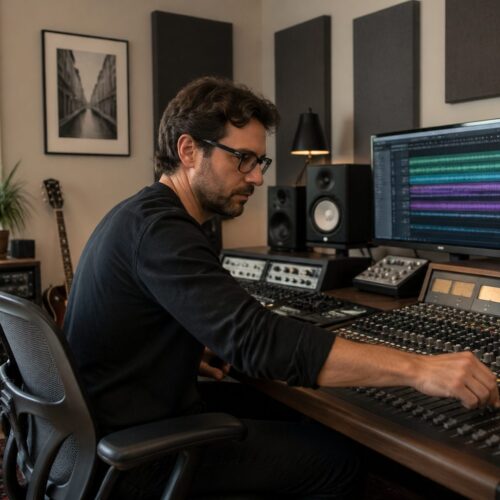

Most home offices have the same bass problem, the room is small, the boundaries are close, and the low end stacks up fast. You hear it as boomy notes, missing notes, and that weird “one note bass” effect that makes voice and kick drums hard to judge.
Even if you are not mixing music, that bass mess shows up as fatigue when you are on calls all day or trying to edit video with consistent dialogue levels. The room keeps changing what you think you are hearing, so you keep chasing the wrong fixes.
A ceiling bass trap for home office setups can be a smart move because the ceiling is a huge boundary that people ignore. When you treat the right ceiling zones, you can shorten bass decay without giving up floor space or turning your desk area into a foam fort.
The ceiling also tends to be the one surface you can treat without fighting furniture, doors, or the reality of living in the room. If you share the space, ceiling corner treatment is often the only upgrade that does not start arguments.
That said, ceiling treatment is not magic, and it will not fix a bad speaker position or a desk jammed into a corner. The wins come when you understand where pressure builds, then pick the soffit style approach only when the geometry calls for it.
If you treat the wrong zone, you can spend real money and end up with a room that looks more “studio” but still feels lumpy in the low end. The goal is not to decorate the ceiling, it is to make the room stop exaggerating and hiding bass.
What ceiling-level bass treatment can (and can’t) fix
Ceiling level bass treatment mainly targets low frequency buildup that collects at boundaries, especially where surfaces meet. In a typical spare bedroom office, that means wall-ceiling corners and the ceiling plane above and behind the speakers.
It is especially useful when the room is short in height, because the floor-to-ceiling mode can dominate the midbass and make everything feel thick. When that mode rings, it can make perfectly normal mixes sound like they have too much 80 to 120 Hz.
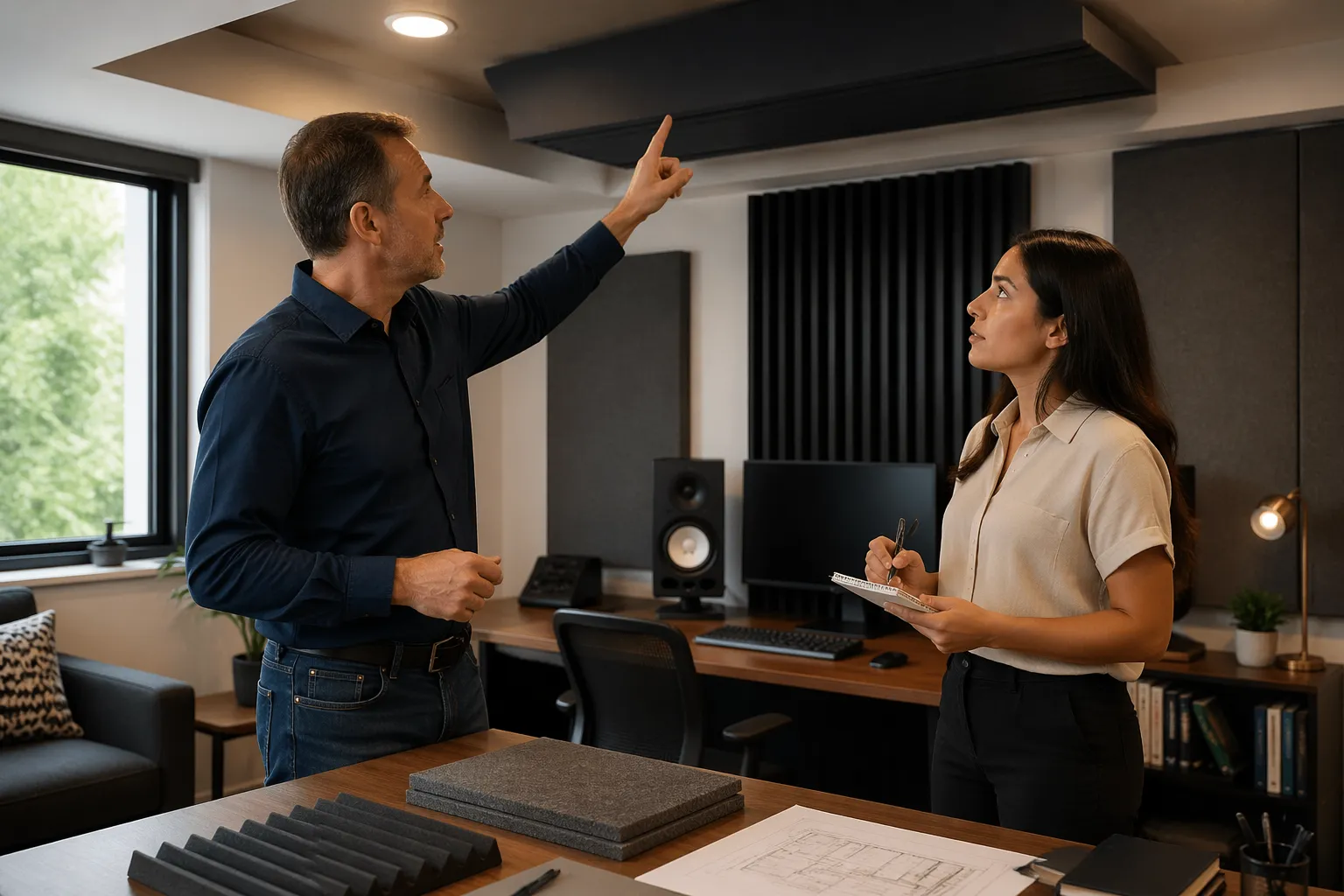
It can reduce ringing, which is the long decay that makes bass notes smear into each other. When the decay gets shorter, you can set EQ and compression with less guesswork because the room stops “singing along.”
That improvement is not always a dramatic change in loudness, and that is why people sometimes miss it at first. The real giveaway is that bass becomes easier to follow at low volume, and you stop needing to crank the monitors to “hear the low end.”
What it cannot do is fill in a deep null at the listening position caused by a strong cancellation. If your chair sits in a 70 Hz null, adding absorption overhead may help a little, but moving the listening position often helps more.
Nulls are geometry problems, and the room is literally subtracting energy at that spot. Absorption can reduce how sharp the cancellation feels, but it cannot change the fact that two wavefronts are meeting out of phase where your head is.
It also cannot fix bad symmetry, like a desk shifted toward one side wall with a closet opening on the other. Bass traps do not replace basic layout, they just make a decent layout behave better.
If the left speaker sees a wall and the right speaker sees open space, you will get different boundary gain and different decay, and the stereo image will lean. You can treat your way out of some of that, but it is always cheaper to start with a balanced setup.
Ceiling treatment also will not fix noise problems like HVAC rumble or street traffic, even though those issues live in the low frequencies too. If the problem is sound coming into the room, you are in isolation territory, not acoustic treatment territory.
Finally, it will not turn tiny speakers into full-range monitors, so do not expect a 4-inch woofer to suddenly tell the truth at 35 Hz. What it can do is make whatever speakers you have behave more consistently, which is the real home office win.
Identifying wall-ceiling pressure zones in your room
Low frequencies build pressure where boundaries meet, and wall-ceiling corners are a repeat offender in home offices. If you stand up and the bass changes a lot compared to sitting, you are hearing vertical modes and ceiling interactions.
That stand-up test is crude, but it is a fast way to confirm the ceiling is part of the story. If the bass gets louder when your ears get closer to the ceiling, you have a clue about where pressure is accumulating.
A simple way to find hotspots is to play a slow sine sweep at a moderate level and walk the perimeter. When the sweep hits a modal peak, the corner areas often get louder and more “stuck,” like the sound is glued to the boundary.
Do the same walk while you raise and lower your head near the wall-ceiling line, because the loudest spot is not always exactly in the corner. In some rooms the hotspot is a foot or two down the wall, which changes how you think about trap depth and placement.
If you have measurement gear, use REW with a calibrated USB mic and look at the waterfall or decay plot. Peaks with long tails point to where absorption can help, and soffit traps often help those tails more than thin panels do.
Try measuring at a few mic heights, not just at ear level, because it helps you see the vertical mode pattern. When the ceiling is involved, the response can shift a lot between a seated ear height and a standing ear height.
Do not ignore the front wall-ceiling corner above the speakers, because that zone often feeds the first axial and tangential modes. In many rooms, that one line of corner space does more work than a random panel placed mid ceiling.
The rear wall-ceiling corners can be just as loud if your listening position is closer to the back wall than ideal. If you clap and the room feels tight but the bass still hangs, that is often a sign that the problem is modal decay, not mid and high reflections.
Also pay attention to the corners above large furniture, because those areas can trap and re-radiate bass in weird ways. A tall cabinet can make a corner behave like a smaller cavity, which can add its own resonant character.
If your room has a dropped ceiling or a hollow plenum, the ceiling itself can act like a membrane at certain frequencies. That can make your measurements look inconsistent, and it can change which corner zones are worth treating first.
Soffit traps vs thick ceiling clouds: choosing the right tool
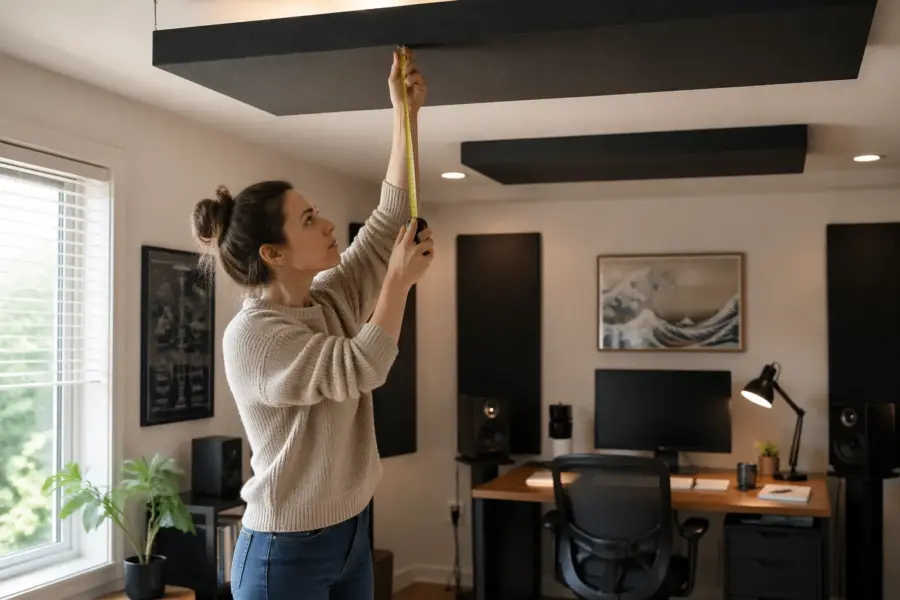
Soffit traps sit in the wall-ceiling corners, usually as long wedges or rectangular “columns” that run along the perimeter. Thick ceiling clouds hang flat overhead, usually centered over the desk and listening position, and they behave more like broadband absorbers.
In plain terms, soffits are about pressure zones and volume, while clouds are about reflection paths and coverage. Both can help bass a bit, but they help it in different ways and at different efficiency per inch of thickness.
If your main issue is low frequency buildup that feels strongest along the perimeter, soffit traps usually win because corners concentrate pressure. If your issue is early reflections and a boxy midrange, a thick cloud may give you more obvious improvement right away.
A cloud can also make your monitoring feel more stable because it reduces the ceiling reflection that competes with the direct sound. That stability can be mistaken for “more bass,” when it is really just less comb filtering and less smear in the upper bass and low mids.
Soffit traps are harder to build and mount, but they scale well because you can keep adding perimeter length. Clouds are easier to hang, but they start to eat headroom fast if you try to make them thick enough to act like serious bass absorption.
If you are doing video calls and you want the room to sound less hollow, a cloud can be a fast quality-of-life upgrade. If you are mixing or doing critical listening and the bass decay is the thing that keeps lying to you, soffits tend to be the more direct solution.
There is also a hybrid approach where you run narrower cloud strips around the perimeter and keep a thinner cloud over the desk. That can work well in low ceilings where a full deep cloud would feel like it is hovering over your head all day.
| Room symptom | Better first choice | Why it tends to work |
|---|---|---|
| Long bass decay at 40 to 120 Hz | Soffit traps | Corner pressure zones feed modal ringing |
| Boomy bass near walls, thinner bass at the chair | Soffit traps plus layout tweaks | Reduces boundary peaks while position fixes nulls |
| Fluttery, harsh “ceiling slap” on voice | Thick ceiling cloud | Stops early reflection between speakers and ceiling |
| Imaging feels smeared, center is unstable | Thick ceiling cloud | Improves reflection control at the listening position |
| Ceiling is low, head feels close to it | Soffit traps or perimeter cloud strips | Less headroom loss than a deep hanging cloud |
If you are unsure, start by measuring and deciding whether your problem is decay or response shape. Long decay usually points to needing more corner volume, while a jagged response with lots of midrange glare can point to reflection control.
Also be honest about what you can install cleanly, because a half-finished ceiling project can make a home office feel like a construction zone. The best tool is the one you can build safely, mount securely, and live with for years.
Placement plan: front, rear, or full perimeter
If you can only treat one area, start at the front wall-ceiling corners above the speakers and along the front wall. That zone tends to excite the strongest modes because the speakers pump energy straight into the boundaries.
Front placement also tends to help translation because it reduces the room’s tendency to hype the low end right where the speakers are working hardest. When the front of the room is calmer, the bass you hear is closer to what the speakers are actually producing.
Rear wall-ceiling corners often matter almost as much, especially if your chair is closer to the back wall than you want to admit. A rear soffit run can reduce the “bass behind your head” effect that makes mixes sound thick but sloppy.
Rear treatment can also make the room feel quieter at the same SPL, because you are not sitting in a zone where energy keeps bouncing and piling up. That matters in a home office where you want clarity without blasting the volume.
Full perimeter soffit traps make sense when the room is close to a cube or when multiple modes ring for a long time. In those rooms, you are fighting geometry, and spreading absorption along all wall-ceiling corners is one of the few moves that scales.
Perimeter runs also help when you do not have the freedom to put big traps on the rear wall, like when there is a door, a closet, or a window that needs to stay usable. The ceiling line is often the only continuous real estate you can count on.
If you are building in phases, do the front run first, then the rear, then the side runs. That sequence usually produces audible improvements at each step, and it keeps you from committing to a full build before you know the room’s real bottleneck.
Do not block HVAC returns, sprinklers, or ceiling fans, because you will hate the room later even if it measures better. In a home office, comfort and airflow matter, and the best treatment is the one you keep installed.
Also think about lighting, webcams, and monitors, because soffits can cast shadows or interfere with mounting arms. It is worth planning the room as a whole system so the acoustic upgrade does not create a daily annoyance.
If you have a ceiling-mounted projector or a boom arm for a mic, leave clearance so you are not bumping into treatment. A small gap in one section is fine if it keeps the room functional, as long as you do not accidentally leave the most important corner untreated.
How soffit-style treatment interacts with studio geometry
Soffit traps work best when the room has clean, continuous corners where pressure can build consistently. If your ceiling line breaks with beams, soffits, or a stepped ceiling, you may need shorter segments placed at the loudest sections instead of a full run.
Those breaks can actually be helpful if they act like diffusers for mid and high frequencies, but they rarely solve bass on their own. For low end, the room still behaves like a pressure box, and the corners still tend to be the hot zones.
In a room with a sloped ceiling, the highest pressure often still sits where the slope meets the side walls, but the exact spots can shift. A ceiling bass trap for home office use in a sloped room often ends up heavier on the low side near the front wall.
Slopes can reduce flutter echoes and change reflection angles, which is nice, but they can also create uneven modal distribution. That is why measurements matter more in sloped rooms, because the “obvious” corner is not always the most effective corner.
Closets and open doorways change the math because they act like leaky boundaries at some frequencies. Sometimes the “best” corner to treat is the one that stays closed most of the day, not the one that vents into a hallway.
A closet can also behave like a bass absorber if the door is thin and the cavity is large, but it is inconsistent and hard to predict. If you rely on a closet as part of your bass control, you are basically relying on a variable acoustic device that changes when the door opens.
Desk placement matters because the desk is a big reflective surface close to the speakers, and it can mask improvements you make elsewhere. If you treat corners but keep the speakers too close to the desk and front wall, you may still hear muddiness that is not purely bass.
The desk can also create a strong reflection that shows up as a dip in the low mids, which people sometimes misread as a bass problem. If you fix the desk reflection with speaker stands, a smaller desk, or a slight tilt, your bass decisions often get easier without touching the corners.
Speaker distance from the front wall interacts with the ceiling corner plan because SBIR can land right in the upper bass. If you are fighting a 100 to 150 Hz hole, you may need to move the speakers before you decide the ceiling needs more absorption.
Room symmetry matters for soffit runs, too, because uneven treatment can shift the decay differently left and right. If you cannot match the treatment, you can sometimes balance it by adding a comparable amount of absorption on the opposite wall at a different height, then re-measure.
If the ceiling is concrete or very rigid, bass pressure can be more intense because less energy is lost to boundary flex. In that case, deeper corner trapping tends to pay off, and thin solutions tend to feel like they do nothing.
Build and mounting considerations for safety and performance
A soffit trap needs real depth to do real bass work, and 12 inches is a practical minimum for many home offices. If you can manage 16 to 24 inches in the corner, you usually get a more noticeable change in decay below 100 Hz.
Depth is not just about absorption coefficient charts, it is about giving the low end enough material and air volume to lose energy. In small rooms, the difference between 8 inches and 16 inches can be the difference between “I think it helped” and “okay, that fixed something.”
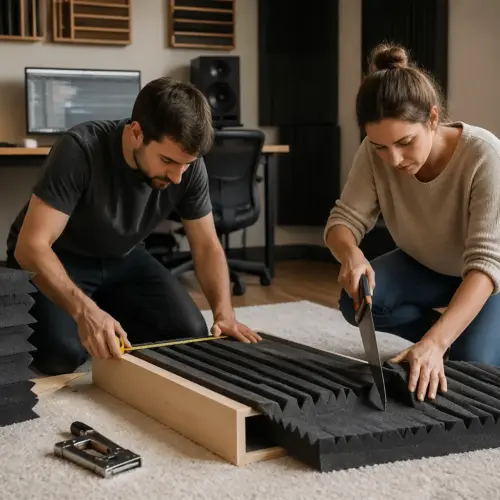
Use rigid fiberglass or mineral wool that holds its shape, like Owens Corning 703 or Rockwool Safe’n’Sound, and build a simple wood frame if the run is long. Leave an air gap behind the material when possible because the corner already creates one, and that helps the low end.
If you are building a wedge style trap, keep the face as open as possible so you are not turning it into a reflective box. A simple frame with fabric and minimal wood on the front face usually performs better than a heavy, sealed build.
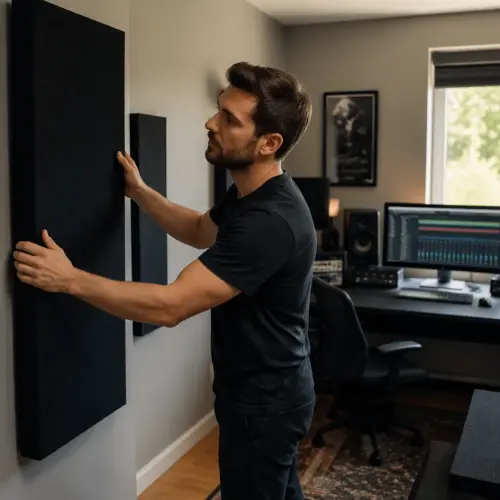
Mounting should assume the trap could fall, because gravity does not care how careful you were on install day. Screw into ceiling joists or wall studs, use proper brackets, and avoid relying on drywall anchors for anything heavier than a small cloud.
If you cannot find joists where you need them, consider a cleat system that spreads the load across multiple studs. In rentals, you may need a freestanding perimeter frame that presses into the corner without permanent fasteners, but it still has to be stable.
Fabric matters for performance and for living with the room day to day, so pick something breathable like Guilford of Maine or a similar open weave. If you can blow air through it easily, sound can get through it too, and that is the point.
Do not wrap traps in plastic or use a vapor barrier on the face, because it reflects highs and reduces absorption where you want it. If you need a dust liner, use a thin, breathable backing layer on the inside, not a sealed outer skin.
Think about fire safety, especially in an office with computers, power strips, and chargers running all day. Use fire-rated fabric when you can, and keep treatment away from hot lights, transformers, and anything that could fail and heat up.
Also plan for maintenance, because you may need to access cables, ceiling boxes, or Wi‑Fi gear later. A removable panel section can save you from tearing the whole run apart when you add a new camera or move a light.
If aesthetics matter, keep the soffit lines straight and consistent, because messy geometry makes the room feel smaller. A clean build looks intentional, and that makes it easier to justify in a home office that has to look normal on video calls.
How to confirm the improvement in bass decay
Your ears will notice cleaner bass lines, but you should still measure because perception shifts with volume and mood. Use REW to capture before and after sweeps at the listening position, then compare waterfalls in the 30 to 200 Hz range.
Take multiple measurements and average them, because a single mic position can land in a small local dip or peak. Even moving the mic an inch or two can change the response in the low end, so a small cluster of measurements gives you a more honest picture.
Look for shorter tails at the same peak frequencies, because that shows you reduced ringing rather than just changing the tonal balance. If the peak level drops slightly but decay stays long, you may need more corner volume or better placement.
Also watch for the opposite problem where the tonal balance changes but the decay does not, because that can trick you into thinking you “fixed” bass. A room can sound less boomy simply because the peak shifted, while the time-domain mess is still there.
Also check the spectrogram view because it makes stubborn resonances obvious, especially around 50 to 90 Hz in small rooms. When soffit traps work, those bands stop hanging around like a fog after the sweep ends.
If you want a quick sanity check, look at RT60 or Topt estimates in REW, but treat them as rough in small rooms. The waterfall is usually more intuitive because you can see exactly which frequencies refuse to die.
Do a few listening checks with familiar material that has steady sub and midbass, like Billie Eilish “bad guy” or Daft Punk “Giorgio by Moroder.” If the kick and bass separate more clearly at the same monitoring level, your room is behaving better.
Add a couple of speech checks too, because a home office lives and dies on intelligibility. If your voice recordings need less low-cut to sound clean, that is often a sign the room’s bass decay is no longer smearing the fundamentals.
Finally, confirm that the improvement holds at different volumes, because some resonances feel worse when you listen louder. A good treatment change tends to make the room more consistent, so the bass character does not swing wildly as you adjust the knob.
Common placement mistakes that waste ceiling corner space
The most common mistake is treating only the center of the ceiling and ignoring wall-ceiling corners entirely. A big cloud can help, but if the room has strong modal ringing, you usually get more bass control per cubic inch in the corners.
Another common mistake is placing a cloud too thin and too tight to the ceiling, which limits low frequency effectiveness. If you want a cloud to help bass at all, thickness and an air gap matter, and that often conflicts with headroom in a home office.
Another mistake is stopping soffit traps short of the corners that matter, like leaving gaps above tall bookcases or cabinets. Those gaps can keep feeding low frequency buildup, and you end up with a room that measures better but still sounds uneven.
Gaps are not always fatal, but they should be intentional, not accidental. If you must leave a gap, leave it in a corner that already leaks into a doorway or an opening, not in the corner that measures like a pressure cooker.
People also mount thin “corner panels” flat across the corner and call them soffit traps, then wonder why nothing changes below 100 Hz. If the trap is only 2 to 4 inches thick, it is mostly a midrange absorber with a corner-shaped marketing story.
Another waste is building a deep trap but sealing it behind a hard face or a non-breathable fabric. If sound cannot get into the material, the trap becomes furniture, and the bass keeps ringing as if nothing happened.
Finally, watch for asymmetry, like a trap run on the left wall-ceiling corner but nothing on the right because of a window. If you must leave one side untreated, compensate elsewhere and recheck imaging, because bass control can still pull the stereo picture around.
Asymmetry can also show up when one corner has a door header or a beam that forces you to use a smaller trap. If one side has less corner volume, you may need to add extra trapping on that side’s rear corner to keep decay balanced.
One more mistake is ignoring the transition between soffit segments, like leaving hard gaps every few feet. Continuous runs tend to behave more predictably, while chopped-up segments can leave the room with a “better but still weird” low end.
People also forget that the ceiling corner is not just one line, it is four lines, and the room will pick the weakest link. If you only treat one corner because it was easy, the room can still ring because the other corners keep storing energy.
When a ceiling bass trap for home office use makes the most sense
Soffit style ceiling treatment makes sense when you already have decent reflection control at ear level but the low end still lingers. If your side wall panels are done and your cloud is decent, corner volume is the next lever that actually moves the needle.
It is also a good move when you have done the usual speaker positioning work and the room still refuses to behave. At that point you are not dealing with a simple placement issue, you are dealing with a small-room physics issue.
It also makes sense when floor space is limited, like a shared office where you cannot stack big bass traps behind the chair. A ceiling bass trap for home office setups keeps the footprint clean while still attacking wall-ceiling corners where pressure lives.
In a room that has to look presentable, soffit traps can be built to look like a clean architectural detail. A neat perimeter run can read like a trim feature, while giant floor traps can make the room feel cramped and temporary.
If you record voice or acoustic instruments in the same room, soffit traps can reduce that “room tone” boom that shows up when you back away from the mic. You still need some broadband absorption at head height, but the corner control keeps recordings from sounding like a closet.
This is especially noticeable on male voice, where the fundamentals can excite the room modes and make the recording sound thicker than it should. When the decay is shorter, you can use less corrective EQ and still get a clean, natural tone.
Soffits can also help if you use a subwoofer in the office, because subs excite the room more aggressively and reveal modal problems faster. You may still need careful crossover and placement, but the room will stop fighting you as hard.
If your room is very large with high ceilings, soffit traps can still help, but the payoff per dollar drops compared to adding more thick broadband panels. Big rooms usually need a mix of absorption and careful speaker placement, not just more corner fill.
In very large rooms, the ceiling corners are farther from the listening position, so the perceived change can be subtler. In small rooms, everything is close, so ceiling corner treatment tends to feel more immediate and more worth the effort.
It also makes sense when you want improvements that do not depend on perfect mic technique or perfect listening posture. A better-decaying room helps you whether you are leaning back in your chair, standing at a whiteboard, or moving around during a call.
Quick checklist before you commit to soffit traps
Before you build anything, confirm that your speaker and chair positions are not the real problem. Move the chair forward and back in small steps, then rerun a sweep, because a 10 inch change can flip a deep null into something workable.
Do the same with speaker distance from the front wall if you have room to experiment. A few inches can shift SBIR dips, and that can change whether you need more trapping or just a better starting geometry.
Once the layout is sane, decide whether you need corner depth or overhead coverage, because they solve different problems. This is where most people waste money, they buy the wrong shape for the problem they actually have.
Also decide how permanent you want the solution to be, because a home office often changes over time. A modular soffit build that can be removed in sections is easier to live with than a fully built-in run that assumes the desk will never move.
Make sure you have a plan for cable management and power, because ceiling work can get messy fast. If you are going to be up there anyway, it is a good time to tidy camera cables, mic cables, and lighting power so the room stays clean.
- Measure baseline decay with REW waterfall
- Check front wall-ceiling corners for peaks
- Confirm joist locations for safe mounting
- Target 12 to 24 inches of corner depth
- Use breathable fabric, avoid plastic backers
- Keep HVAC vents and returns clear
- Plan wire routing for lights and cameras
Budget for more material than you think, because the first build often teaches you what you want to improve. It is common to start with the front run and then realize the rear corners are still ringing, so plan for phase two.
Finally, decide how you will evaluate success before you install anything. If you know you are chasing shorter decay at 60 Hz and a tighter kick region, you will make better choices than if you are just hoping the room feels “better.”
Conclusion
Soffit traps are a practical way to control low frequency buildup in the wall-ceiling corners that most home offices leave untouched. When you give them enough depth and place them where the pressure is strongest, bass decay tightens up and your monitoring gets easier.
The best part is that the ceiling corners are usually available even in rooms that are packed with furniture. That makes soffit style treatment one of the few upgrades that can be both effective and space-efficient in a real working office.
A ceiling bass trap for home office use makes the most sense after you fix the basics, including layout, symmetry, and early reflection control. Measure before and after, trust your ears second, and you will know whether corner volume or a thick cloud was the right call.
If you approach it like a small engineering project instead of a decoration project, the room will reward you with consistency. When the low end stops lingering, everything else in the workday gets easier, from editing dialogue to making mix decisions that translate outside the room.