
Closets and alcoves are the stuff that make home office studios annoying, because they break the nice, rectangular assumptions most acoustic advice depends on. If you want bass control with closets and alcoves, you have to treat them like active parts of the room, not background storage.
Low frequencies do not care that your closet is “off to the side” or that your alcove is “behind the desk.” They see extra volume, extra boundaries, and extra places for pressure to pile up.
I have measured rooms where the closet changed the 60 to 120 Hz region more than the expensive panels on the walls did. Once you accept that, you can use odd features to your advantage instead of fighting them.
The goal is not perfection, because asymmetrical rooms rarely give you that. The goal is repeatable translation, where kick, bass guitar, and voice fundamentals stop changing every time you lean an inch.
How closets and alcoves change low-frequency behavior
A closet opening is like a pressure leak at some frequencies and like a reflective boundary at others. Which one you get depends on the opening size, depth, and what is inside it.
Think of the closet as a side chamber attached to your main room, because that is what it is acoustically. Side chambers change the effective room volume, and that shifts where modes land and how strong they feel at your chair.
At very low frequencies, the closet can behave like added cubic footage that the room can “breathe” into. At slightly higher bass frequencies, the opening can be small enough that the closet stops acting like extra volume and starts acting like a resonator.
An alcove can act like a short tunnel that stores energy and releases it late. That late release is one reason alcove resonance can make bass notes sound “longer” on one pitch and “shorter” on the next.
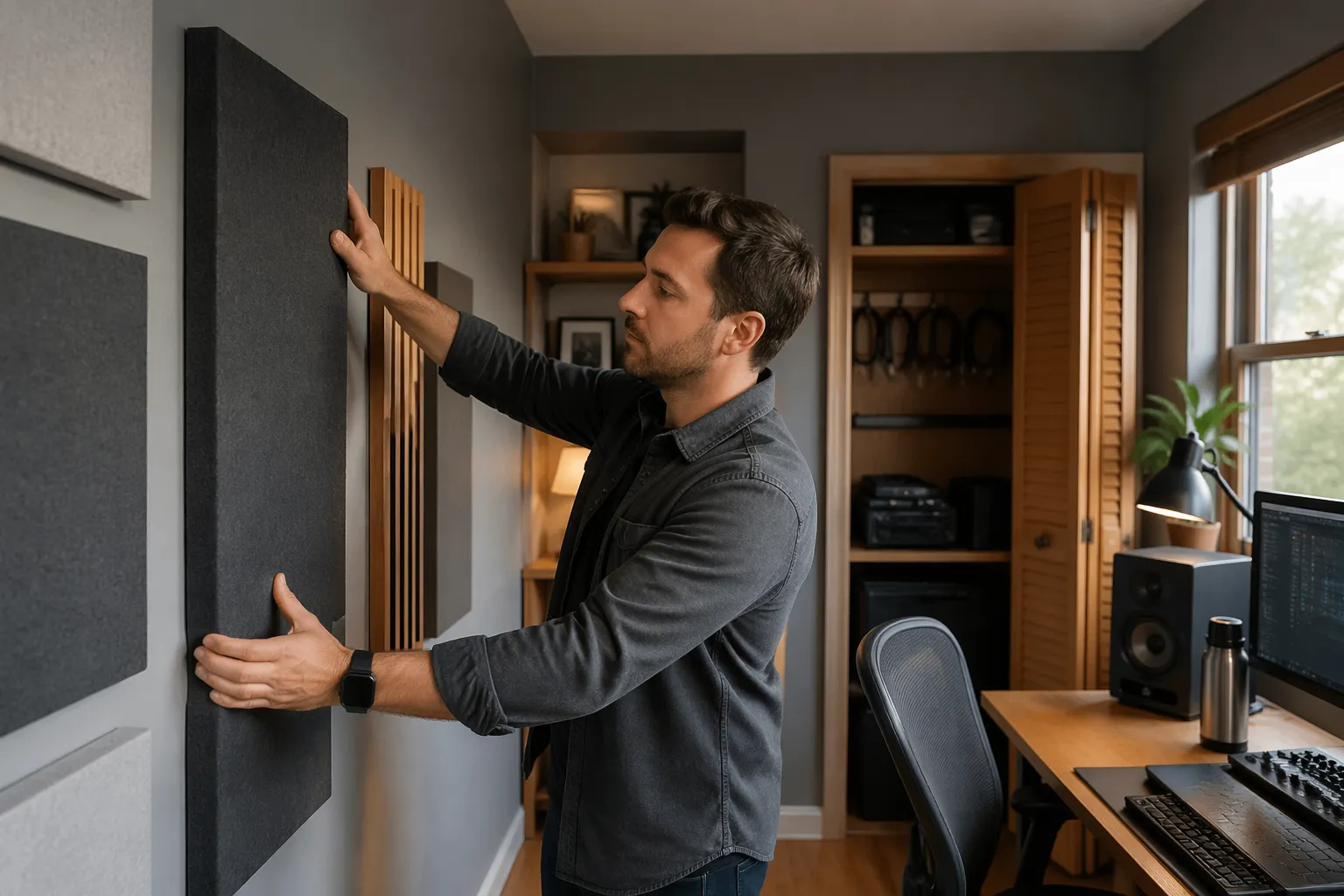
If you clap or speak near an alcove and hear a little “bloom,” that is the same idea happening lower down, just slower and harder to notice without a sweep. In a mix position, that bloom can smear kick definition and make bass guitar sustain feel inconsistent.
When a closet sits near a corner, it changes the corner loading you normally rely on for predictable bass buildup. You might think you have a simple front left corner, but the closet steals or shifts that pressure zone.
That matters because most small-room bass strategies assume corners are the most reliable places to trap. If one corner is actually a corner-plus-cavity, the pressure maximum may move, and your trap placement may be slightly wrong even if it looks right.
Closet door reflections are the other half of the problem, because thin doors flap and re-radiate energy like a cheap drumhead. You hear it as a papery, uneven low mid, and you measure it as ragged decay around 100 to 250 Hz.
Doors also create a large, flat reflection plane at ear height, and that can mess with imaging even when the bass is the main complaint. If the door is near a speaker, it can add a bright edge to transients that makes you mix darker than you should.
Even if the closet is closed, the cavity behind the door still couples to the room through seams and door flex. That coupling is weak at some frequencies and strong at others, which is why the response can look random until you test open versus closed.
Closets that have shelves, boxes, and hard bins often behave differently than closets full of hanging clothes. Hard objects inside can create their own little cavities and rattles, which can add narrow junk in the low mids that looks like a room problem but is really storage noise.
Alcoves with hard, parallel returns can also create a short flutter path that rides on top of the bass issue. You might not hear it as a classic flutter echo, but you can hear it as a vague, phasey quality in vocals and guitars.
One more sneaky effect is that closets and alcoves change the way the room “loads” your speakers, especially if the opening is close to the front wall. That loading can change how much bass the speaker seems to produce, which can trick you into thinking your monitor EQ is wrong.
Deciding whether to open, close, or treat the closet area
Start with a simple rule: if the closet is deep and stuffed with clothes, an open door often helps. The clothes behave like a messy, broadband absorber, and the extra “soft volume” can reduce peaks at the listening position.
Clothes are not magic bass traps, but they do a good job of killing upper bass and low mids that make rooms feel boxy. They also break up the internal reflections inside the closet, which reduces how much energy comes back out into the room.
If the closet is shallow and mostly empty, leaving it open can make things worse. You can get a narrow, stubborn peak caused by the cavity depth, and it reads like a classic alcove resonance even though it is a closet.
Empty closets are basically little drums with a rectangular mouth, and they love to ring on one or two notes. That ring can be strong enough that you end up overcutting those notes in your mixes, then wondering why the mix sounds thin elsewhere.
Closed doors can be better when the closet is empty, but only if the doors are solid and sealed reasonably well. Hollow core sliders and bi folds usually add closet door reflections and buzzing hardware that show up right where you want clean low mids.
If you have sliding doors, pay attention to the track and the overlap seam, because that is where a lot of the vibration noise starts. A little felt, foam tape, or a better guide can turn a “mystery resonance” into a non-issue.
Treating the closet area does not always mean building a permanent trap inside it. Sometimes the best move for bass control with closets and alcoves is replacing a flimsy door sweep, tightening hinges, and adding weatherstrip so the door stops acting like a resonant panel.
A solid-core door is a bigger upgrade than most people expect, because it reduces both flex and leakage. If you cannot replace the door, adding mass with a door panel or even a temporary moving blanket can still reduce the worst flapping.
Another option is to partially fill the closet with absorption that you can remove later, like thick mineral wool panels leaned against the back wall. Leaned panels are not as elegant as built-in frames, but they let you test whether the closet can be turned into a real trapping zone.
Be careful about stuffing the closet with random foam, because thin foam mostly handles highs and does almost nothing for the bass you are actually chasing. You can end up with a room that feels dead on top but still boomy underneath, which is a frustrating place to mix.
One practical approach is to treat the closet as a variable acoustic tool. Keep it open when mixing, close it when you need isolation for calls, and measure both so you know what you are trading away.
When you do that, write down which state you used for each mix session, because consistency matters more than the “best” curve on a graph. If you always mix with the closet open, your brain adapts, and your decisions become more repeatable.
If the closet is near the listening position, consider whether an open door creates a strong early reflection path. In that case, you might prefer the closet open but with a thick panel placed to block the direct line of sight from speaker to closet interior.
If the closet is behind you, opening it can sometimes reduce the strength of the rear wall reflection by turning that surface into a softer, deeper boundary. That can make the room feel less “slappy” and can reduce the sense of bass bouncing back into your head.
Using alcoves as trapping zones without losing the room
An alcove is tempting to ignore because it feels like “not the main room,” but that is exactly why it can help you. If you place absorption where pressure is already trying to collect, you get more bass reduction per inch of material.
Alcoves often sit at the end of the room or beside a main wall, which means they can line up with modal pressure zones. If you have a bass note that feels like it inflates the room, there is a decent chance the alcove is participating in that inflation.
The trick is to trap the alcove without turning your office into a padded cave. You can keep the room usable by treating the back and sides of the alcove first, then only filling the opening if measurements say you still need more.
Start with thickness, because thin panels in an alcove mostly change the tone of reflections, not the bass decay. A 6-inch absorber with an air gap will usually do more for the 80 to 200 Hz region than a stack of 2-inch panels that look impressive but measure weak.
If the alcove is deep, you can treat it like a mini bass trap room by placing absorption on the back wall and in the alcove corners. The goal is to stop the alcove from acting like a storage capacitor that charges up and releases bass late.
If the alcove is shallow, it is often better to fill most of it with absorption rather than trying to “line” it. Shallow alcoves tend to create narrow peaks, and narrow peaks respond well to filling the cavity with thick, porous material.
Do not forget the boundary around the alcove opening, because that edge can create a reflection and a diffraction effect that messes with imaging. Treating the first few inches around the return can clean up the midrange even if the bass is your main target.
If you need the alcove for storage, use soft storage instead of hard bins when possible. Soft bags, fabric drawers, and clothes reduce internal ringing, while hard plastic tubs can add a hollow “thunk” that shows up as low-mid clutter.
Sometimes the best alcove move is a removable absorber that sits in the opening like a plug. A plug lets you test a big acoustic change without committing to construction, and it also gives you a quick way to switch between “mix mode” and “normal room mode.”
Be cautious about turning an alcove into a diffuser project before you fix the bass, because diffusion does not solve decay problems in small rooms. Diffusion can be great later, but the first win is usually reducing the time the room holds onto bass energy.
| Alcove situation | What it tends to do | Practical treatment move |
|---|---|---|
| Deep alcove behind speakers | Stores bass energy and adds long decay | Thick panel on back wall plus corner wedges inside |
| Shallow alcove beside desk | Creates a narrow peak from alcove resonance | Fill with 6 inch absorption, leave a small air gap |
| Alcove with hard side returns | Adds early reflections and low mid smear | Absorb side returns, add a rug if floor is hard |
| Alcove used for shelving | Diffuses highs but can ring in low mids | Add soft backing behind shelves, avoid empty cavities |
When you treat an alcove, measure from the listening position and also take a measurement inside the alcove itself. If the alcove shows a big peak at a certain frequency, that is a clue that the alcove is storing that frequency and feeding it back into the room.
Do not assume the alcove is always bad, because sometimes it breaks up symmetry in a way that reduces a single strong mode. The point is to learn what it is doing in your room, then decide whether to damp it or leave it alone.
If the alcove is near the front wall, watch for changes in speaker boundary interference response, because the alcove can change the effective distance to a boundary. That can move a dip or peak right into the kick drum region, which is why front-wall alcoves can feel especially annoying.
Handling asymmetry: keeping bass balanced left to right
Asymmetrical rooms are normal in home offices, and closets are a common reason one side “sounds bigger” than the other. Your ears interpret that as a stereo image that leans, even when your monitors are level and matched.
The bass imbalance is not just about loudness, it is also about timing and decay. If one side of the room stores bass longer, the phantom center can feel unstable because the low end arrives and fades differently on each side.
Fixing it starts with speaker and desk placement, not with buying more foam. If one speaker fires past a closet opening and the other fires into a solid wall, you have created different boundary conditions and different bass gain.
Even a small difference in side wall distance can change the 80 to 200 Hz region enough to make one speaker feel thicker. That is why moving a desk two inches can sometimes do more than adding a thin panel in the wrong place.
Try to keep the front wall region symmetrical within the first few feet, even if the back of the room is a mess. When you cannot, you can still balance bass by using thicker trapping on the stronger side and lighter treatment on the weaker side.
It helps to identify which side is stronger by measuring each speaker separately and comparing the low-frequency decay. The side with longer decay is usually the side that needs more trapping or more damping of a closet or alcove feature.
Do not chase symmetry by moving the listening position off center just because the room is weird. Centered listening often gives you the best shot at consistent left to right timing, and you can treat your way out of some imbalance.
If you move off center, you often trade one problem for three others, like stronger side wall reflections and worse modal nulls. Staying centered gives you a stable reference, and it makes your measurement comparisons more meaningful.
Subwoofers complicate asymmetrical rooms, but they also give you leverage. A sub placed with measurement guidance can smooth modal peaks that your main speakers excite unevenly because of a closet or alcove.
Multiple subs can help even more, but even one sub can be a powerful tool if you treat placement like a science experiment. The goal is not “more bass,” it is smoother bass that does not swing wildly when you move your head.
If you use a sub, consider crossing over a bit higher than you think, because that can reduce how much the main speakers interact with the odd geometry near the desk. You still have to manage localization, but a careful crossover can reduce the left-right mismatch in the upper bass.
Do not ignore the ceiling and floor in an asymmetrical room, because vertical modes can still dominate even when the side-to-side layout is messy. A thick ceiling cloud and a rug can make bass and low mids feel more even by reducing overall decay and reflection clutter.
If you are stuck with a closet on one side, you can sometimes fake symmetry by adding a similar absorption area on the other side at the same distance from the speakers. It is not perfect, but it can make the early reflection environment more consistent, which helps your brain lock the image.
Practical treatment placements for doors, trim, and odd angles
Doors and trim look harmless, but they create gaps and hard edges that scatter mids and reflect highs right back to your chair. The bass issue is usually door flex, while the imaging issue is the hard, flat plane of the door itself.
A door that flexes is basically a panel absorber that you did not design, so it resonates wherever it wants. That resonance can make one note feel hollow and another note feel swollen, which is the opposite of what you want when you are trying to judge low-end balance.
If you have closet door reflections, start by stopping rattles and sealing the perimeter. A strip of adhesive foam weatherstrip and a tighter latch can remove a surprising amount of low mid buzz.
Check the door handle, strike plate, and any loose trim around the frame, because those parts can buzz sympathetically. A tiny buzz can sound like distortion in a bass synth, and it can waste hours if you think it is coming from your monitors.
For a swinging door near a first reflection point, hang a panel on the door with over the door hooks or a French cleat. A 2 by 4 foot panel that is 4 inches thick is not subtle, but it is often cleaner than trying to treat a narrow strip of wall beside the frame.
If you cannot hang a panel, a heavy curtain can still reduce the high-frequency reflection off the door, though it will not do much for bass. Curtains are useful when the door is frequently used and you need something that moves with it.
Odd angles like sloped ceilings can help if you treat the corners where they meet the walls. Bass still piles up in tri corners, even when the geometry looks fancy, so thick corner traps stay relevant.
Slopes can reduce flutter and some midrange standing waves, but they do not automatically fix low-frequency modes. If anything, they can make the room harder to predict, which is why measurement becomes even more important.
Baseboards and window trim can prevent panels from sitting flush, which reduces low frequency effectiveness. Use simple spacers or a wood frame so your panel has an air gap, because an air gap often gives you more absorption than smashing the panel against the wall.
An air gap also helps when you are treating an alcove return, because it increases the absorber’s efficiency without increasing its footprint too much. In small offices, that extra efficiency per inch is the difference between a workable room and a room you cannot walk through.
For doors that must stay accessible, consider a freestanding gobo panel that you can slide into place during mixing. A gobo can cover a reflective door, add some bass absorption, and avoid the hassle of mounting hardware into a frame you do not own.
Do not forget the floor-to-wall junctions where trim creates small gaps, because those gaps can whistle air and buzz when bass is loud. A little caulk or careful reattachment of loose baseboard sections can remove noises that masquerade as acoustic problems.
If you have an angled wall next to a closet or alcove, treat it like a normal reflection surface first, then decide whether it needs extra bass help. Angles can reduce some reflections, but they can also aim reflections directly at your ears if the geometry lines up badly.
Closet and alcove checklist before you buy more treatment
A lot of people jump straight to more panels and ignore the cheap fixes that make those panels work better. For bass control with closets and alcoves, the boring hardware steps can be the difference between clean decay and a room that still rings.
Spend an hour with a flashlight and your hands, pushing on doors and listening for buzz. If something moves, it is part of the acoustic system, and it will show up in your measurements.
Look at the closet and alcove as if you were trying to make them quiet for a microphone, because that mindset reveals the weak points fast. Loose shelves, hollow doors, and rattling tracks are all little instruments waiting to play along with your kick drum.
Also check what is inside the closet, because a stack of empty cardboard boxes can ring like a drum and a pile of hangers can jingle at just the wrong time. Cleaning up the storage can be a real acoustic improvement, not just tidying.
Before you buy more absorption, make sure the absorption you already have is placed where it can actually work. A great panel in a low-pressure location will do less than an average panel placed in a corner or in an alcove that is clearly storing energy.
If you are renting, prioritize reversible fixes like weatherstrip, door sweeps, and freestanding panels. Those changes often give you a cleaner baseline, and they make future treatment choices more obvious.
- Seal closet door perimeter with foam weatherstrip
- Tighten hinges, handles, and sliding door hardware
- Add a door sweep to reduce leakage and flap
- Fill empty closet volume with clothes or thick blankets
- Place a thick panel on the alcove back wall first
- Check for rattling shelf pins and loose trim
- Leave a 2 to 4 inch air gap behind wall panels
After you do the checklist, re-evaluate whether the closet should be open or closed for your typical work. The best choice is the one that gives you stable bass and minimal noise, not the one that looks neat in a photo.
If you have a closet that must stay empty, consider dedicating it to acoustic use by adding one or two thick panels and leaving them there. A closet that is treated on purpose is often more valuable than a random wall area that you treat out of habit.
For alcoves, decide whether you want them to be absorptive, reflective, or variable, because half-measures can be confusing. A partly treated alcove can sometimes create a strange tonal tilt where the highs are controlled but the low mids still ring.
Finally, check your monitor stands, desk items, and anything that touches the floor near the closet or alcove. Bass vibration can travel through furniture, and that can make a closet door buzz even if the door itself is not the original problem.
How to test improvements when the room isn’t symmetrical
You cannot fix what you cannot repeat, so testing has to be consistent even in asymmetrical rooms. Mark your chair position with tape, lock your mic height, and do not move the speakers between runs.
Consistency also means keeping the closet and alcove in the same state for each measurement series. If you measure once with the closet half open and once with it fully open, you may think your treatment change mattered when it was really the door position.
Room EQ Wizard with a cheap USB mic like the UMIK 1 is the most practical path for home offices. Use a sweep, then look at frequency response and decay, because bass problems are often more obvious in the waterfall plot than in the main curve.
When you look at decay, focus on whether problem frequencies die faster after each change, not just whether the peak got smaller. A slightly smaller peak with a much shorter decay is often a better mixing situation than a flatter curve that still rings.
Measure left speaker alone, right speaker alone, then both together, and save each file with clear names. If one side changes a lot when you open a closet, you have proof that the closet is part of the left right imbalance.
Also measure with the closet door fully closed, fully open, and removed from the equation as much as you can, like open with a curtain pulled across. Those comparisons tell you whether the main issue is the cavity, the door panel, or the reflection off the door surface.
For alcove resonance, watch for a narrow peak that stays put even when you move the mic a little. If the peak drops when you stuff the alcove opening with a thick panel, you have found a reliable trapping zone.
If the peak shifts a lot with small mic moves, you may be looking at a room mode rather than a pure alcove resonance. In that case, the alcove might still help, but you will likely need corner trapping or placement changes too.
After measurements, do a listening test with boring material, like pink noise and a simple kick drum loop. If the kick pitch changes when you turn your head, you still have a modal problem that needs more low frequency absorption or a placement change.
Use a few reference tracks you know well and listen at moderate volume, because loud playback can excite rattles and mask decay differences. Moderate volume also keeps your ears from compressing and makes it easier to hear whether the low end is actually smoother.
When you make changes, make one change at a time and keep notes, because closets and alcoves can interact in non-obvious ways. A panel that helps with the closet open might do almost nothing with the closet closed, and that is useful information rather than a failure.
If you use EQ correction, measure before and after treatment without changing the EQ profile, so you can see what the room itself is doing. EQ can hide problems in the frequency response while leaving decay untouched, which is why it should come after the physical work.
Conclusion
Closets and alcoves are not acoustic decoration, they are bass devices that you inherited from your floor plan. When you treat them on purpose, bass control with closets and alcoves becomes less mysterious and a lot more predictable.
Start with open versus closed testing, fix the door and trim problems that add noise, then use the alcove volume as a trapping area when it makes sense. With asymmetrical rooms, you win by measuring, making one change at a time, and keeping left to right balance as the priority.
Once the bass stops swinging, the rest of your treatment decisions get easier, because you are no longer chasing a moving target. A room with controlled decay lets you trust your monitors, even if the room still has quirks you cannot fully erase.
Closets and alcoves will always be part of the sound of a small office, but they do not have to be the part that ruins your low end. Treat the geometry you have, keep your setup consistent, and aim for translation instead of fantasy-room perfection.