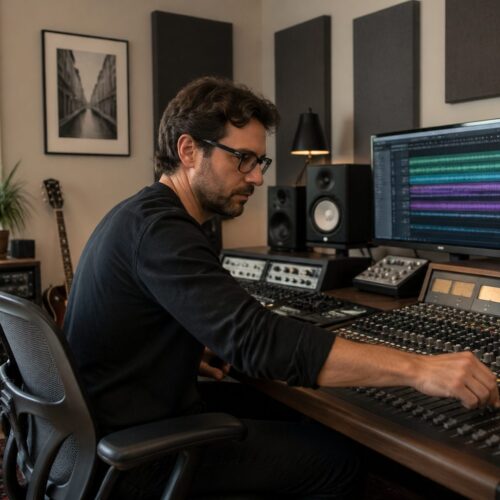

In a home office studio, bass problems usually come from where the speakers and chair sit, not from a missing plugin or a fancy interface. If your low end feels boomy one day and thin the next, placement is the first thing I blame.
The best speaker placement for bass in a home office is rarely the spot that looks tidy on a desk or lines up with a window. It is the spot where the room stops fighting you, at least enough that EQ moves make sense.
Small rooms exaggerate certain notes because sound bounces between walls and stacks up in predictable patterns. You can spend weeks chasing that with EQ, or you can move the speakers and listening position and fix a big chunk of it in an afternoon.
This article focuses on practical geometry, front wall distance, and listening position choices that tighten bass without turning your office into a construction project. Acoustic treatment still matters, but speaker boundary interference and basic symmetry decide whether treatment works or just masks a mess.
Why moving speakers changes bass more than you expect
When you slide a speaker a few inches, you change the timing between the direct sound and the reflections off nearby boundaries. In the low end, those tiny timing shifts cause big peaks and deep nulls, so the bass can swing from huge to gone.
People assume bass is “omni” so placement should not matter much, but rooms do not care about that assumption. The room sets up standing waves between the front and back walls, side walls, and floor and ceiling, and your speakers feed those waves.
Boundary gain is the easy part, because a speaker closer to a wall usually sounds louder in the lows. The nasty part is cancellation, where a reflection arrives out of phase and punches a hole in a narrow range like 70 Hz or 120 Hz.
If your chair sits in a null, you will keep turning up bass in your mix until it is a disaster everywhere else. If your speakers sit in a bad spot, you will hear “tight” bass that is really just missing the notes your room cancels.
Nearfield monitors help because the direct sound is stronger relative to the room, but they do not cancel physics. Speaker boundary interference is still there, just shifted in frequency depending on front wall distance and desk height.
Start with the listening position: where bass is most reliable
Before you touch the speakers, pick a listening position that avoids the worst room modes. In most rectangular rooms, sitting dead center front to back is a reliable way to land in a deep low frequency null.
A classic starting point is placing your ears about 38 percent of the room length from the front wall, measured to the wall behind the speakers. It is not magic, but it often gets you away from the strongest length mode problems.
In a home office, the desk often forces the chair too close to the back wall, and that makes bass lumpy and time smeared. If you can, pull the whole setup forward so the chair is not within a foot or two of the rear boundary.
Use real test signals and music you know, because guessing by “more bass” is how people end up with one note rooms. A slow sine sweep from 20 Hz to 200 Hz, played at moderate level, will tell you where the room drops out or piles up.
If you measure, keep it simple and consistent, and do not chase perfection with one graph. Even a phone RTA can show you the big problems, while a UMIK-1 and REW can show you exactly which frequencies are getting wrecked at your listening position.
Front wall spacing and SBIR: finding a workable distance
Once the listening position is reasonable, front wall distance is the next lever, because it sets the first big speaker boundary interference dip. The reflection off the wall behind the speakers mixes with the direct sound and creates a cancellation that moves with distance.
In practice, you usually choose between very close to the front wall or far enough out that the SBIR dip lands lower than your speakers can strongly reproduce. The middle distances often put the dip right in the punch zone, where kick and bass guitar live.
| Front wall distance (speaker to wall) | Typical SBIR dip region | What you tend to hear |
|---|---|---|
| 2 to 6 inches | Often above 200 Hz | Tighter low end, less obvious hole |
| 10 to 18 inches | Often 120 to 200 Hz | Missing punch, chesty low mids |
| 24 to 36 inches | Often 80 to 120 Hz | Kick weight shifts, bass notes disappear |
| 48 inches or more | Often below 70 Hz | Cleaner upper bass, harder in small rooms |
Side wall symmetry and what it does to low end
Symmetry is not an audiophile obsession, it is how you keep left and right bass response from disagreeing. If one speaker is closer to a side wall than the other, the boundary effects and early reflections will shift differently on each side.
That mismatch shows up as bass that leans left on one note and right on another, which is maddening when you are trying to set kick and bass balance. You can also get a phantom center that wobbles, even if your monitors are level matched.
Start by measuring the distance from each speaker to its nearest side wall, and make those distances the same. If your room forces an asymmetrical setup, you can still aim for symmetry around the listening position by shifting the desk and speakers together.
Side wall reflections are more obvious in mids and highs, but they still affect bass clarity because they mess with timing and stereo cues. A clean stereo image makes low end decisions easier, since you can hear pitch and note length better.
If you have one open side, like a doorway or hallway, the bass can feel different between channels even with perfect speaker spacing. In that case, you may need to rotate the whole setup to a different wall so both sides “see” similar boundaries.
Height, stands, and desk reflections that affect bass clarity
Speaker height changes the floor bounce path, and that can carve out a dip in the upper bass and low mids. If your monitors sit too low on a desk, you often get a weird hollow sound that people misread as “not enough bass.”
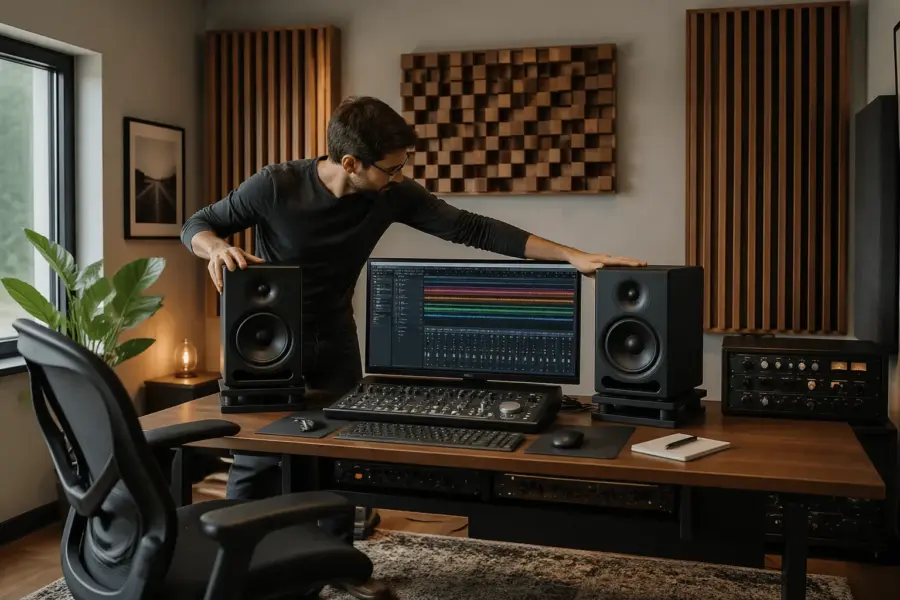
Put the tweeters at ear height and keep both speakers the same height, even if you have to use stands that straddle the desk. A stable stand also stops the desk from acting like a giant passive radiator when the kick hits.
Desk reflections are usually blamed for comb filtering in the highs, but they also smear transients that define bass tightness. If the attack of the kick is fuzzy, the low end will feel bigger and slower than it really is.
Try pulling the speakers forward so the front baffles are close to the desk edge, because that reduces the reflection path off the desktop. If you can angle the desk surface down or use a thin desk pad, you often hear the low end snap into focus.
Isolation pads can help if your desk is light and resonant, but they do not fix SBIR or room modes. I treat them like a cleanup tool after you get the geometry right, not the main event.
A step-by-step placement routine you can repeat
When you change three variables at once, you never learn what caused the improvement, so use a repeatable routine. The goal is to lock in a listening position first, then adjust front wall distance, then fine tune toe in and spacing.
Keep notes and use the same test tracks every time, because your ears adapt fast and lie to you. I like one track with steady sub, one with punchy kick, and one with bass guitar notes that walk up the scale.
- Mark the listening position on the floor with tape
- Start speakers 2 to 6 inches from the front wall
- Match left and right side wall distances
- Set an equilateral triangle to your ears
- Move speakers in 1 to 2 inch steps, then recheck sweep
- Adjust toe in until center image locks without brightness
- Recheck level matching with pink noise
Why the triangle matters less than the bass, but still matters
You will hear a lot about the equilateral triangle, and it is a solid starting point for imaging. Bass tightness, though, depends more on boundaries and modes than on whether your speakers are exactly 36 inches apart.
Still, the triangle affects how you judge bass because it affects phantom center stability and transient clarity. If the center image is smeared, low end instruments blur together and you start making level moves that fight each other.
Set the speakers so the tweeters aim at your head or slightly outside your shoulders, then listen for a centered vocal and a snare that feels like it is in one place. When that locks in, bass pitch is easier to follow, especially on small monitors.
If you sit too close, the speakers can sound impressive but disconnected from the room, and low end decisions can turn strange on other systems. If you sit too far, the room takes over, and your best speaker placement for bass in a home office becomes much harder to find.
A good compromise in many home offices is 3 to 4 feet from tweeter to ear, assuming nearfields and a normal desk depth. If the room is tiny, accept the closer distance and focus on front wall distance and rear wall clearance for the chair.
Using measurement without getting stuck in measurement
Measurements are useful because they show you problems that your brain normalizes after ten minutes. They also keep you honest when a change sounds “better” only because it got louder.
For SBIR and front wall distance experiments, look at the 60 to 250 Hz region and watch for deep narrow dips that shift when you move the speakers. If a dip stays put when you move speakers, it is probably a room mode tied to listening position.
Use smoothing sparingly, because heavy smoothing can hide the exact cancellations you are trying to avoid. I like to check 1/12 or 1/24 octave for placement decisions, then step back and listen to music to confirm it matters.
Time domain plots matter too, because bass that measures flat can still ring and feel slow. If your room shows long decay below 120 Hz, placement helps some, but bass trapping is the next real upgrade.
If you do not want to measure, you can still do a disciplined listening test with sine tones at 40, 50, 63, 80, 100, and 125 Hz. Write down which tones jump out and which vanish at your listening position, then move one variable and repeat.
When acoustic treatment changes what placement can do
Placement can get you to “workable,” but treatment decides how wide the workable zone is. A room with corner bass traps and some front wall absorption gives you more options for speaker spacing and front wall distance.
Thick traps in corners reduce modal ringing, which makes bass notes stop faster and sound more even. That does not erase speaker boundary interference, but it can reduce how severe the peaks around the SBIR dip feel.
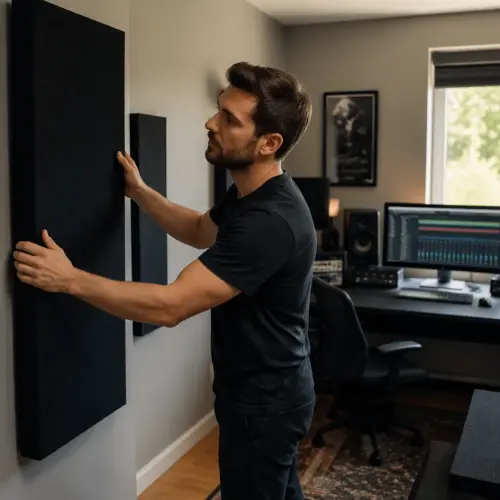
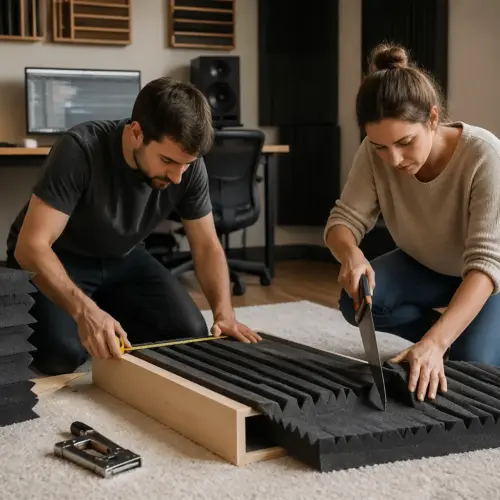
Front wall absorption behind the speakers can help if you cannot place monitors very close to the wall. It is not a thin foam panel fix, because SBIR is a low frequency problem and needs real thickness or an air gap to matter.
Side wall panels are mostly about early reflections, but they can still help you judge bass because the stereo image gets cleaner. When the image is stable, you can hear whether the bass guitar is sharp or flat, and that is half the battle.
If your room is a typical office with drywall and a hollow door, even one or two heavy panels can change what you hear. I would rather see two legit 4 inch panels and a couple corner traps than a full wall of thin foam.
Common home office layouts and what I would do first
Most home offices force you into one of three setups, desk on the short wall, desk on the long wall, or desk in a corner. Each one pushes you toward different compromises in listening position and boundary distances.
Desk on the short wall is usually the easiest for symmetry, and it often gives you more side wall distance. It can also put the back wall too close, so you may need to pull forward and accept that the room behind you looks awkward.
Desk on the long wall can work, but it often puts one speaker near a window and the other near a bookshelf or door. If you do this, prioritize matching side wall distances and treat the first reflection points so the stereo image does not tilt.
Corner desks are convenient and terrible for bass, because both speakers load boundaries differently and SBIR turns into a guessing game. If a corner desk is your only option, get the speakers on stands, pull them off the desk, and keep front wall distance as consistent as you can.
In any layout, avoid placing the listening position with your head inches from a wall, because the bass response changes wildly with tiny movements. A little empty space behind your chair is one of the cheapest upgrades you can make.
Conclusion
The best speaker placement for bass in a home office starts with a sane listening position, then uses front wall distance to manage speaker boundary interference. After that, symmetry, height, and desk reflections decide whether the bass sounds tight or just loud.
If you do one thing this week, mark your chair location, move the speakers close to the front wall, and test in small increments with the same tracks. Once you hear the low end stop swinging around, treatment choices get simpler and your mixes translate with less drama.