
Most home offices that double as a studio have the same problem, the low end is either boomy at the desk or mysteriously thin where you want it. Before you buy a stack of panels, you can get real improvement from bass control using furniture in a small studio, but only if you understand what furniture can and cannot do.
Bass is stubborn because the wavelengths are long, so the room and its boundaries decide a lot of what you hear. Furniture changes those boundaries a little, and sometimes that little bit is enough to clean up a nasty peak or null.
I like furniture moves because they are cheap experiments, and you can reverse them in five minutes if they make things worse. The catch is that random “add a couch” advice usually fails, because placement matters more than the object.
In a small room, the difference between “unmixable” and “good enough” is often a few inches and a few big objects in the right places. If you approach furniture like a layout tool instead of a magic absorber, you can make the room behave more predictably.
This is not about turning your home office into a foam cave or buying designer acoustic furniture. It is about using what you already own to reduce the worst low-end surprises so your decisions translate outside the room.
What furniture can and can’t do for low frequencies
Furniture is great at breaking up mid and high frequency reflections, but bass does not care about a thin surface or a small object. If you expect a chair to “trap bass,” you will end up chasing your tail and blaming the speakers.
Low frequencies act like pressure changes in the room, and the biggest pressure zones are usually in corners and against walls. That is why thick corner traps work, and why a shallow bookshelf rarely fixes a 60 Hz hump by itself.
What furniture can do is change the effective boundary conditions, especially if it adds mass, depth, or a big air cavity. A large storage cabinet, a packed bookcase, or a couch can shift how a room mode builds up, even if it does not “absorb” much bass in the strict sense.
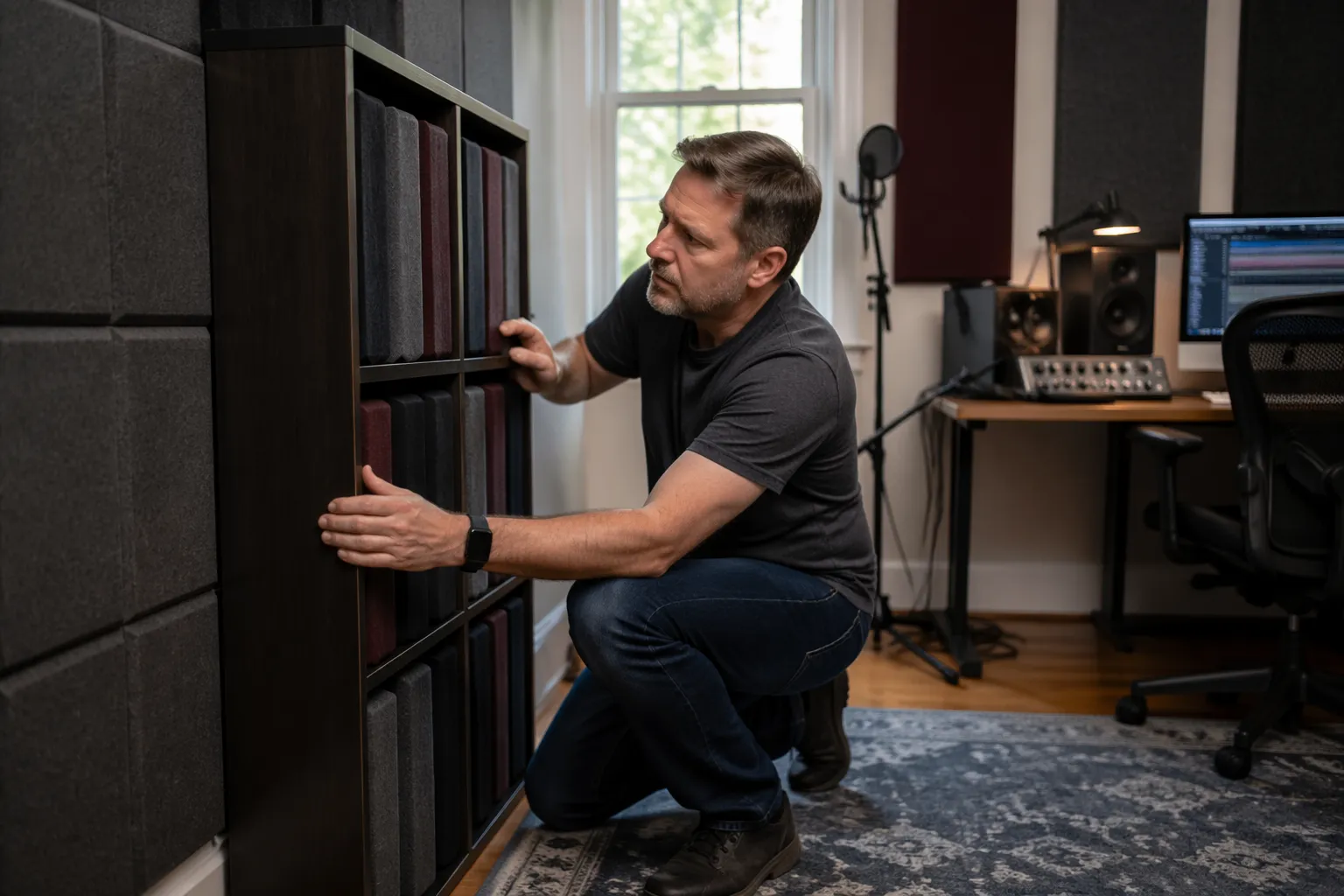
Furniture also helps by forcing you to change the layout, and layout changes can be the real win. Moving the desk off the exact centerline, or pulling the listening position away from the back wall, often beats any single piece of gear.
The main limitation is that most furniture is too thin to do much below about 80 to 100 Hz, where many rooms have their worst peaks and nulls. A couch can take the edge off, but it will not erase a deep cancellation created by speaker and wall geometry.
It also matters whether the furniture is “lossy” or “reflective,” because a glass-front cabinet and a fabric sofa behave like totally different boundaries. If you add a reflective surface near the speakers, you can improve bass slightly while making the top end harsher, which is not a win.
Another thing furniture can do is add asymmetry, and asymmetry is a double-edged sword. It can break up a strong standing wave pattern, but it can also wreck stereo balance if the left and right sides of the room no longer match.
Think of furniture as nudging the room rather than fixing it, like changing the alignment of a door that keeps sticking. You are trying to reduce extremes so the room stops forcing you into bad EQ and level choices.
If you are mixing, the goal is not “more bass” or “less bass,” but bass that is consistent and readable across notes. When furniture helps, it usually makes the low end less jumpy and the decay less smeared.
One more reality check is that furniture moves can trade one problem for another, so you need to listen for side effects. It is common to reduce a boom at the chair and accidentally create a new boom two feet behind you that leaks into vocal takes.
Using bookcases and storage to reduce bass problems
A bookcase is not a bass trap, but it can still be useful when you treat it like a chunky, irregular boundary. The best results come from a full bookcase with mixed depths, hardcovers, and some empty pockets, not a neat row of identical binders.
Bookcase placement matters more than people admit, because putting a big object against a wall changes the air volume and the nearby reflections. If your back wall is bare drywall, a deep bookcase can reduce the “slap” you hear while also slightly softening upper bass ringing.
For bass control using furniture in a small studio, I prefer bookcases on the rear wall rather than the side walls near the speakers. Side wall bookcases can create uneven early reflections that mess with stereo imaging, especially if only one side has storage.
Storage cabinets can be more helpful than open shelves if they are large, heavy, and placed where pressure builds up. A tall cabinet in a rear corner can act like a partial boundary extension, and it sometimes reduces a single-note boom that shows up at the chair.
A bookcase works best when it is actually full, because empty shelves are mostly thin boards and trapped dust. If you do not have enough books, mix in storage boxes, folded towels, and a few irregular objects to keep the surface from acting like a clean reflector.
Depth variation matters because it changes how energy scatters back into the room, especially in the low mids where “boxiness” lives. A row of books all flush to the edge looks tidy, but it tends to behave more like a flat wall than you think.
Do not ignore the weight factor, because a flimsy shelf that rattles is basically a noise generator. If the shelf buzzes on bass notes, you will end up turning down the low end and mixing too bright.
If you have a choice between a wide, low bookcase and a tall, narrow one, the wide one often plays nicer on the rear wall. A tall narrow shelf in one corner can create a left-right imbalance that you will hear as a tilted image.
Cabinets with doors can be useful because they keep the surface more consistent, which sometimes reduces weird flutter between the rear wall and the desk. The downside is that a big flat door can act like a reflector, so it helps to break it up with handles, trim, or even a draped throw.
Try not to cram storage right next to the speakers, because it changes the early reflection pattern and can make the monitors sound “bigger” but less accurate. When the front wall area is clean, you have a better chance of hearing what the speakers are actually doing.
When you place a bookcase on the rear wall, pay attention to whether it sits directly behind your head or slightly above ear level. If it is too low, it may not change the reflections that are actually bothering you at the listening position.
It can also help to leave a small gap behind a bookcase if the room allows it, because that air space changes how the wall behaves. Even a one to three inch gap can reduce the “hard wall” feel without making the room look awkward.
If you have multiple bookcases, matching them left and right on the rear half of the room is often safer than placing one on a side wall and one on the back. Symmetry is not a religion, but it is a good default when you want stable imaging and repeatable bass.
Where a couch or padded chair can actually help
Couch absorption is real, but it mostly starts paying off above deep bass, often in the 100 to 300 Hz range where many small rooms sound “boxy.” That range still matters because it is where kick drum punch and male vocal warmth can turn into mud.
A couch helps most when it sits on the back wall behind your listening position, because that is where lots of rooms build up low frequency pressure and low mid reflections. If you put the couch on a side wall, you might tame some flutter, but you can also make the left and right reflection pattern uneven.
A thick couch also reduces the “hardness” of the rear wall return, which is the reflection that hits you after the direct sound and early side reflections. When that rear return is too strong, bass notes feel longer than they are and the groove gets blurry.
The couch does not need to be fancy, but it needs real volume and real cushion depth. A thin futon looks like a couch and behaves like a blanket on the floor, which is not the same thing acoustically.
Padded chairs can help in smaller ways, mostly by reducing the amount of hard surface area in the rear half of the room. A single chair will not fix a mode, but it can take the edge off a honky low mid that makes everything sound like it was recorded in a closet.
Leather seating is tricky because it reflects more high end than fabric, so it can make the room brighter while only slightly helping the low mids. If you have a leather couch, a thick throw blanket is not just cozy, it is a practical acoustic tweak.
If you record vocals in the same room, the couch can also reduce the “roomy” sound you get when the mic faces the back wall. That is not bass control exactly, but it is part of the same problem of energy bouncing around a small space.
A couch behind the listening position can also encourage you to sit a little forward, which often moves you out of a nasty null. Sometimes the couch helps because it changes your habits, not because it is absorbing a ton of energy.
Be careful with oversized recliners near the side walls, because they can create a big reflective armrest right at ear height. That can mess with imaging while doing very little for the deep bass you were worried about.
If the room is extremely small, even a compact loveseat can be too much and push you into the center of the room. In that case, a padded chair plus a thick rug can be a better compromise than forcing a couch into a space that cannot breathe.
| Seating option | Best placement | What it tends to change |
|---|---|---|
| Fabric couch with thick cushions | Centered on rear wall | Less low mid buildup, softer rear wall reflection |
| Leather couch | Rear wall, add throw blanket | Less help in highs, modest help in low mids |
| Padded reading chair | Rear corner, away from side wall first reflection | Small reduction of boxiness, minor diffusion |
| Armless bench or thin futon | Avoid as “treatment,” use for seating only | Very little absorption, mostly layout changes |
When you test seating changes, listen for how quickly bass notes stop after the kick hits, not just how loud they are. A small reduction in decay can make the low end feel tighter even if the level barely changes.
Also listen to the low midrange on snare and guitars, because that is where couches often make the biggest difference. If the room stops sounding “hollow,” you are moving in the right direction.
Avoiding furniture layouts that make bass worse
The fastest way to make bass worse is to shove every large item into the same corner, then wonder why one note takes over the room. Corners already have the strongest pressure, so piling mass there can create a lopsided response that is hard to mix on.
Another common mistake is blocking only one front corner with a tall cabinet while leaving the other corner open. That asymmetry can pull your phantom center off to one side and make bass lines wander when you move your head.
Watch out for a big desk with deep drawers that forms a cavity right under the monitors. If the desk surface and the cavity line up with your speaker height, you can get a nasty dip around the upper bass that makes you over-EQ kick drums.
Bookcase placement can also backfire if you build a hard “tunnel” along one side wall, especially in a narrow room. You end up with strong side reflections and a lopsided decay time, and the bass problems you started with remain.
One layout that causes trouble is the “everything against the walls” approach where the center of the room is empty and reflective. That can make the room feel louder and more echoey, and it often exaggerates the difference between the desk position and the rest of the space.
Another trap is putting a tall, hard surface right next to one speaker, like a wardrobe on the left and open air on the right. The early reflections become mismatched, and the bass can feel like it leans to one side even when the speakers are level-matched.
Be careful with floating shelves and lightweight cabinets that resonate, because resonances are not “absorption,” they are added notes. If you hear a buzz, a rattle, or a ringing tone, fix that before you judge the bass response.
Large flat surfaces at desk height are another sneaky problem, especially if you add a second table or a printer stand beside you. Those surfaces create strong reflections in the low mids that can make bass instruments feel disconnected from their attack.
Avoid placing a tall bookcase exactly at the first reflection point on only one side, because it can create a bright “ping” that draws attention away from the center. Even if the bass improves slightly, the stereo picture becomes less trustworthy.
If you have a bed in the same room, the bed can be either a blessing or a curse depending on where it sits. A bed shoved into one corner can create a weird mix of absorption and boundary changes that is hard to predict without testing.
Try not to create a narrow pathway between tall furniture on both sides, because it can act like a reflective corridor. That corridor effect tends to emphasize certain low mid frequencies and makes claps and snares sound sharp and annoying.
Finally, do not ignore the ceiling height and anything tall that gets close to it, like wardrobes or stacked storage bins. When you reduce the open volume in one part of the room, you can change how the vertical modes behave and create new dips at the desk.
Combining furniture with targeted treatment for best results
Furniture gets you part of the way, but targeted treatment finishes the job because it is designed for the physics you are fighting. If you already own a bookcase and a couch, treat them like layout tools, then add bass traps where the measurements tell you the room stores energy.
Start with corner traps in at least two vertical corners, because that is where deep bass builds up in most rectangular rooms. After that, use a thick panel on the rear wall if you sit close to it, since the rear wall reflection can smear the low mids even when the bass is “loud enough.”
Storage cabinets can work with treatment if you leave space for a trap behind or above them, instead of sealing every inch of wall. A 4 inch panel with an air gap behind a cabinet line can outperform the cabinet itself, and you still keep your storage.
I also like using a bookcase as a mounting surface for light treatment, like a couple of 2 inch panels on the sides to calm first reflections. That approach keeps the room usable, and it stops the “studio look” from taking over your home office.
The order matters because furniture tweaks can change what the “right” treatment is, especially on the rear wall. If you add a couch and a bookcase first, you might need fewer panels than you would in an empty room.
Targeted treatment is also about consistency, because furniture can move and the room changes when you clean or reorganize. A couple of real traps in the corners keep the room from falling apart every time you shift a shelf by a foot.
When you add panels, thickness and placement beat quantity, so do not scatter thin foam everywhere and hope it adds up. A few thick panels in the right spots will do more than a wall of thin tiles that only affect the highs.
If you cannot install panels permanently, furniture can help you make treatment portable, like panels that lean behind a cabinet or stand behind the couch. Portable treatment is not perfect, but it is better than leaving the room completely untreated.
It is also smart to treat first reflections even if your main complaint is bass, because early reflection control improves clarity and makes bass decisions easier. When the mids are cleaner, you stop compensating with low end boosts that the room cannot handle.
When you combine a rear-wall couch with rear-wall absorption, do not overdo it to the point where the room feels dead behind you and bright in front. A balanced decay is easier to work in, and it tends to translate better to headphones and cars.
If you use a subwoofer, furniture and treatment become even more important because the sub excites modes strongly. A sub can be amazing in a small room, but only if the room is controlled enough that the sub is not just feeding the loudest mode.
Even simple treatment like a thick rug can work with furniture by reducing floor bounce and cleaning up the low mids. It will not fix deep bass, but it can remove a layer of smear that makes bass lines harder to judge.
Where to place bookcases, couch, and storage cabinets for the biggest payoff
If you want the biggest payoff from bass control using furniture in a small studio, put the largest soft item on the rear wall and keep the front half of the room clean and symmetrical. That usually means speakers on stands, a desk that is not oversized, and matching space to the left and right of the listening position.
Bookcase placement is easiest when you treat it like a rear wall “texture” rather than side wall decoration. A deep bookcase centered behind you often works better than two skinny shelves on the side walls, even if the total storage volume is the same.
Storage cabinets do their best work when they sit against a wall that is otherwise bare, because they change that wall’s effective stiffness and reflection pattern. If you can, avoid putting a cabinet exactly halfway along the room length, because that midpoint often lines up with a modal node or antinode depending on frequency.
For couches, a few inches off the back wall is better than hard against it, because the air gap lets the cushion motion do more. If you cannot pull it off the wall, add a thick quilt or moving blanket draped behind the couch to tame the upper bass and low mids.
Start by deciding where the speakers and listening position must go, because everything else should support that triangle. If you place furniture first and then squeeze the desk wherever it fits, you usually end up mixing in a bass null.
As a rule, avoid sitting with your head right against the back wall, because the boundary effect and reflections are at their strongest there. A couch on the back wall helps, but it is still better if your ears are not pinned to the boundary.
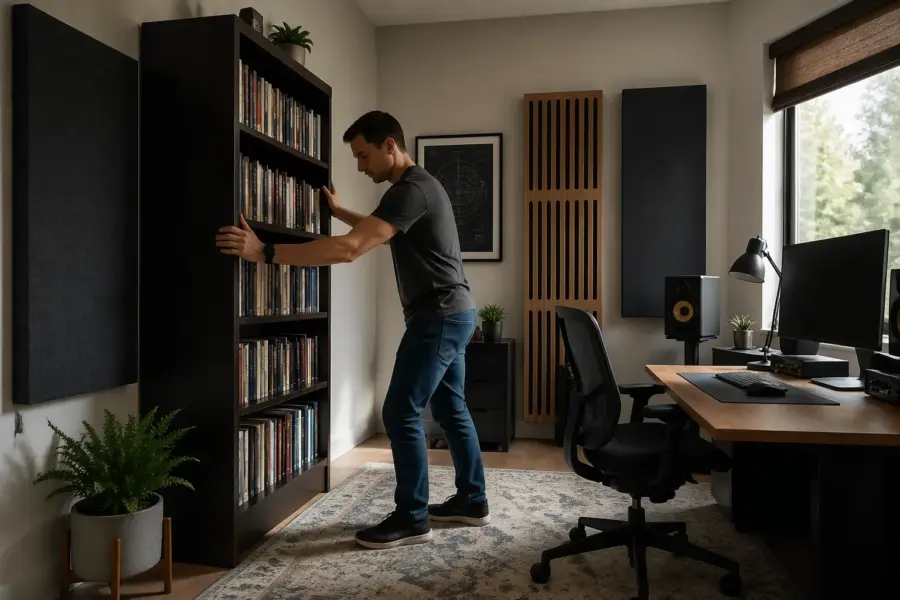
When you place a bookcase on the rear wall, try to keep it roughly centered on the listening position to avoid pulling the image left or right. If you need to offset it for a door, offset other items to restore balance.
For cabinets, the rear corners are often worth trying because they sit in high-pressure zones and can change how the corner “feels” to the room. If the cabinet is very reflective, consider putting it in the rear corner rather than near the speakers.
Avoid placing tall storage directly beside the desk at ear level if it creates a hard surface close to one ear. That kind of near-field reflection is distracting and can make you misjudge panning and reverb tails.
If you have two matching cabinets, placing them symmetrically on the rear wall can make the room feel more even than putting one on a side wall. Symmetry in the rear half is not as critical as the front half, but it still helps with balance.
Do not forget the vertical dimension, because a tall bookcase changes the wall differently than a low credenza. A low unit can be great if you plan to add a panel above it, while a tall unit may block the exact spot where you would want treatment later.
If your room is also a living space, the best payoff layout is the one you will keep, not the one you tolerate for a week. A stable layout lets you learn the room and stops you from constantly re-adapting to new bass behavior.
When you are unsure, prioritize front-wall symmetry, rear-wall softness, and clear side-wall first reflection zones. Those three choices usually get you closer to a usable low end than any single furniture “hack.”
Quick placement moves that are worth trying first
Before you buy anything, do the simple moves that change the room response the most. You can waste a weekend swapping chairs, but moving the listening position by 6 to 12 inches can change a deep null into a workable dip.
These are the small experiments I run when I walk into a cramped home office with obvious bass issues. They take little effort, and they usually point to what treatment will matter later.
Do each move one at a time and listen for a specific change, like a single note getting less dominant or the kick getting tighter. If you change three things at once, you will not know what actually helped.
Use a looped section of music with consistent bass, and keep your monitor level fixed so you are not fooled by louder equals better. If you can, mark the floor with painter’s tape so you can return to the original layout instantly.
When you slide the chair, do it in small steps and stop when the bass feels most even, not when it feels biggest. The “wow” spot is often a peak that will make you under-mix low end later.
When you move a bookcase, pay attention to whether the low mids get clearer, because that is a common early win. If the room suddenly sounds less like a cardboard box, you are probably reducing a strong rear reflection.
- Pull the desk 6 to 18 inches off the front wall
- Slide the chair forward and back while looping a bass-heavy track
- Center the bookcase on the rear wall, then shift it 6 inches left or right
- Move a storage cabinet from a side wall to the rear corner
- Place the couch behind the chair, then pull it 4 inches off the wall
- Remove one tall item near a front corner to restore left-right symmetry
If you have monitors on the desk, try raising them slightly and pulling them forward so the front baffle is closer to the desk edge. That can reduce desk reflections and sometimes cleans up the upper bass where the desk and speakers interact.
If you can put the monitors on stands, try it even temporarily, because it changes the boundary relationship and frees the desk from acting like a giant reflector. A stand move can reveal whether your bass issue is mostly the room or mostly the desk setup.
Another quick move is rotating the entire setup to face a different wall if the room shape allows it. In some rooms, firing down the long dimension is smoother, and in others the short dimension gives you better symmetry and fewer obstructions.
Do not forget to check what happens when you open or close a door, because doors change the low frequency leakage and pressure. A door that opens into a hallway can act like a pressure release and slightly reduce a peak at certain frequencies.
If you have a closet with a sliding door, try leaving it slightly open while you listen, because the cavity can change the low-end behavior in surprising ways. This is not a replacement for treatment, but it is a real variable in small rooms.
Quick checks to make sure the change is real
Your ears adapt fast, so you need a repeatable check or you will “hear” improvements that are just novelty. I use the same two songs and the same short sine sweep every time, and I keep the volume fixed.
For music, pick a track with steady bass notes that walk up and down, like Billie Eilish “bad guy” or Daft Punk “Giorgio by Moroder.” If one note still jumps out hard, the room mode is still running the show and the furniture move did not solve it.
If you can, run a quick measurement with Room EQ Wizard and a cheap USB mic like the UMIK-1. You are looking for fewer sharp peaks below 200 Hz and a smoother decay, not a perfectly flat line that only exists in marketing photos.
Do a reality check from more than one seat, because a single sweet spot can fool you. Walk to the door, stand in the back corner, then sit again, and listen for whether the bass changes are smaller than before.
When you do the sine sweep, listen for sudden jumps in loudness and for spots where the tone almost disappears. If the sweep feels more even after a move, you probably improved the modal balance even if the bass is not “bigger.”
Pay attention to decay by clapping and listening to the room ring, but do not over-trust claps for bass problems. Claps mostly tell you about mids and highs, so use them as a side check rather than the main test.
Use headphones as a reference for the bass balance of your test tracks, because headphones remove the room from the equation. If the room makes the bass line feel totally different than the headphones, you still have a translation problem.
Level-match your comparisons, because a 1 dB change can feel like “more detail” and “tighter bass.” If your monitor controller has markings, take a photo so you can return to the exact level.
When you measure with REW, look at the waterfall or decay plot, not just the frequency response. A slightly uneven response with faster decay is often easier to mix on than a flatter response that rings forever.
If you do not have a measurement mic, a phone RTA app can still show you big changes if you are careful and consistent. It will not be laboratory accurate, but it can confirm whether a move reduced a major peak.
Give your ears a short break between tests, because fatigue makes bass feel less defined and can bias you toward brighter settings. A two-minute reset can make your decisions more honest than another hour of tweaking.
Conclusion
Furniture can help, but it helps in specific ways, and it rarely replaces real bass trapping. Use bookcase placement, couch absorption, and storage cabinets to support a good layout, then add targeted treatment where the room stores energy.
The best home office studios look normal because the fixes are mostly practical, not flashy. When you treat furniture as part of the geometry problem, bass control using furniture in a small studio becomes a real tool instead of a hopeful shortcut.
If you take one idea from this, let it be that placement beats shopping, and testing beats guessing. A couple of careful moves can make your room more honest, and an honest room saves you time every time you mix.
Once the low end is more consistent, you can trust your monitors at lower volumes and make better decisions faster. That is the real payoff, because it makes the room feel like a tool instead of a fight.