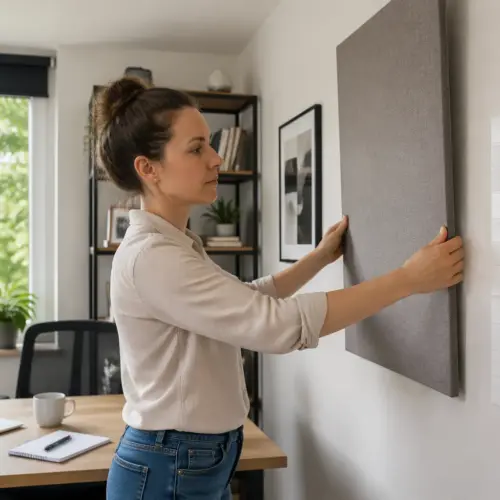


Most DIY acoustic panels fail for a boring reason, the builder guessed the depth and hoped for the best. A clean acoustic panel frame depth guide keeps you from wasting money on lumber, insulation, and fabric that will never do what you want.
Frame depth is the part you notice first when you hang a panel, because it changes how far the panel sticks out and how heavy it feels. It also changes what frequencies you actually absorb, especially once you factor in an air gap.
If you work in a home office, you probably care about voice clarity, keyboard clatter, and the harsh ring that shows up on calls. Picking the right depth is a trade, you balance low frequency control against space, cost, and how much you want your walls to look like a recording booth.
This article focuses on practical builds with common materials like 1x lumber, mineral wool, fiberglass, and fabric wrapping. You will see where wood frame thickness matters, how insulation depth affects absorption, and which fabric wrap method avoids the annoying wrinkles that scream “DIY.”
What “frame depth” changes in performance and appearance
Frame depth sets the maximum insulation depth you can fit without crushing the material, and that choice nudges the panel’s absorption curve. Thicker panels generally do better below about 250 Hz, while thin panels mostly tame mid and high reflections.
Depth also controls how much you can “cheat” with an air gap, because a deeper frame can hide a stand off or French cleat without looking awkward. A 2 inch panel spaced 2 inches off the wall can behave closer to a 4 inch panel at some frequencies, but the mounting has to be solid.
On camera, deep panels cast stronger shadows and read as chunky rectangles, which some people love and others hate. If your home office doubles as a living space, a slimmer profile often wins even if it gives up some bass control.
Depth changes weight too, because more insulation and larger lumber add pounds fast. That matters if you rent, if your walls are old plaster, or if you plan to hang panels above a desk where you do not want surprises.

Common depth options and where each one works best
One inch to 1.5 inch frames are basically “reflection killers” for flutter echo and slap, and they keep a room from sounding like a bathroom. They work well behind a monitor, near a glass window, or on the wall you face during video calls.
Two inch frames are the standard starter build because they fit many fiberglass boards and keep the panel from looking bulky. In a typical 10×12 home office, a few 2 inch panels at first reflection points can make speech sound less edgy right away.
Three inch frames are a sweet spot when you want a little more low mid control without building a deep box. They also let you use 2 inch insulation with a small air space inside the frame, which can be a nice trick when you already bought the wrong thickness.
Four inch frames are where panels start acting like serious broadband absorbers, especially if you add an air gap behind them. They are a good choice for the wall behind your chair, the wall behind speakers, or any spot where the room “booms” when you talk.
Six inch and deeper frames make sense when you are chasing bass issues in a small room, but they are hard to place without eating space. I like them most for corner traps or for a single deep panel behind a mic position, where the thickness pays off.
Matching frame depth to insulation type and compression
Insulation depth is not just a measurement, it is tied to density and how the fibers resist airflow. If you compress mineral wool to “make it fit,” you change that airflow resistance and you can shift performance in ways you did not plan.
Fiberglass boards like Owens Corning 703 and 705 come in predictable thicknesses, so your acoustic panel frame depth guide can be pretty literal with them. Mineral wool brands vary more, so measure the real thickness before you cut wood.
| Insulation type | Typical thickness choices | Frame depth fit and compression note |
|---|---|---|
| Fiberglass board (OC 703 style) | 2 inch, 4 inch | Build to exact depth, avoid compression for predictable results |
| Fiberglass board (OC 705 style) | 2 inch, 4 inch | Denser board, heavier, needs stronger mounting and stiffer frame |
| Mineral wool board (Rockwool type) | 2 inch, 3 inch, 4 inch | Measure actual thickness, light compression is possible but do not crush edges |
| Mineral wool batt (soft) | 3.5 inch, 5.5 inch | Needs backing or netting to prevent sag, do not rely on fabric to hold it |
| Polyester acoustic batt | 2 inch, 3 inch, 4 inch | Easy handling, can fit snug, tends to need more thickness for bass |
How wood frame thickness affects rigidity and usable depth
Wood frame thickness is the hidden part of depth planning, because nominal lumber sizes are not what they claim. A “1×3” is about 0.75 inch thick and 2.5 inches deep, which means you cannot fit true 3 inch insulation without either compressing it or changing lumber.
For 2 inch insulation, 1×3 lumber is comfortable because you get a little breathing room for a fabric wrap method that folds cleanly. For 4 inch insulation, 1×5 lumber is common, and it also gives you more staple area so the fabric stays tight.
Rigidity matters more as the frame gets deeper, because a deep rectangle wants to rack and twist when you pick it up. If you build 4 inch or 6 inch panels, add corner braces, a center cross brace, or at least good glue and square clamping during assembly.
Cheap pine can warp after you bring it home, especially if it sat in a humid big box store aisle. I buy a couple extra boards, sight down them in the parking lot, and return the ones that look like propellers.
Air gaps, wall spacing, and when depth is not the only lever
If you have limited space, an air gap behind a panel is the easiest way to get more low frequency absorption without a thicker box. A 2 inch panel with a 2 inch gap often beats a 2 inch panel glued flat to drywall, especially in the low mids that make voices sound boxy.
The trick is that the gap has to stay consistent, because a panel that leans or bows changes the spacing and looks sloppy. Spacers, standoffs, or a simple cleat system keep the panel parallel to the wall and keep your mounting repeatable.
Air gaps also help if you want to use a thinner frame for visual reasons, because the wall side becomes your “extra depth.” That approach works well behind a desk where nobody touches the panel, but it is annoying in hallways where people bump into it.
Do not expect an air gap to replace corner bass trapping, because corners collect pressure and need more volume. If your room has a one note boom around 80 to 120 Hz, depth plus corner placement matters more than clever spacing tricks.
Avoiding warping, sagging, and fabric ripples
Warping starts with wet or twisted lumber, but it finishes with weak joinery and uneven tension. Use wood glue, pre drill, and clamp the frame square on a flat surface instead of trying to hold it in the air with one hand and a driver in the other.
Sagging usually shows up when people use soft batts without any internal support. If the insulation can slump, add a breathable backing like landscape fabric, thin muslin, or plastic garden netting stapled to the rear of the frame.
Fabric ripples come from rushing the corners and from stapling in one direction only. Pull the fabric evenly, staple the middle of each side first, then work outward in small steps like you are tightening a drum head.
Your fabric wrap method matters as much as depth, because thick frames force tighter corner folds that can bunch up. If you hate bulky corners, use a thinner fabric, trim excess, and keep your staple line straight so the face stays crisp.
Safety and comfort tips for handling and sealing materials
Mineral wool and fiberglass irritate skin and lungs, so treat them like you would treat sanding dust. Wear gloves, long sleeves, and a decent respirator, then vacuum the work area instead of sweeping fibers into the air.
Sealing the back and edges cuts down on stray fibers and keeps panels cleaner over time, especially in a home office where you sit close to the wall. A thin dust cover fabric on the back is usually enough, and you can tape seams if you want a neater finish.
- N95 or P100 respirator for cutting insulation
- Nitrile coated work gloves
- Long sleeves you can wash separately
- Shop vacuum with a clean filter
- Dust cover fabric or breathable backing cloth
- Utility knife with fresh blades
- Drop cloth to catch fibers and staples
Depth choices for home office goals like calls, editing, and music
If your main problem is harshness on Zoom, you can fix a lot with 2 inch panels placed close to where your voice hits first. Put one behind your monitor, one on the wall you face, and one to the side if you sit near a bare corner.
If you edit podcasts or record voiceovers, I prefer 4 inch panels behind and slightly beside the mic position because they reduce low mid buildup. You hear the difference when you compress vocals, because the room tone stops pumping and breathing.
If you mix music on nearfields in a small room, 4 inch panels at first reflection points and thicker corner treatment beat a wall full of thin panels. Thin panels make the room less bright but they often leave the bass problems untouched, which is the part that ruins decisions.
If you play acoustic instruments in the room, depth choices depend on whether you want the room to feel “dry” or just controlled. A mix of 2 inch and 4 inch panels usually feels natural, while going all thick can make the room feel oddly dead for casual playing.
Sizing depth to placement, doors, and day to day traffic
A deep panel in the wrong spot becomes a shoulder check hazard, especially near a door swing or a tight path to a chair. Measure the clearance you actually use, not the clearance you think you use when the room is perfectly tidy.
Behind a desk, depth is almost free because you rarely walk there, so I lean thicker in that zone. On side walls near a doorway, 2 inch panels with an air gap often make more sense than 4 inch panels that stick out and get bumped.
Ceiling clouds are a special case because depth adds weight right over your head. If you want a cloud, build it rigid, use proper anchors into joists, and keep the design simple so it does not sway when the HVAC kicks on.
If you rent, think about how you will patch the wall later, because heavier panels push you toward bigger anchors. A lighter 2 inch build with careful placement can give you most of the benefit without turning your drywall into Swiss cheese.
A quick checklist before you commit to a build
Before you buy wood, decide what problem you are solving, because “make it sound better” leads to random panels in random places. Write down whether you need call clarity, better monitoring, less echo, or less bass boom, then choose depth to match.
Confirm your insulation depth with a tape measure, confirm your lumber’s real dimensions, and confirm your mounting plan. This is the boring part of an acoustic panel frame depth guide, but it is the part that keeps the build clean.
Pick fabric before you build if you care about looks, because thick frames need more fabric and tighter corner folds. Some “acoustic” fabrics are stiff and fight you, so test a small wrap on scrap wood before you commit to ten panels.
Budget for the small stuff like glue, corner braces, staples, and hanging hardware, because those costs sneak up fast. If you plan to add an air gap, include spacers or cleats in the plan so you do not improvise on install day.
Conclusion
The right frame depth comes from matching your room’s problems to a build you can live with every day. When you respect wood frame thickness, insulation depth, and a clean fabric wrap method, the panels look intentional and they work.
If you only take one rule from this, stop compressing insulation just to make a frame “work.” Build the depth you need, or use an air gap on purpose, and your results will sound like you planned them.