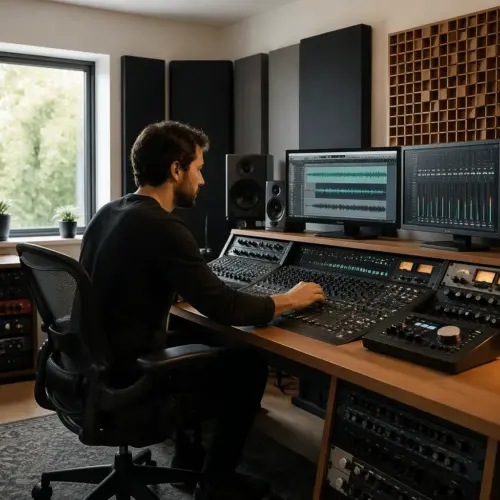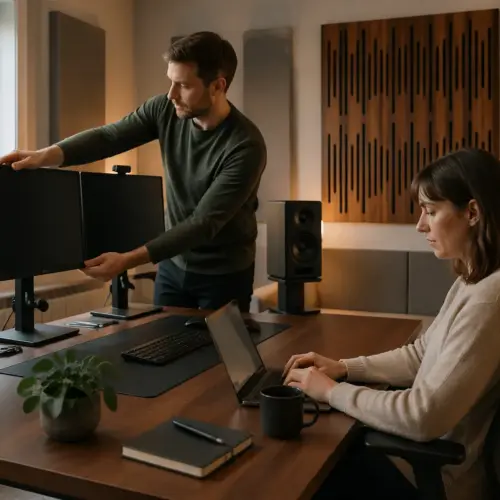

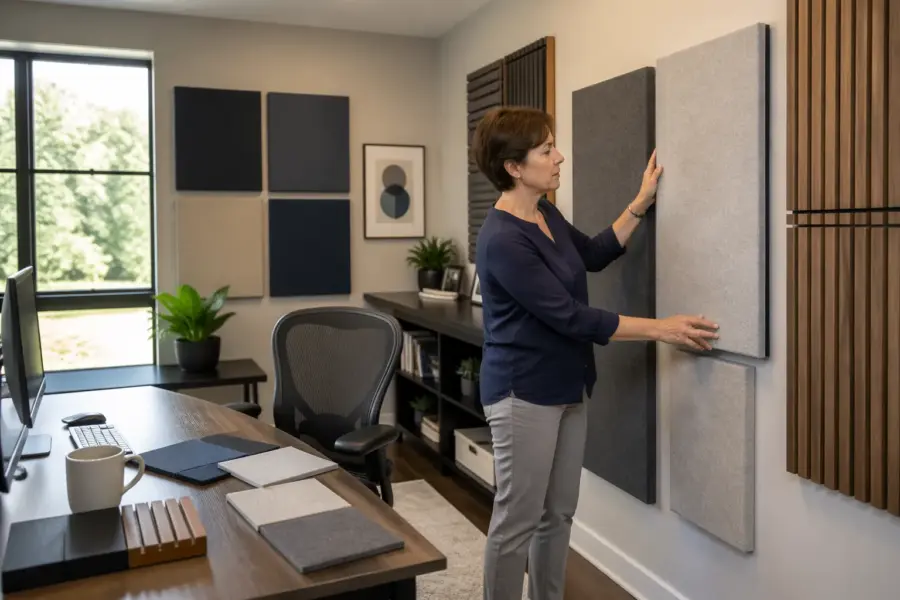
An L-shaped room can make your home office sound weird even when you buy decent speakers and keep the volume reasonable. The shape pushes reflections and bass into places you do not expect, so your mix position can sound thin while the couch sounds huge.
When people talk about treating an L shaped room for audio, they usually jump straight to panels and bass traps. Geometry moves come first because they decide where the pressure zones and early reflections land, and treatment works better when you stop fighting the room.
If your office is part of an open plan acoustics setup, the L often opens into a hallway, kitchen, or dining area. That opening can help in one way and hurt in another, so you need a plan that treats the listening area like a small room attached to a big one.
The good news is you can usually get a big improvement without rebuilding walls or filling the place with foam. Most of the wins come from choosing a sensible “main rectangle,” placing the desk and speakers like you mean it, and then treating only the surfaces that actually matter.
It also helps to accept that an L-shaped office will never behave like a perfect studio, and that is fine. Your goal is a listening area that is consistent and repeatable, so decisions you make at the desk do not fall apart on headphones, in the car, or on a living room system.
Why L-shaped rooms behave differently than rectangles
A rectangle has predictable axial modes, so you can estimate where bass peaks and nulls will show up. An L-shape breaks that predictability by adding a second cavity that couples to the first like a leaky side chamber.
The inside corner of the L acts like a pressure collector, which is why bass buildup often shows up there even if it is not a “real” corner with two full-length walls. At the same time, the open leg can act like a bass vent, so one side of the room holds energy while the other side dumps it.
Early reflections get messier because one side wall might be close and the other might be missing or far away. That asymmetry can smear the stereo image, especially around 1 kHz to 6 kHz where your brain uses timing cues to place sounds.
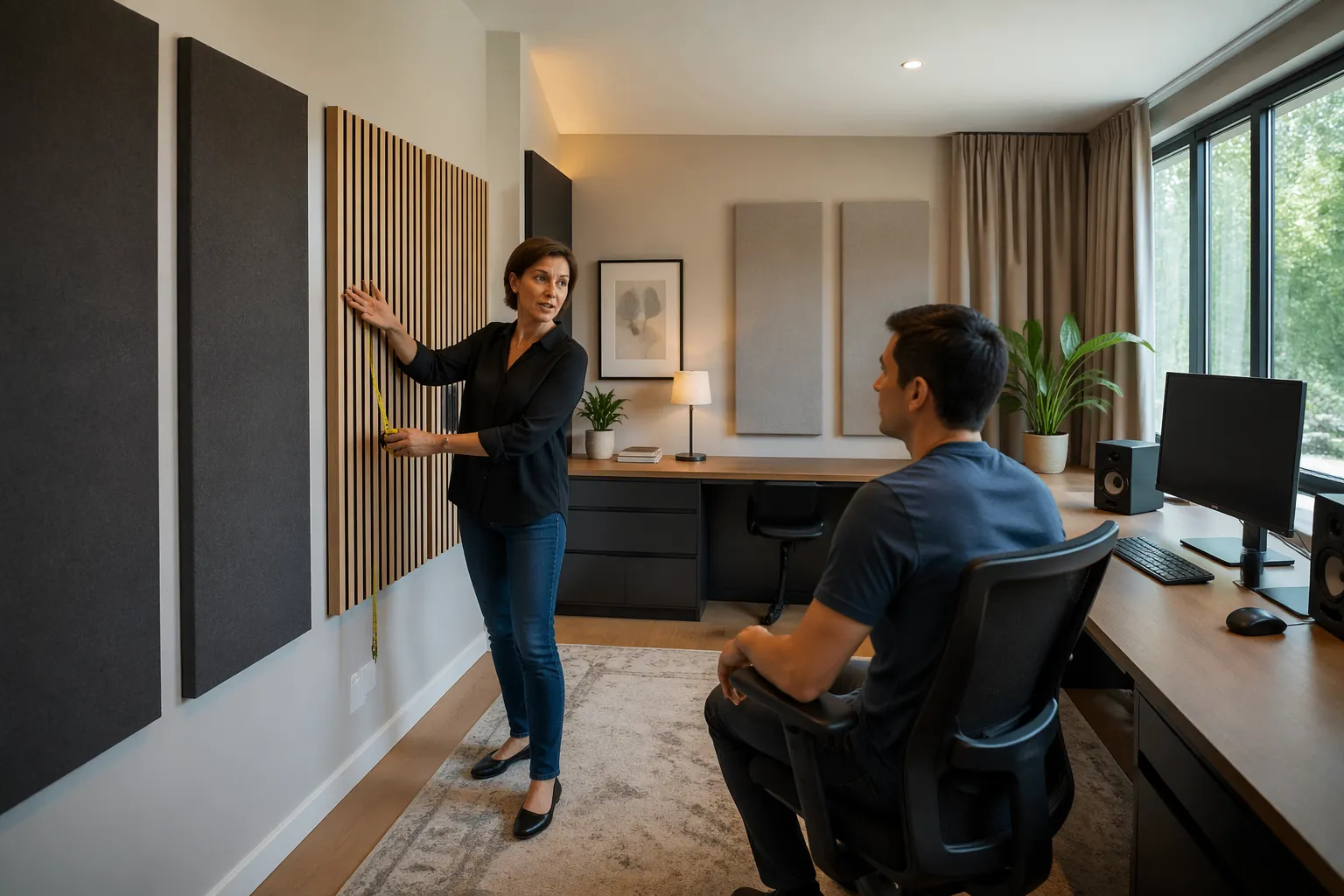
Furniture placement tends to follow the floor plan, and that can accidentally create a hard “acoustic corridor” down the long leg of the L. When that corridor lines up with the speakers, you get a bright slap echo that makes the room sound cheaper than it is.
Another difference is that the L creates multiple “effective lengths,” so the room can support several competing low-frequency patterns. You can hear this as bass notes that jump forward and backward depending on where you sit, even if you only move a foot.
The transition area near the bend also tends to create odd midrange reflections because sound can bounce off surfaces that are not part of your main listening rectangle. That is why an L-shaped room can sound fine on pink noise but still make vocals feel phasey or hollow.
Because the two legs are connected, energy can “store” in one leg and then bleed back into the other with a slight delay. That delayed return is subtle, but it can soften transients and make reverb tails feel louder than they should.
If one leg has a different ceiling height, different flooring, or a big window, the mismatch gets worse because the two sections absorb and reflect different frequency ranges. You end up with a room that is not just asymmetrical left-to-right, but also inconsistent front-to-back.
Even HVAC noise and household sounds behave differently in an L because the bend can block some frequencies and funnel others. That matters if you do voice work, because a quiet “noise floor” in one spot does not guarantee it stays quiet at the mic position.
Picking the best “main rectangle” for your setup
The trick is to pretend the L is two rectangles and pick one as the control zone. Your listening area should live in the more enclosed rectangle, not in the middle of the bend where energy piles up.
Measure the two legs and choose the one with the most consistent boundaries, meaning four surfaces that exist for most of the length. A leg with a long uninterrupted side wall usually gives you more predictable early reflections, even if it is not the bigger leg.
Try to avoid placing the desk right at the inside corner where the two legs meet. That spot tempts you because it “uses space well,” but it is where bass buildup and midrange reflections like to stack up.
If the open leg leads to a kitchen or stairwell, treat that opening like a boundary that changes with doors, curtains, and people moving around. Your goal is consistency, so pick the rectangle that stays the same day to day.
Think about what is behind you when you sit at the desk, because the rear area controls a lot of what you perceive as “room sound.” A solid rear wall is easier to treat than a half wall or a doorway that changes the decay time every time someone walks through.
Also consider where you can physically place treatment without it being a daily annoyance. A slightly smaller main rectangle that lets you mount panels properly will usually beat a bigger area where you keep compromising because doors and closets need to function.
Windows are not automatically a deal breaker, but a big window in the wrong spot can force you into bad speaker symmetry. If one leg has a large window and the other has a normal wall, the “stable” rectangle is often the one where both side boundaries are similar materials.
If you do both work calls and music, pick the rectangle that lets you keep the mic position consistent too. It is easier to treat one zone well than to chase two separate acoustic problems in two different parts of the L.
Once you choose the main rectangle, commit to it by treating the other leg as support space rather than part of the listening field. That mindset alone prevents a lot of random placement decisions that accidentally sabotage the acoustics.
Where to face: orienting speakers toward the most stable area
Speaker orientation is a geometry decision first and a treatment decision second. In most L-shaped offices, you get the cleanest response by firing down the longer, more enclosed leg so both side boundaries behave similarly.
If one side opens into the other leg of the L, that side becomes “soft” at low frequencies and “hard” at mid and high frequencies, which is a nasty split. Pointing the speakers so the open section is behind you usually gives your ears a steadier front field and a less jumpy phantom center.
Try to keep the speakers the same distance from the nearest side boundaries, even if the room itself is not symmetrical. When the left speaker is near a wall and the right speaker is near open space, the tonal balance of the two channels can differ enough to make panning decisions unreliable.
Nearfield monitoring helps in L-shaped rooms because it reduces the ratio of room sound to direct sound. That does not mean you can ignore the room, but it means small geometry improvements show up faster and feel more obvious.
Keep the front wall situation in mind, because boundary interference from the wall behind the speakers can create a dip in the low mids. If you have to choose between a slightly worse side condition and a much better front wall distance, the front wall distance often wins for clarity.
Do not assume the “long way” is always correct if the long leg is actually the open leg. If firing down the long direction means one speaker is effectively firing into a doorway, you can end up with a lopsided low end that never settles.
In some L-shaped offices, the best option is to face a shorter but more symmetrical wall so the first reflections match. The room may feel tighter, but the stereo image can become dramatically more stable.
| Orientation option | What you usually hear | When it makes sense |
|---|---|---|
| Speakers fire down the longer enclosed leg | Better stereo stability, fewer side-to-side tonal swings | One leg has two solid side walls and a solid front wall |
| Speakers fire toward the inside corner of the L | Big bass peaks, muddy low mids, uneven imaging | Rarely, only if treatment and placement constraints force it |
| Speakers fire across the short leg into the open plan area | Lean bass at the desk, bass loudness shifts with distance | When the “open” area is huge and acts like a bass sink |
| Desk faces the opening, speakers fire into the main rectangle | Strong early reflections behind speakers, workable imaging | When the wall behind speakers is treatable and symmetrical |
Whatever orientation you pick, lock in a basic equilateral triangle between your head and the two speakers before you judge anything else. If the triangle is off, you can misdiagnose imaging problems that are really just geometry mistakes.
Keep the tweeters at ear height and aim them so the axes cross just behind your head, unless your monitors are designed for a different toe-in. A consistent toe-in reduces how much the room’s side conditions dominate what you hear.
Finally, do not forget that your chair orientation matters too, because your body is part of the acoustic scene. If you sit at an angle to “fit” the desk into the L, you can create different reflection paths to each ear even when the speakers are placed correctly.
Managing bass flow into the open section
In open plan acoustics, the open leg can act like a pressure release for deep bass, but it does not release evenly across frequencies. You might lose 40 Hz energy while 80 Hz piles up, which makes kick drums sound like they change notes.
Start by placing the speakers and chair so the listening area sits in the “main rectangle” and the opening is off to one side or behind you. This reduces the chance that one speaker couples to the opening more than the other, which is a common cause of left-right bass imbalance.
Use the opening on purpose by keeping it clear of tall reflective furniture near the boundary line. A bookcase right at the mouth of the open leg can create a partial barrier that traps certain bass bands and exaggerates bass buildup at the bend.
If you can hang a heavy curtain across part of the opening, you can tame mid and high reflections without pretending it is a bass wall. Curtains do not fix 60 Hz, but they can stop the open leg from acting like a bright echo chamber that feeds back into your listening area.
Think of bass in an L-shaped room as something that “chooses paths,” not something that fills the room evenly. If one path is a wide opening and another path is a solid wall, the room will steer low frequencies into the opening and leave you with a strange mix of dips and lumps.
One practical move is to keep the listening position away from the exact line where the main rectangle meets the open leg. Sitting right on that boundary can put your head in a pressure transition zone where small changes in frequency cause big changes in level.
If you use a subwoofer, the open leg can make the “sub sounds fine here” test misleading because bass seems to disappear into the other space. That is why measurements or at least slow sweeps are worth doing before you decide the sub is weak or broken.
Try to keep both speakers the same distance from the opening, even if that means shifting the whole desk a few inches. A small shift can reduce the feeling that the left channel has more weight than the right channel, which is a common complaint in L-shaped rooms.
Rugs and soft furniture in the open leg can help the overall decay time, but they will not tame the core bass problems by themselves. Use them as “polish” after you have the main rectangle behaving, not as the first fix.
If the open area is large, you can sometimes treat it like a bass sink and lean into it by facing that direction. The catch is that you need the sink to be consistent, so a space that is sometimes full of people and sometimes empty can change your low end from day to day.
Making asymmetry workable with placement choices
L-shaped rooms almost always force some asymmetry, so the goal is controlled asymmetry instead of accidental asymmetry. You can live with different left and right boundaries if the first reflection timing and level are close enough.
Start with equal distance from each speaker to your ears, then work outward to make the side reflection paths similar. If the left wall is close and the right side opens, pull the whole setup slightly toward the open side so the close wall reflection arrives later and weaker.
Do not center the desk on the overall L footprint, because that “center” is not acoustically meaningful. Center the desk on the main rectangle you chose, and treat the other leg like a big alcove that you manage rather than ignore.
Keep large reflective objects, like a glass cabinet or a whiteboard, off the near side wall at ear height. If you must have one, put it on the far side where the reflection path is longer and easier to absorb with a panel.
Asymmetry also shows up in what is behind each speaker, not just what is beside them. If one speaker has a wall behind it and the other has a doorway behind it, you can get different boundary reinforcement that shifts the tonal balance.
Try to keep the area immediately around both speakers visually and physically similar, even if the rest of the room is not. Matching the first few feet around each monitor is often enough to make the phantom center stop wandering.
Do not forget the floor, because one side might be carpet and the other might be hardwood if the L transitions into another zone. A consistent rug under the desk area can reduce that left-right difference in the upper mids.
When you cannot make the room symmetrical, make the listening position symmetrical relative to the speakers. That means the chair is centered on the speaker line and the speakers are angled the same way, even if the walls do not cooperate.
If you do video calls, keep the camera placement from forcing the speakers into weird positions. It is better to move the camera or monitor than to shove one speaker into a corner and then wonder why the low end is lopsided.
Finally, keep your expectations realistic about the far field in an L-shaped room. You can make the desk area solid, but the couch in the other leg may still sound different, and that is normal.
Practical checks for a better listening area
You do not need lab gear to make smart geometry moves, but you do need a repeatable check. Use a free tone generator and a slow sweep, then walk the listening area and the inside corner to hear where bass buildup gets ugly.
For a more honest picture, use Room EQ Wizard with a USB mic like the UMIK-1 and take measurements at the chair and a few inches around it. The point is not chasing a perfect line, it is seeing whether your last move made the null at 90 Hz better or worse.
When you do sweeps, keep the volume moderate and consistent so you do not confuse “louder” with “better.” A small change in speaker distance to the wall can look dramatic on a graph, but you still need to confirm it sounds more even on music you know well.
Use a few reference tracks that you have heard in many places, and focus on specific cues like vocal placement, kick drum pitch, and snare brightness. If those cues stabilize, you are moving in the right direction even if the room is not perfect.
Clap tests and spoken voice tests are still useful for identifying flutter echo in the long leg of the L. If you hear a zingy decay, you have a reflection path that will also smear cymbals and consonants.
Take notes as you move things, because L-shaped rooms can trick you into looping back to a worse setup. A simple “desk 6 inches left, speakers 3 inches forward” note saves you from relying on memory.
- Mark the main rectangle boundaries with painter’s tape
- Start the chair at about 38 percent of the main rectangle length
- Match speaker-to-side-wall distances as closely as the shape allows
- Check bass at the inside corner and at the chair with a slow sweep
- Move the desk in 2 to 4 inch steps before buying more treatment
- Keep the mouth of the open leg clear of tall hard furniture
If you measure with REW, pay attention to the waterfall or decay plots, not just the frequency response. An L-shaped room can look “okay” on a smoothed response while still ringing too long at a few bass notes.
Do not over-correct with EQ before you finish placement and basic treatment. EQ can help, but it cannot fix a deep null caused by geometry, and it can waste headroom trying.
When you find a better position, confirm it by moving slightly around it and making sure it stays good. A setup that only sounds right in a one-inch sweet spot is a sign you are sitting in a fragile interference pattern.
If you work at low volume most of the time, do your checks at that level too. Some room problems feel “gone” when you crank it, but they still mess with balance when you mix quietly.
Practical treatment zones that give the biggest return
Once your geometry is decent, treatment starts paying off fast, and you can stop guessing. Focus on the zones that affect what you hear at the desk, not the zones that just look like they should be treated.
First reflection points on the left and right are the obvious win, but the L-shape changes what “side wall” means. If one side is an opening, treat the nearest hard surface that still reflects toward your ears, which might be a partial wall, a column, or even a cabinet face.
Put a thick absorber behind the speakers if you sit close to the front wall, because boundary interference can wreck the low mids. A 4-inch mineral wool panel with a 2-inch air gap is a practical starting point in a home office where deeper traps are hard to fit.
For bass, treat real corners first, then treat the inside corner of the L as a bonus corner if you can. A floor-to-ceiling superchunk is great, but even two stacked 4-inch corner traps can calm bass buildup enough to make EQ decisions less risky.
The rear wall of the main rectangle is often the next best target, because it controls strong reflections that arrive slightly later than the side reflections. In a small office, that rear bounce can make the midrange feel cloudy and make reverbs sound louder than they are.
If the rear wall is close to your head, prioritize absorption over diffusion. Diffusion needs distance to work, and in a tight listening area it can just turn a strong reflection into a bunch of smaller strong reflections.
In an L-shaped room, you may also have a “pseudo wall” created by a partial divider or a shelving unit near the bend. Treating the face of that divider can reduce the weird reflections that seem to come from the side even when there is no full wall there.
Do not ignore doors, because a hollow door can resonate and add a boxy tone in the low mids. A simple door seal or a heavier door curtain can reduce rattles and make the room feel more controlled.
If you are on a budget, build fewer panels but make them thicker. A couple of well-placed 4-inch absorbers usually beat a bunch of thin panels spread randomly around the L.
Try to keep treatment symmetrical around the listening axis even if the room is not symmetrical. Matching what the left and right channels “see” near the desk is more important than making the whole L look evenly treated.
Once the basics are in place, small additions like a panel on the bend wall or a trap in the inside corner become easier to evaluate. You will hear the change instead of guessing, because the main problems are already under control.
Ceiling and desk reflections in an L-shaped office
Ceiling reflections often matter more in small offices than people want to admit, because the bounce is short and strong. In an L-shape, the ceiling plane is still continuous, so it can be the one “symmetrical” surface you can treat to help imaging.
A 2-by-4 foot cloud above the desk, centered between the speakers and your head, can smooth the top end without killing the room. Use 4-inch thickness if you can, because thin foam tiles mostly fix the hissy stuff and leave the harshness.
The desk itself creates a hard reflection that arrives fast, especially with nearfield monitors on short stands. Raise the speakers so the tweeters clear the desk edge, and angle them so the first bounce does not shoot straight into your ears.
If you use a big screen, treat around it rather than trying to cover it, because you still need to see it. A pair of narrow panels to the left and right of the display can reduce flutter and keep vocals from sounding like they come with a built-in comb filter.
Monitor stands help because they let you position the speakers without relying on the desk surface. Even small isolation pads can reduce how much the desk vibrates and re-radiates energy into the room.
If you have a low ceiling, the cloud becomes even more important because the ceiling reflection can arrive so quickly that it blends with the direct sound. That blend can make the upper mids feel aggressive even when the speakers are not bright.
Ceiling fans and light fixtures can create little reflection hotspots too, especially if they sit right above the listening area. You do not need to obsess over them, but moving the desk a few inches can sometimes avoid a surprisingly strong bounce.
The desk reflection is also affected by how far back your keyboard and mouse sit, because that changes the angle of the reflective surface. A shallow desk setup with the speakers slightly forward can reduce the reflection strength without any extra treatment.
If you cannot do a ceiling cloud, a thick rug under the desk area still helps by reducing some of the floor-ceiling bounce energy. It will not replace a cloud, but it can take the edge off and make the room less splashy.
Keep your desktop clear of hard clutter like stacked notebooks or shiny accessories near the speaker line. Random objects can create tiny reflections that add up and make the top end feel busy and inconsistent.
Dealing with the inside corner and the bend
The bend in the L is where the room changes rules, so treat it like a problem zone even if you do not sit there. If you leave it bare drywall, it can throw a bright reflection back into the listening area and pump up bass buildup at the same time.
A tall absorber panel placed diagonally across the inside corner can work like a corner trap without permanent construction. If you can spare the space, a thick freestanding gobo there is one of the rare moves that helps both legs of the room.
Do not put your subwoofer right in the bend unless measurements prove it works, because that spot excites both legs and can create a one-note boom. Sub placement near the front wall but away from the exact corner often gives a smoother transition between the main rectangle and the open section.
If the open leg is a hallway, the bend can behave like a horn mouth and amplify certain midbass notes. Breaking up that path with a thick runner rug and a wall panel can make the hallway less “live” without turning it into a closet.
Pay attention to what surfaces “see” the speakers through the bend, because sound does not need a straight line to bounce back. A hard wall just around the corner can still send a reflection into the listening area with a slightly longer delay that makes imaging feel vague.
If the bend area has a bare floor and bare walls, it can act like a little reverb chamber that feeds the main rectangle. Adding a rug, a soft chair, or a thick absorber there can reduce that extra decay without treating the entire open leg.
Sometimes the bend is also where you store boxes, instruments, or office gear, and that clutter can be either helpful or harmful. Soft, irregular clutter can add a bit of scattering, but hard flat items can create a strong reflection that is worse than an empty wall.
If you have a choice, avoid placing a reflective desk return or side table right at the inside corner. That surface can create a midrange reflection path that is hard to predict and hard to fix later.
When you treat the inside corner, do not block airflow or access in a way that makes you remove the treatment later. A slightly smaller trap that stays in place beats a huge trap that gets moved every week.
After you treat the bend, re-check the bass response at the listening position, because the change can be bigger than you expect. The bend is a coupling point, so improving it can tighten the low end in the main rectangle even if you did not touch the main rectangle corners.
Conclusion
Treating an L shaped room for audio starts with choosing a main rectangle and aiming your setup at the most stable boundaries. Once the listening area is in the right place, your panels and traps finally act like tools instead of band-aids.
Use the open plan acoustics reality to your advantage by controlling what the opening does, then target bass buildup in real corners and the inside bend. The best result is a room that sounds consistent enough that your work translates, even if the floor plan stays awkward.
If you take anything from this, it is that placement changes are the cheapest form of acoustic treatment. Moving the desk, speakers, and chair with intention can remove problems that no amount of random panel buying will solve.
Once the geometry is stable, treat the first reflections, the front wall area, and the corners you can realistically use. After that, small improvements like a ceiling cloud or a bend absorber become easy decisions instead of expensive guesses.
An L-shaped office will always have a personality, but it does not have to be a problem. With a clear main rectangle and a controlled listening zone, you can get a clean stereo image, more honest bass, and a room that feels professional enough to trust.