
Turning a garage into a studio usually starts with gear and ends with regret about the room. The fix is to start with geometry, because geometry decides what your monitors and treatment can even do.
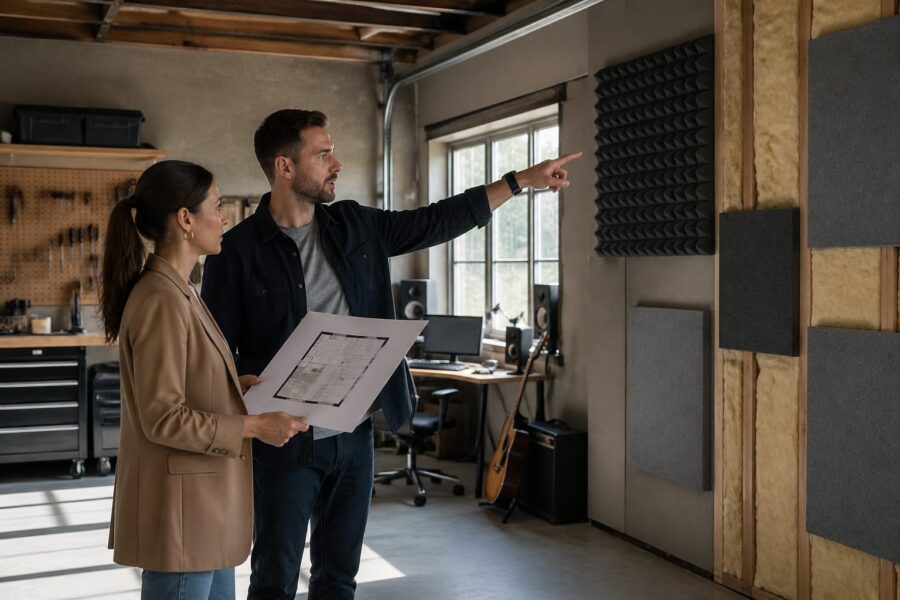
A garage conversion home studio room geometry problem looks familiar on paper, four walls, a ceiling, and a floor. In practice, garages bring weird proportions, hard surfaces, and one wall that is basically a giant acoustic liability.
If you have built a bedroom studio before, some rules carry over and some do not. The goal is to keep the rules that still work, then adapt the ones that break when the room is wider, taller, and made of concrete.
How garage dimensions differ from typical bedroom studios
Most bedroom studios are narrow rectangles with an 8 foot ceiling, and the room modes stack up in predictable places. A garage often has a bigger footprint, a higher ceiling, and proportions that shift the low end problems into different frequencies.
That extra width sounds like a gift until you realize your listening triangle can drift off center without you noticing. Once you lose symmetry, stereo imaging gets smeared and you start chasing phantom panning issues in mixes.
Garages also tend to have alcoves, water heaters, storage bumps, or a jog in one wall. Those features can act like mini resonant cavities, so the garage studio acoustics can change a lot with small layout decisions.
Bedrooms usually have drywall and carpet that at least take the edge off reflections. A garage is often bare studs, drywall on one side, block on another, and a concrete floor home studio situation that is reflective everywhere.
Another difference is that many garages are closer to squares than bedrooms, especially single-car garages that are not much longer than they are wide. Squarer rooms tend to pile modes on top of each other, which can make one bass note feel huge while the next disappears.
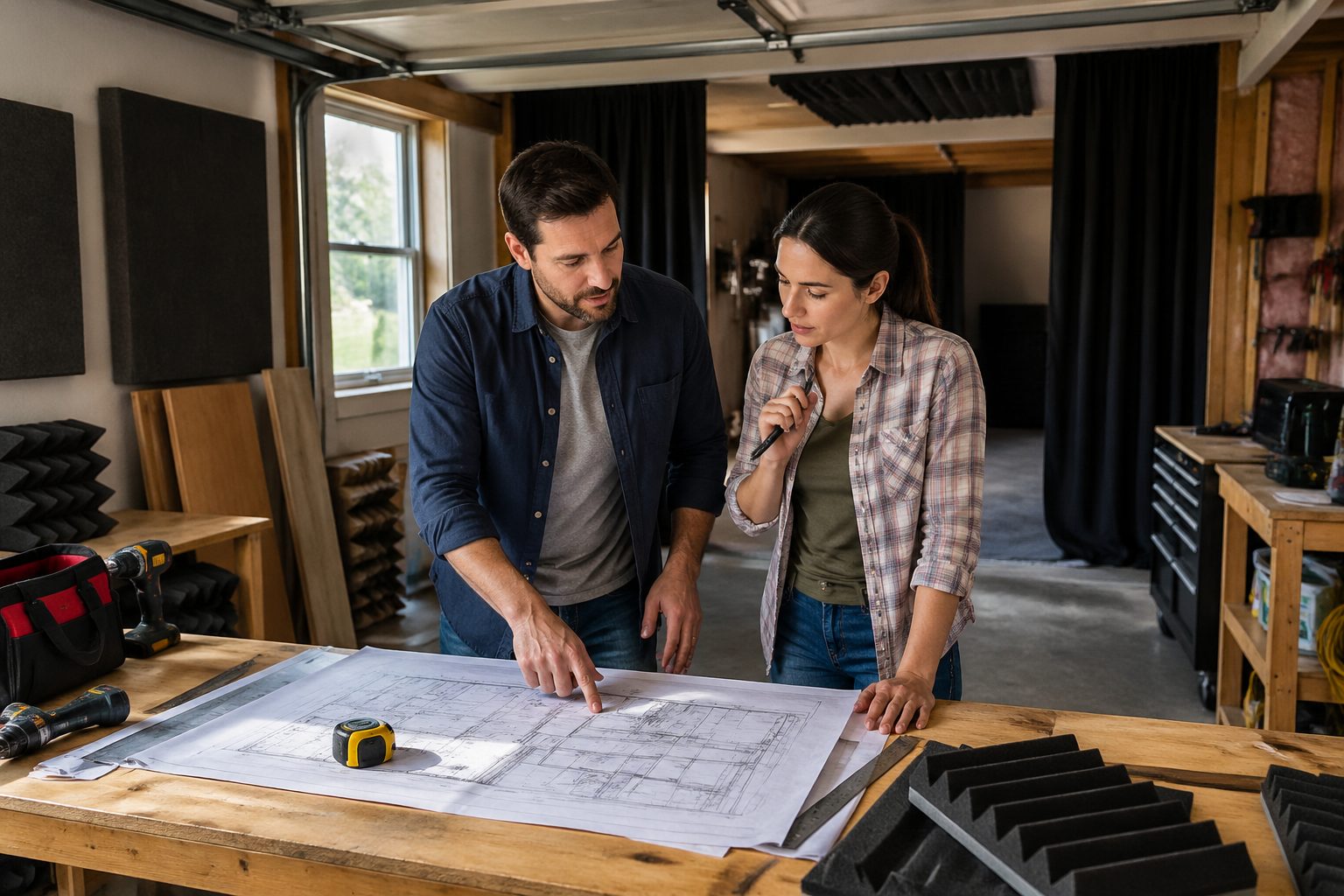
Even when the garage is a long rectangle, the height can be the wildcard because the ceiling is sometimes pitched or stepped. That changes how the vertical modes behave and can create a strange “one side of the room sounds different” effect if the ceiling shape is asymmetrical.
Garages also have more boundary stiffness than bedrooms, because concrete and block do not flex the way drywall on studs does. Stiffer boundaries reflect more energy back into the room, so peaks and nulls can feel more dramatic at the mix position.
Because garages are meant for cars, they often have fewer soft objects by default, which means the decay time can be long even at midrange frequencies. When the midrange rings, you will instinctively mix with less reverb and less sustain, and the track will feel small outside the room.
Temperature and humidity swings are also more common in garages, and that matters because air and materials behave differently across seasons. The room might measure one way in winter and feel different in summer, especially if the door and walls expand and contract.
Finally, garages are often attached to the house on one side and exterior on the other, so the construction is inconsistent around the perimeter. That inconsistency can create uneven absorption and transmission, which shows up as asymmetrical decay even when the dimensions look symmetrical.
Choosing which wall to face in a garage layout
In most rectangular rooms, facing the short wall is still the safest default because it gives you more depth behind you. In a garage conversion home studio room geometry plan, that depth matters because you need distance for bass to develop and for treatment to work.
Start by finding the most symmetrical wall pair, then decide which of those walls can become your front wall. Symmetry is not a vibe, it is how you keep left and right reflections similar so your brain stops second guessing the center image.
If one side wall is block and the other is framed drywall, you can still make it work, but plan on matching absorption and diffusion to get them closer. I would rather face a slightly shorter wall with matched side boundaries than a longer wall with mismatched materials.
Do not commit based on where power outlets happen to be, because you can add outlets and you cannot add geometry. Pick the orientation that gives you a clean front wall, consistent side walls, and enough space behind the listening position for thick treatment.
Look at what happens behind the wall you want to face, because an exterior wall can behave differently than an interior wall. If one candidate wall is shared with the house, it may transmit less low end outward but also reflect differently than the exterior side.
Also consider what is on the other side of the side walls, because a wall backed by open storage or a hollow cavity can act like a giant panel absorber. That can be helpful, but it can also make one side of the room decay faster than the other.
When you choose the front wall, you are also choosing where you will place the heaviest treatment, because the front corners and the area behind the speakers usually get the most material. It is easier to commit to that if the front wall does not need to remain a walkway or a storage access path.
Think about sight lines and workflow, because a layout that forces you to twist your body to reach instruments tends to pull the desk off center over time. A centered desk is not a one-time decision, it is something you keep true as the room fills up.
If the garage has a side entry door, avoid putting it at a first reflection point if you can, because doors are usually thin and reflective. Even if you treat around it, you will still have a hard boundary that changes when the door is open or closed.
When in doubt, mock it up with tape on the floor and live with the orientation for a day before you move furniture. The right wall to face often becomes obvious when you stand where the speakers would go and imagine where the treatment has to fit.
How the garage door wall changes your front or rear geometry
The garage door is the one feature that can wreck an otherwise sensible layout, because it is large, stiff, and full of seams that reflect in unpredictable ways. A garage door reflection can act like a giant specular mirror in the mids and highs, then leak bass in ways that change with weather and door construction.
If you can avoid placing the garage door at the front wall, do it, because early reflections from that surface will hit you fast. If the door must be in the room, I prefer it behind the listening position where you can treat it like a problematic rear boundary.
Garage doors also tend to be slightly concave or segmented, which means they can scatter some frequencies while focusing others. That can create a weird “bright but not clear” sensation where the top end feels loud yet the image still feels unstable.
If the door has windows, those glass panels are like little tweeter mirrors at ear height. You can cover them, but it is better to plan the layout so they are not in a direct line between the speaker and your ear.
Another issue is that the door is rarely airtight, so it behaves like a pressure release at low frequencies. That can reduce the worst peaks, but it can also reduce the room’s ability to build consistent low end, which makes kick and bass feel different from day to day.
The door tracks and hardware can rattle at specific notes, and those notes are often right in the range you care about for bass translation. If you hear a buzz that comes and goes with certain keys, check the door before you blame your monitors.
When people build a false wall in front of the garage door, the biggest mistake is leaving it too thin. A shallow “decor wall” with a little foam does not stop reflections, it just adds a new reflective surface a few inches in front of the old one.
A better approach is to treat the door area as a single continuous zone, even if you cannot permanently modify the door. Curtains, movable gobos, and thick panels on stands can work if they cover enough area and sit close enough to the door to reduce the gap reflection.
If you need the garage to still function as a garage sometimes, plan for treatment that can move quickly without changing the geometry of your mix position. The goal is to keep the speakers and desk fixed, then make the door wall treatment the thing that folds or rolls away.
| Garage door placement | Main acoustic risk | Practical mitigation |
|---|---|---|
| Front wall behind speakers | Strong early reflections and comb filtering | Build a false wall with thick absorption in front |
| Rear wall behind listening position | Flutter and slapback into the mix position | Deep rear absorption, plus diffusion if space allows |
| Side wall near first reflection point | Asymmetric imaging and harsh side bounce | Heavy side panels and keep desk centered |
| Angled corner or partial door area | Odd specular angles and uneven decay | Cover the area with a continuous absorber zone |
Even with mitigation, treat the garage door like a variable boundary that can change if you service it, insulate it, or replace it. If you do major door upgrades later, re-measure the room because the low end behavior can shift more than you expect.
If the door is on the rear wall and you have enough depth, a thick absorber plus an air gap can make that rear reflection much less aggressive. If you do not have depth, prioritize absorption over diffusion, because diffusion needs distance to work without sounding like slap.
When the door is on a side wall, the biggest risk is that you will treat one side heavily and the other side lightly, which breaks the stereo field. In that case, treat both sides as if they are doors, even if only one side actually is.
Concrete floors and hard walls: setting up before treatment
A concrete floor home studio setup creates a bright room fast, because the floor reflection arrives almost as quickly as the desk reflection. That reflection changes what you hear around 150 to 300 Hz, which is right where guitars, vocals, and snares get boxy.
Before you buy panels, place your desk and monitors so the tweeters are not firing straight into a bare floor zone. A thick rug helps, but a rug alone does not fix the low mid bounce unless it is paired with better speaker height and a clean path to your ears.
Hard garage walls usually mean you hear the room before you hear the speaker, especially at moderate volumes. I like to start with stands that decouple the monitors, then pull the desk away from the front wall enough to fit real absorption behind the speakers.
If the walls are unfinished, resist the urge to add thin foam everywhere, because it just makes the room dull and still boomy. Save your money for thick broadband panels, then use small amounts of foam only for specific rattles or small reflective patches.
Desk placement matters more on concrete because the floor reflection and desk reflection combine into a messy early reflection cluster. A smaller desk or a desk with a lower profile can reduce that, which is why huge flat worktops often sound worse than they look.
Monitor height is also a geometry decision, not a gear decision, because the vertical angle changes how much energy hits the floor. If you can raise the speakers slightly and tilt them correctly, you can reduce the floor bounce without changing the room at all.
Concrete can make your room feel “fast” in the highs, which tricks you into thinking your monitors are harsh. Before you EQ your speakers or buy new ones, tame the first reflection points and listen again at the same SPL.
If you are adding a floating floor or laminate on top of concrete, do it for comfort and usability, not because you think it is acoustic treatment. Most thin flooring choices do almost nothing for low frequencies, and some add new squeaks that show up on quiet recordings.
Hard walls also expose any small parallel surfaces that create flutter, like between two block walls or between a block wall and a painted drywall wall. You can hear it as a zingy ping when you clap, and it will smear transients when you track vocals or percussion.
Before treatment, do a simple walk test with pink noise or a steady bass tone and note where the room changes drastically. Those spots often line up with boundary distances, and they tell you where not to place the listening position or the sub.
Finally, do not ignore the garage’s built-in reflective objects like metal cabinets, tool chests, and appliances. If they must stay, keep them behind the listening position or off to the sides where they are not contributing to early reflections.
Ceiling height advantages and how to use them
A taller garage ceiling can reduce the severity of the first vertical mode compared to a low bedroom ceiling. That does not mean the ceiling stops mattering, it just means you have more room to place a proper cloud and still keep headroom.
Use the height to hang a thick ceiling cloud, ideally 4 to 6 inches with an air gap, right above the listening position. That one move often cleans up the phantom reverb that makes you mix too dry and then wonder why the track sounds wet elsewhere.
If you have exposed joists, you can take advantage of them and build deeper absorbers between bays. A deep absorber overhead is one of the few places where you can add thickness without losing floor space.
High ceilings also tempt people to stack storage up high, and that can rattle like crazy when the kick hits. Secure anything overhead, and keep the area above the speakers and mix chair clear so you do not create random reflective shelves.
If the ceiling is pitched, aim to place the listening position so the left and right ceiling angles are as similar as possible. A pitched ceiling can help break up flutter, but it can also create an uneven stereo field if the pitch is only on one side.
A ceiling cloud should be sized like it matters, because a tiny cloud only treats a tiny reflection zone. If you can cover the area from slightly in front of the speakers to slightly behind your head, the improvement is usually obvious right away.
The air gap above the cloud is not optional decoration, it is part of the absorber’s effectiveness at lower frequencies. Even a few inches of gap can make a 4-inch panel behave more like a thicker absorber in the low mids.
Garages with open rafters sometimes have insulation exposed, and that can act as accidental absorption. Do not assume it is enough, but do recognize that adding a finished ceiling can make the room brighter if you remove that absorption.
Lighting choices matter too, because big reflective fixtures can become little mirrors above your head. Recessed or low-profile fixtures tend to behave better than shiny shop lights placed directly over the listening position.
If you track vocals or acoustic instruments, the ceiling height can be a real advantage because it pushes some reflections later in time. A controlled ceiling lets you record in the same room you mix in without the recordings sounding like they were made in a tiled box.
Do not forget that the ceiling meets the walls in corners, and those wall-ceiling corners can hold substantial bass energy. If you cannot fit big corner traps on the floor, sometimes you can add corner trapping up high where it is less intrusive.
Managing bass in a large untreated concrete space
A big garage can sound less boxy than a small bedroom, but the bass can be harder to control because it takes longer to decay. When you clap and hear a long ring, the low end is doing the same thing, just slower and harder to notice.
Start by measuring, because guessing at bass problems in a garage is a waste of time and money. A free tool like Room EQ Wizard and a basic measurement mic can show you where the nulls are sitting at the listening position.
Corner bass traps matter more in a garage because the boundaries are often harder and less lossy than in a bedroom. I lean toward thick porous traps first, then consider membrane traps only after you know which frequencies refuse to behave.
If the garage door leaks bass, you may see a smoother low end but less punch, because the room stops acting like a sealed box. That can be fine for mixing if you treat the rest of the room, but it can also make translation weird if the leak changes when the door flexes.
Large rooms often create the illusion that you do not need as much trapping, because the bass does not feel as “lumpy” at first. The reality is that the decay can still be long, which makes it hard to judge how tight your low end really is.
Pay attention to the difference between peaks and nulls, because you cannot fix a deep null with EQ. If your listening position is sitting in a cancellation zone, the right move is usually to move the chair or the speakers, not to boost 60 Hz until the woofer cries.
Subwoofer placement is a geometry tool in a garage, especially if the room is wide and you have options. The sub crawl can feel silly, but it is one of the fastest ways to find a spot that excites fewer problem modes.
If you run a sub, set the crossover and phase after you have a reasonable amount of trapping, because the room can change the best settings. A sub that is perfectly integrated in an untreated garage can become wrong once the bass decay is controlled.
It also helps to think in terms of surface area, because big hard surfaces store and return bass energy. Adding thick absorption across larger sections of wall, not just in the corners, can shorten decay in a way that feels like the room suddenly got more “professional.”
Do not ignore the back wall, because that is where a lot of low frequency energy ends up in a typical front-facing setup. A deep rear absorber can make bass lines easier to read, which usually leads to better compression and less over-EQ in the low end.
When you measure, look at both frequency response and waterfall or decay plots, because a smooth curve can still hide long ringing. A garage can measure “okay” in amplitude but still feel slow, and that slow bass is what makes mixes translate poorly.
If you are building traps, volume is the cheat code, because thicker and larger traps are more forgiving. A few big traps placed well usually beat a dozen small panels scattered around like stickers.
Listening position rules that still apply in a garage
The old advice about sitting around 38 percent of the room length from the front wall still works as a starting point. In a garage conversion home studio room geometry layout, it is a starting point, not a law, because doors and alcoves can shift the best spot.
Keep the listening position centered left to right, even if the garage has storage on one side that makes centering inconvenient. If you mix off center, you will treat the wrong problems and your stereo decisions will drift.
Set your monitors so the tweeters hit ear height and form an equilateral triangle with your head. Then toe them in enough that you see a tight center image, because a wide toe out tends to excite more side wall reflections in hard garages.
Do not park your chair right against the back wall just because the room is big and you want open space in front. The rear wall is where low frequency pressure builds, so sitting there makes the bass sound louder and less defined than it really is.
Keep the speakers the same distance from the side walls, even if you have to sacrifice a bit of walkway space. Unequal side distances create unequal boundary interference, and that usually shows up as a lopsided low mid response that is hard to un-hear.
Distance from the front wall matters too, because speakers too close to the wall can exaggerate upper bass and smear transients. Some monitors are designed for near-wall placement, but you still want to test positions rather than assume the spec sheet will save you.
Try to keep the listening position away from the exact center of the room, because the center often aligns with strong nulls for certain modes. If you sit dead center, you might get a dramatic dip that makes you overcompensate in the mix.
Also watch the height of your ears relative to the floor and ceiling, because vertical modes do not care that your desk is expensive. A small change in chair height can shift what you hear around the low mids, so lock in your seating height before you measure and treat.
If you have to place the desk slightly forward or back due to a garage door or a side entry, move in small increments and re-check the bass. In a garage, a 6-inch move can be the difference between hearing the kick fundamental and hearing a hole where it should be.
Keep the area between the speakers and your ears as clean as possible, because clutter creates early reflections and diffraction. A laptop stand, a controller, and a screen are fine, but avoid tall racks that rise into the direct path.
Finally, choose a monitoring level you can repeat, because garages can make loud monitoring feel exciting while hiding problems. Consistent SPL helps you judge bass and vocal level without the room’s hype pushing you around.
First treatment priorities for a garage conversion
For garage studio acoustics, the first buys should handle early reflections and bass, because those two problems wreck decisions fast. Fancy diffusion can wait until you have a stable frequency response and a controlled decay time.
Start with a ceiling cloud, thick side panels at the first reflection points, and absorption behind the speakers if you can spare the depth. If the garage door reflection is in the rear, plan on deeper rear wall absorption than you would in a bedroom.
Then hit the corners with as much trap volume as you can fit, because thin corner wedges do not do much below the low mids. If you build DIY traps, use rigid mineral wool or fiberglass with breathable fabric, and leave an air gap when possible.
Finally, deal with rattles and leaks, because garages love to buzz at specific notes. Weatherstripping, door latches, and loose panels can make you think your kick drum has distortion when it is just the room shaking.
Early reflection control is not just about side walls, because the ceiling and the desk are usually the first offenders in a garage. If you treat the sides but ignore the ceiling, the room can still feel splashy and your center image will not fully lock in.
Use the mirror trick to find first reflection points, but confirm with your ears because garages can have odd angles and obstructions. When the reflection points are right, you should notice less harshness without losing detail.
Behind-the-speaker absorption is especially useful when the front wall is hard and close, because it reduces the strength of the front wall bounce. Even a few inches of real broadband absorption can make the low mids feel less congested.
For the rear wall, thickness is the difference between a room that feels controlled and a room that just feels quieter. A thin rear panel can tame flutter, but it will not stop the low end from slapping back into your listening position.
If you cannot permanently mount panels, build them as freestanding units and treat them like movable walls. A couple of heavy gobos can double as vocal recording control and as mix position treatment when placed correctly.
Do not forget the wall-ceiling corners and wall-floor corners, because those are big bass collection zones. If floor space is limited, soffit-style traps up high can add a lot of volume without making the room feel cramped.
Once the basics are in, diffusion becomes a taste choice rather than a desperate fix. In a garage, diffusion tends to work best on the rear wall or rear half of the room, where you have enough distance for the scattered energy to blend.
After each treatment step, re-measure and listen to reference tracks you know well, because your brain adapts quickly. The goal is not to make the room dead, it is to make it predictable so your decisions survive outside the garage.
Also plan for noise control, because garages often have HVAC, water heaters, or exterior noise that bedrooms do not. Acoustic treatment is not soundproofing, but reducing rattles and sealing gaps can lower the noise floor enough to make recording easier.
Conclusion
A garage conversion home studio room geometry plan works when you respect symmetry, choose the right facing wall, and treat the garage door like the special case it is. Most of the classic studio layout rules still apply, but the surfaces and proportions raise the stakes.
Get the layout right first, then treat early reflections and bass before you chase small tweaks. Once the room behaves, your monitors start sounding like tools instead of opinions, and mixing gets a lot less stubborn.
The best part is that good geometry decisions keep paying off, because every panel you add later works better when the layout is sane. When you start with the room, the gear you already own often feels like a free upgrade.
A garage will never be a purpose-built control room, but it can absolutely become a reliable place to make decisions. If you treat the big problems first and measure as you go, you can get mixes that translate without fighting the space.