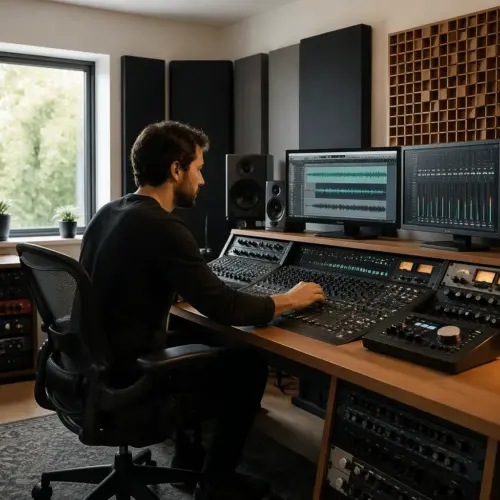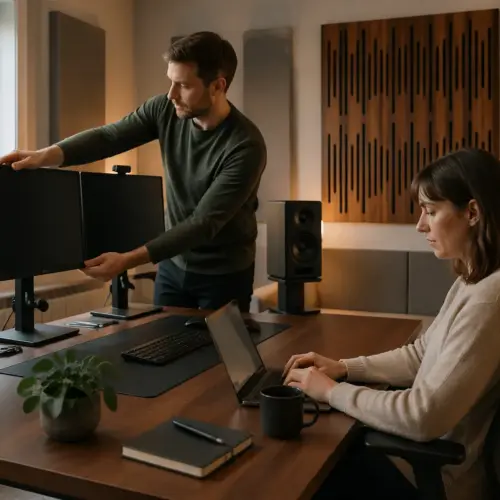

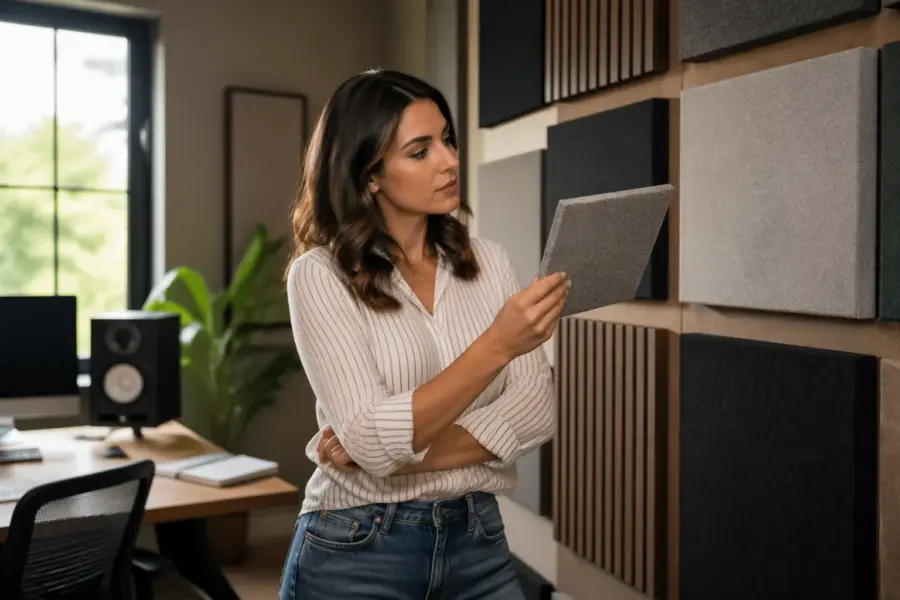
Most home office studios fail in the same boring way, the desk ends up on the “available” wall and the sound gets weird. If you want mixes that translate, you have to decide where you face before you buy panels or start moving furniture.
This article is about how to choose the best wall to face in a room when you work with speakers at a desk. The choice sets your room orientation, your early reflections, and how evenly the bass behaves at the listening position.
I am opinionated about this because I have watched people treat the wrong layout and then chase problems for months. A few minutes of planning saves you from wasting money on acoustic treatment that never gets a fair shot.
The goal: predictable reflections and bass response
The goal is simple, you want the left and right speaker to “see” the room the same way. When the early reflections match, your phantom center stays put and panning decisions stop wobbling.
Predictable also means you can treat the room with common tools like broadband panels and bass traps and get repeatable results. If one side is a hard wall and the other side is a curtain and a doorway, treatment becomes a patchwork.
Bass response is the other half of the decision, because room modes do not care about your workflow. The wall you face determines where the speakers sit relative to boundaries, which changes the low end through speaker boundary distance effects.
Front wall reflections matter even when you think you only hear “bass problems.” A strong reflection off the wall behind the speakers can smear the upper bass and low mids, which makes kick and bass levels hard to judge.
Facing the short wall vs the long wall in typical rooms
In many rectangular bedrooms and spare rooms, facing the short wall is the default recommendation for a reason. It usually gives you more distance behind you, which pushes the rear wall reflection later and makes it easier to control.
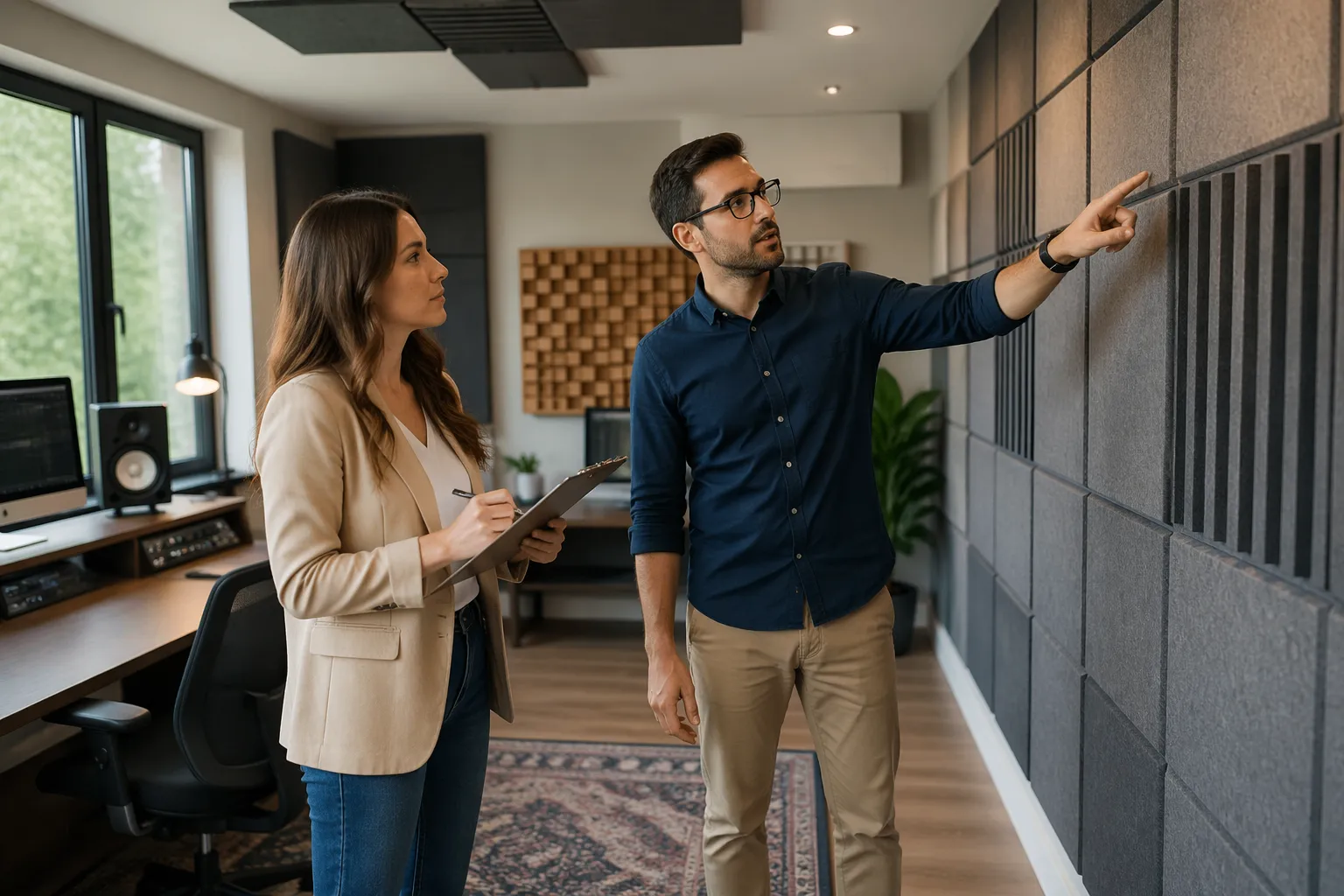
Facing the short wall also tends to spread axial modes in a way that feels less lopsided at the desk. You still get peaks and nulls, but they are often easier to tame with placement and bass trapping.
Facing the long wall can work, but it is pickier about symmetry and side reflections. If your desk sits close to one side wall, you will fight early reflection imbalance before you even start thinking about panels.
There are exceptions where the long wall wins, like very narrow rooms where facing the short wall forces the speakers too close to the side walls. If the side walls are within a couple feet of the speaker cabinets, you can end up with aggressive comb filtering and a pinched stereo image.
Room orientation also affects how much usable depth you have for proper speaker placement. If you cannot get the speakers out from the front wall at all, you may prefer an orientation that lets you manage front wall reflections with thick absorption rather than relying on distance you do not have.
How doors, windows, and openings affect the choice
Openings change everything because they break symmetry and they change how energy leaves the room. A doorway to a hallway often acts like a pressure leak for low frequencies, which can make one side of the bass response feel lighter.
Windows usually create a hard, reflective patch in the mid and high frequencies, even with blinds. If one side wall has a big window and the other side wall is drywall and a bookshelf, you should assume your first reflection points will behave differently.
| Feature | What it does acoustically | What to do about it |
|---|---|---|
| Doorway to another room | Reduces bass buildup on that side, adds asymmetry | Try to keep it behind you, add absorption on the opposite side wall |
| Large window on side wall | Strong early reflection, bright comb filtering risk | Use thick curtain plus a panel at first reflection if possible |
| Closet opening with sliding doors | Rattles, uneven absorption, midbass weirdness | Secure doors, consider leaving it open with absorption inside |
| Open-plan cutout to kitchen or living room | Changes decay time, bass leaks, stereo balance can shift | Face so the opening is centered behind you, or avoid it on one side |
Checking for symmetry around the listening position
Symmetry is not a perfection contest, but you need the basics to line up. Your listening position should have similar side wall distances left and right, and the speakers should have the same relationship to nearby boundaries.
Start by marking a centerline in the room with painter’s tape, running from the wall you would face to the wall behind you. If you cannot place the desk and speakers centered on that line without blocking a door or a closet, that orientation is already on thin ice.
Then look at what the speakers “see” in the first few feet, because that is where the earliest reflections come from. A tall dresser on one side and an open doorway on the other side is a recipe for a skewed image, even if the desk is centered.
Do not ignore ceiling symmetry either, especially in rooms with sloped ceilings or ceiling fans. A fan directly over one speaker can add noise and small reflection differences that show up as a fuzzy top end.
When you check symmetry, include the wall behind the speakers because front wall reflections are a big deal in small rooms. If one speaker is near a corner and the other has open space, your low end will not match side to side and you will chase the wrong EQ moves.
Front wall reflections and speaker boundary distance basics
The “front wall” is the wall you face, the wall behind the speakers, and it has a direct line to your ears. Sound from the woofers hits that wall and bounces back, mixing with the direct sound and creating peaks and dips that depend on distance.
This is where speaker boundary distance becomes practical, because moving the speakers a few inches can shift a null right into the kick drum range. If you have ever heard a kick that disappears at the chair but returns when you stand up, you have met this problem.
As a rough starting point, avoid placing the speaker fronts exactly a quarter wavelength away from the front wall for common bass notes, because that is where cancellations can get nasty. In real rooms you cannot calculate your way out, but you can avoid obviously bad “halfway” and “equal distance” placements.
Many people do best by putting speakers fairly close to the front wall, then using thick absorption on that wall to reduce the reflection strength. The alternative is pulling speakers far out, but in a home office you often do not have the depth to do that without sitting in the middle of the room.
If you are choosing between two walls to face, pick the one that lets you manage the front wall reflections without turning your room into an obstacle course. Your chair needs space behind it, and you need a layout you will actually keep for more than a week.
Quick experiments to compare two orientations
You can learn more in one evening of tests than in a month of reading forum arguments. The trick is to keep the experiment fair, same speakers, same stand height, and roughly the same listening distance in both setups.
Do a quick sweep with free tools like Room EQ Wizard if you have a measurement mic, but do not panic if you do not. You can still compare orientations with familiar music, pink noise, and a simple clap test for flutter echo.
- Mark two desk locations with painter’s tape
- Match speaker height to ear level in both setups
- Keep the listening triangle consistent, same distances
- Play a mono vocal track to check center stability
- Play a bass-heavy reference to spot big nulls
- Clap once at the chair to listen for flutter
- Walk the room corners to hear uneven bass buildup
How doors, windows, and furniture change what you hear
Furniture is acoustic treatment whether you planned it or not, and it can bias your orientation decision. A big couch behind you can help with rear wall reflections, while a bare wall behind you can make the room slap back at your ears.
Desks are a sneaky problem because they create strong reflections in the upper mids and highs. A wide desk with a hard surface can blur the image, so you want an orientation that lets you keep the speakers slightly forward and angled so the tweeters do not fire straight at the desktop.
Windows also change the practical side of the setup, because glare and heat push people to rotate the desk for comfort. Comfort matters, but if you spin the desk to stop sunlight and end up with one speaker jammed into a corner, your mixes will suffer.
Doors influence where you can place panels and bass traps, since you cannot block a door with a four inch absorber and call it a day. If one orientation forces you to leave a key reflection point untreated because of door swing, choose the other orientation even if it looks less “standard.”
Try to think like the sound, not like the furniture catalog. If the room orientation that looks nicest creates uneven side boundaries, you will keep compensating with EQ and you will never trust your low end.
Listening position placement, not too close and not too centered
After you choose a wall to face, your next decision is where the chair lands along the length of the room. Sitting with your head right against the back wall is usually a mess, because the rear wall reflection arrives fast and loud.
Sitting dead center in the room length is also often bad, because that is where some axial modes create deep nulls. A common starting point is around 38 percent of the room length from the front wall, and you adjust from there based on measurements and what you hear.
Your speakers should form an equilateral triangle with your head, but do not worship the geometry if it forces bad boundary distances. If moving the speakers two inches breaks the perfect triangle but smooths a 90 Hz hole, take the smoother bass every time.
Keep your ears off the exact centerline vertically too, which means avoid sitting with your ears exactly halfway between floor and ceiling. You cannot always change ceiling height, but you can raise or lower your chair and speaker stands enough to dodge a stubborn dip.
When people ask how to choose the best wall to face in a room, they often ignore that the chair position is part of the same decision. Pick the orientation that gives you flexibility to move the desk forward and back without hitting a bed, a shelf, or a door.
Common room types and the orientation I usually pick
In a typical 10 by 12 bedroom, I usually face the short wall and center the desk, because it gives the cleanest left-right symmetry. You also get more depth behind the chair for a thick absorber or even a small bookshelf to break up reflections.
In a long narrow room like 8 by 15, I still often face the short wall, but I pay close attention to side wall distance. If the speakers end up within a foot or two of the side walls, I consider facing the long wall to buy space for first reflection control.
In a square-ish room like 11 by 11, neither orientation is a magic fix because the modal spacing is stubborn. I pick the wall that gives the best symmetry and the least annoying openings, then I plan on serious bass trapping and careful speaker boundary distance tuning.
In an office with one whole side open to a hallway or living room, I try to avoid having that opening on only one side of the desk. If I cannot avoid it, I prefer placing the opening behind me rather than beside me, because side asymmetry wrecks imaging faster than most people expect.
In a room with a big window on one short wall, I often face that wall anyway and treat it, because it keeps the side walls more consistent. The alternative sometimes puts the window on one side, and that is a front row seat for uneven early reflections.
Locking in the orientation before you treat the room
Once you pick the wall to face, commit to it long enough to make treatment decisions that match reality. If you buy panels before you settle the layout, you will hang them where they look good, not where they work.
Start with the basics, bass traps in corners you can actually access, then first reflection panels on the side walls and ceiling. The exact placement depends on room orientation, and it depends on where your speakers land relative to the front wall.
Do not forget the front wall behind the speakers, because front wall reflections can be loud in small rooms. A thick absorber behind each speaker, or one wide panel centered between them, often makes the midbass tighter and the stereo image less splashy.
Then treat the rear wall based on distance, because a rear wall two feet behind your head needs absorption more than diffusion. If you have five or six feet behind you, you can experiment with a bookshelf diffuser style setup, but only after you control the low end.
Take measurements or at least do repeatable listening checks after each change, because your brain adapts fast and lies to you. A stable orientation gives you a stable baseline, and that is the only way you can tell if a new panel helped or just changed the problem.
Conclusion
If you want a practical answer to how to choose the best wall to face in a room, start with symmetry and keep the openings from wrecking one side. Then pick the orientation that lets you manage front wall reflections and speaker boundary distance without forcing the chair into a terrible spot.
Do the quick orientation experiments, live with the better setup for a week, and only then start buying or building treatment. When your room orientation is settled, every panel you add has a clearer job and your mixes stop drifting between “too much bass” and “no bass.”